Scite vs Elicit
Plans, free access, limits and intended use side by side, taken from each vendor’s own pages. No score and no winner: the facts show where the two differ.
Change tools
Check whether later papers support or contradict a finding

Find research papers and extract structured information from studies.
- Free access
- Scite: Free access
- Elicit: Free access
- Paid from
- Scite: USD 20 per month billed yearly
- Elicit: USD 49 per user per month
- Plans listed
- Scite: 5
- Elicit: 7
- Public API
- Scite: Not confirmed
- Elicit: Yes
Where Scite and Elicit differ
- Pricing checkPrices confirmed for Scite; pricing review due for Elicit.
- PlansScite lists 5 plans and Elicit lists 7.
Head to head
Each value from the tool’s profile and the vendor’s own pages
| Scite | Fact | Elicit |
|---|---|---|
| Access and price | ||
| Free access availableFree account · USD 0 | Free accessSame | Free access availableBasic |
| USD 20 per month billed yearlyScite Basic | Lowest listed paid plan | USD 49 per user per monthPro (Industry) · billed annually · USD 588 per year; USD 75 billed monthly |
| Free MCP credits; Basic $20/month billed yearly | Pricing model | Free Basic; paid from USD 11 (Academic) or USD 49 (Industry) per user per month |
| 5 | Plans listedDiffers | 7 |
| Not confirmed | Public API | Yes |
| Not confirmed | Card to start | Not confirmed |
| Not confirmed | Open source | No |
| What it is for | ||
| Researchers and students checking how a paper has been cited | Built for | Extracting study data from research papers |
| Research & sources | CategorySame | Research & sources |
| Platforms |
|
| Works with | Not listed |
| How current | ||
| Profile sources checked | ||
| Prices confirmed · Oct 4, 2026 | Pricing checkDiffers | Pricing review due · Sep 24, 2026 |
Official source check for both tools. No hands-on testing and no score: “Differs” marks a documented difference, not a better tool.
Plans and prices
Scite
Prices confirmed · Oct 4, 2026- Free accountUSD 0
- Scite BasicUSD 20 per month billed yearly
- Scite ProUSD 50 per month billed yearly
- Scite TeamUSD 250 per month for 8 seats
- Scite for organizationsCustom
Elicit
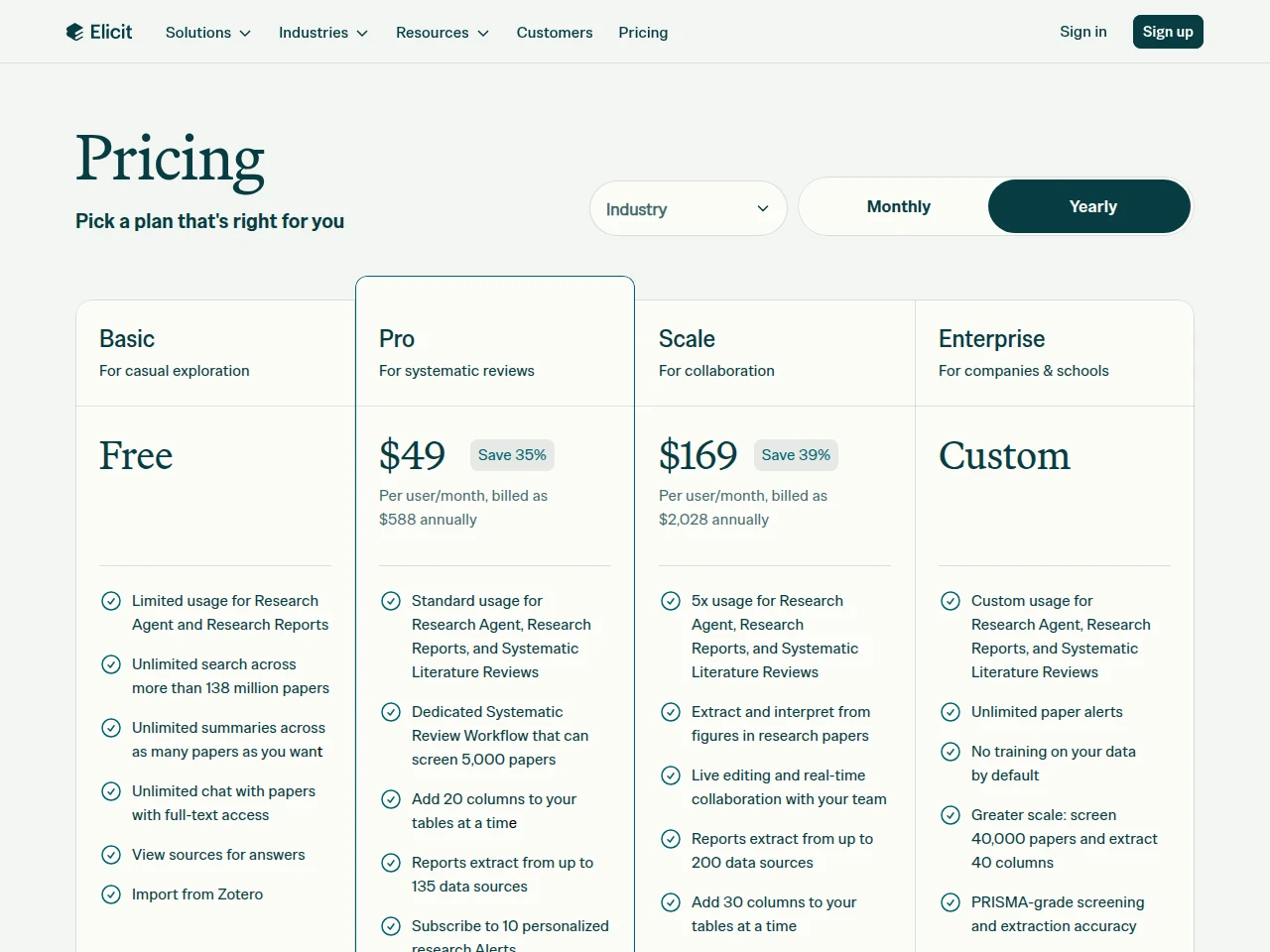
Pricing review due · Sep 24, 2026- BasicFree
- Plus (Academic)USD 11 per user per monthbilled annually · USD 132 per year; USD 19 billed monthly
- Pro (Academic)USD 39 per user per monthbilled annually · USD 468 per year; USD 69 billed monthly
- Pro (Industry)USD 49 per user per monthbilled annually · USD 588 per year; USD 75 billed monthly
- Scale (Academic)USD 89 per user per monthbilled annually · USD 1,068 per year; USD 149 billed monthly
Show 2 more plans
- Scale (Industry)USD 169 per user per monthbilled annually · USD 2,028 per year; USD 279 billed monthly
- EnterpriseCustomthrough sales
Strengths and limits
Scite
Strengths
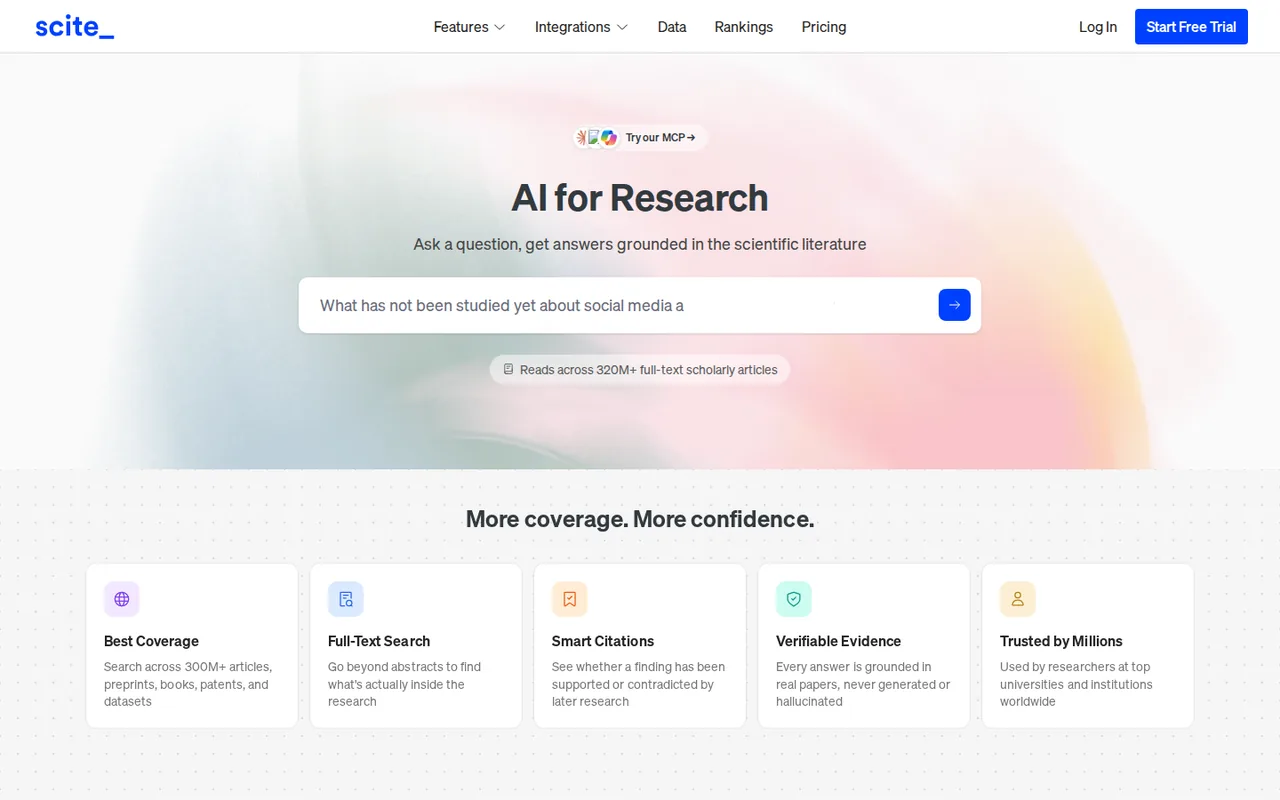
- Citation context rather than a count: The home page and Terms describe showing whether later research supported or contradicted a finding, which gives you a place to start reading.
- Works inside AI assistants: The MCP connector lets ChatGPT and Claude call Scite, and the home page says answers are grounded in real papers.
- Clear data-use terms: The Terms say customer data is not used to train, fine-tune or improve Scite's AI systems.
Limits to plan around
- Free access has a limited scope: The recurring free allowance is for MCP use, not a promise of the full paid web plan. The separate 7-day trial converts to a paid subscription unless cancelled.
- Use of content is restricted: The Terms bar bulk retrieval, redistribution and using Scite content to train or evaluate AI models.
- Fees are non-refundable: The Terms say fees are non-refundable, so cancel before the trial ends if you do not want to continue.
Elicit
Strengths
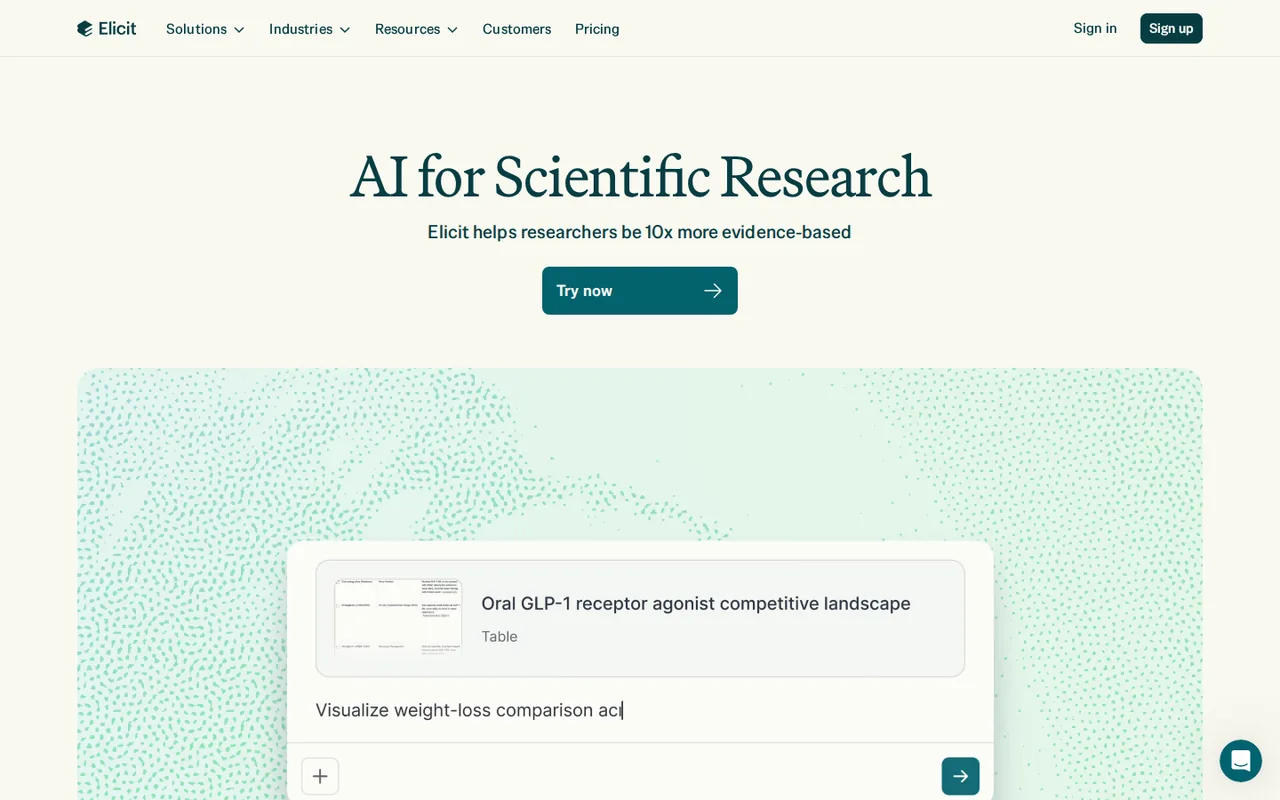
- Free paper discovery: Basic includes unlimited paper search, summaries and chat with accessible full text.
- Quotes behind the output: Extracted values, screening decisions and report claims point to the supporting passage in the source paper.
- Report export on every plan: Research Reports download as PDF or Word even on the free Basic plan.
Limits to plan around
- English focus: Search, summaries and extraction are optimized for English-language research; other-language quality varies.
- Complex table failures: The extraction guide warns that some table layouts can be missed or parsed incorrectly.
- Table exports cost extra: Find Papers and Paper Chat tables need Plus; Systematic Review tables need Pro or higher.
See both products
Start from your task, not from a winner.
Run both tools on the same real task, then compare the result, how much editing it needs and how fast it uses your plan’s allowance.
How we reviewChange this pair
Choose tools
Choose two tools below. You can replace either selection at any time.
Audio & voice
Automation
Coding
Data & spreadsheets
Images & design
Presentations
Research & sources
Video & editing
Website builders
Writing & content
Comparing tools from different categories is fine, and often useful — a writing assistant and a research tool solve different halves of the same job. The table will show you exactly where they diverge.
Questions about comparing tools
How does the comparison work?
Add two tools to the comparison tray from any tool card, then open this page. The table pulls each tool's verified plan details, platforms, strengths and limits from its profile, so both columns carry the same kind of evidence, with a separate source-check date for each tool.
Do you declare a winner?
No. The table sets two tools against each other on documented facts, not on a score. Which one wins depends on your task, your budget and your usage volume — three things we cannot see from here.
Why are some cells empty or marked unverified?
Because we could not confirm that detail on the vendor's own pages. Rather than filling the gap with a figure from elsewhere, we mark it and say why on the tool's profile.
Can I compare more than two tools?
Not at once. Two columns keep the differences readable and force a real decision. Remove either selected tool to replace it, or clear both to start a new pair.
Every figure in the table above comes from the linked profile, where the source and the verification date are listed. Browse all tools or read the editorial policy.