Webflow vs Emergent
Plans, free access, limits and intended use side by side, taken from each vendor’s own pages. No score and no winner: the facts show where the two differ.
Change tools
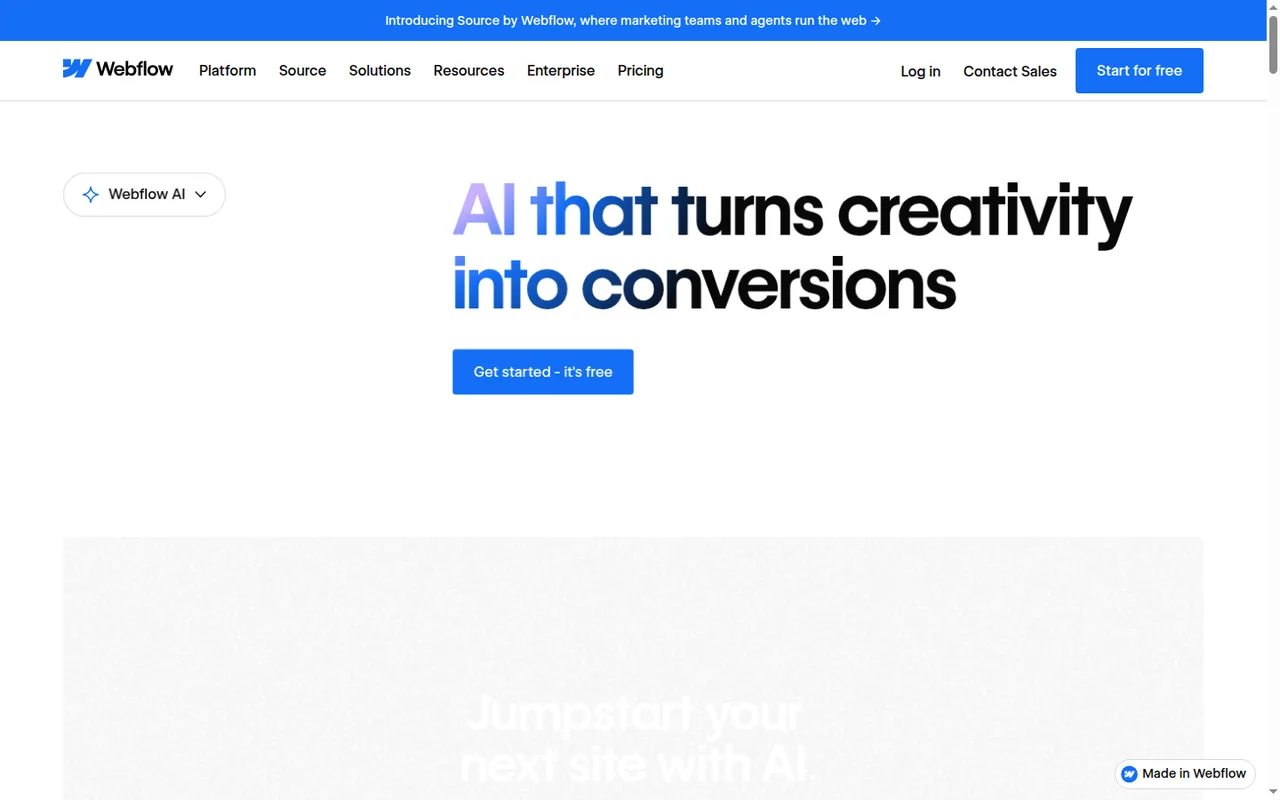
Design, build and host websites visually, with a CMS and built-in AI tools.

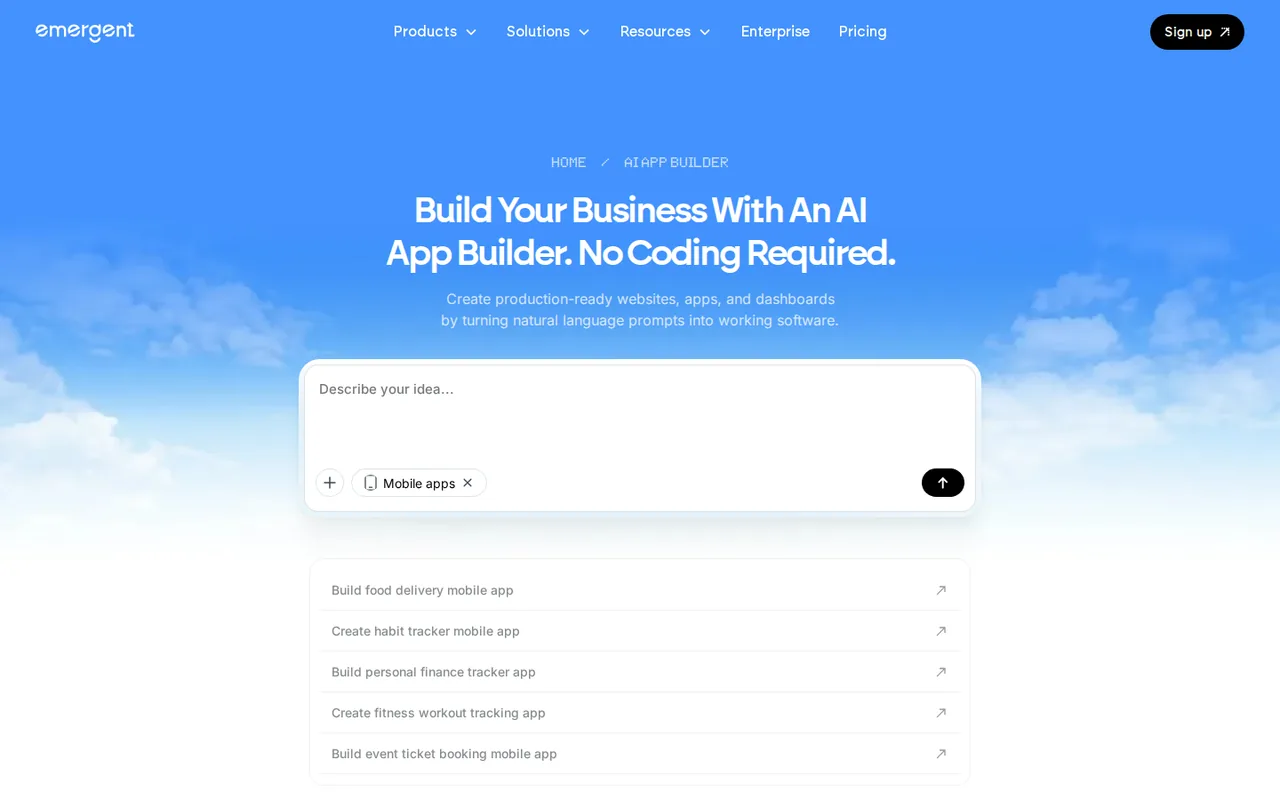
Describe a web or mobile app in chat and let AI agents build and publish it
- Free access
- Webflow: Free access
- Emergent: Free access
- Paid from
- Webflow: USD 15 per site per month
- Emergent: USD 20 per month; $17 per month on annual billing
- Plans listed
- Webflow: 5
- Emergent: 4
- Public API
- Webflow: Yes
- Emergent: Not confirmed
Where Webflow and Emergent differ
- Pricing checkPricing review due for Webflow; prices confirmed for Emergent.
- PlansWebflow lists 5 plans and Emergent lists 4.
Head to head
Each value from the tool’s profile and the vendor’s own pages
| Webflow | Fact | Emergent |
|---|---|---|
| Access and price | ||
| Free access availableStarter | Free accessSame | Free access availableFree · USD 0 |
| USD 15 per site per monthBasic · billed yearly · USD 25 billed monthly | Lowest listed paid plan | USD 20 per month; $17 per month on annual billingStandard · $204 a year |
| Free Starter plan; paid Site and Workspace plans | Pricing model | Free ($0, 10 credits); paid plans from $20 a month |
| 5 | Plans listedDiffers | 4 |
| Yes | Public API | Not confirmed |
| Not confirmed | Card to start | Not confirmed |
| No | Open source | Not confirmed |
| What it is for | ||
| Visually designed marketing and content websites | Built for | Non-developers and small teams who want to turn a described idea into a working web or mobile app prototype |
| Website builders | CategorySame | Website builders |
| Platforms |
|
| Works with |
|
| How current | ||
| Profile sources checked | ||
| Pricing review due · Oct 2, 2026 | Pricing checkDiffers | Prices confirmed · Oct 17, 2026 |
Official source check for both tools. No hands-on testing and no score: “Differs” marks a documented difference, not a better tool.
Plans and prices
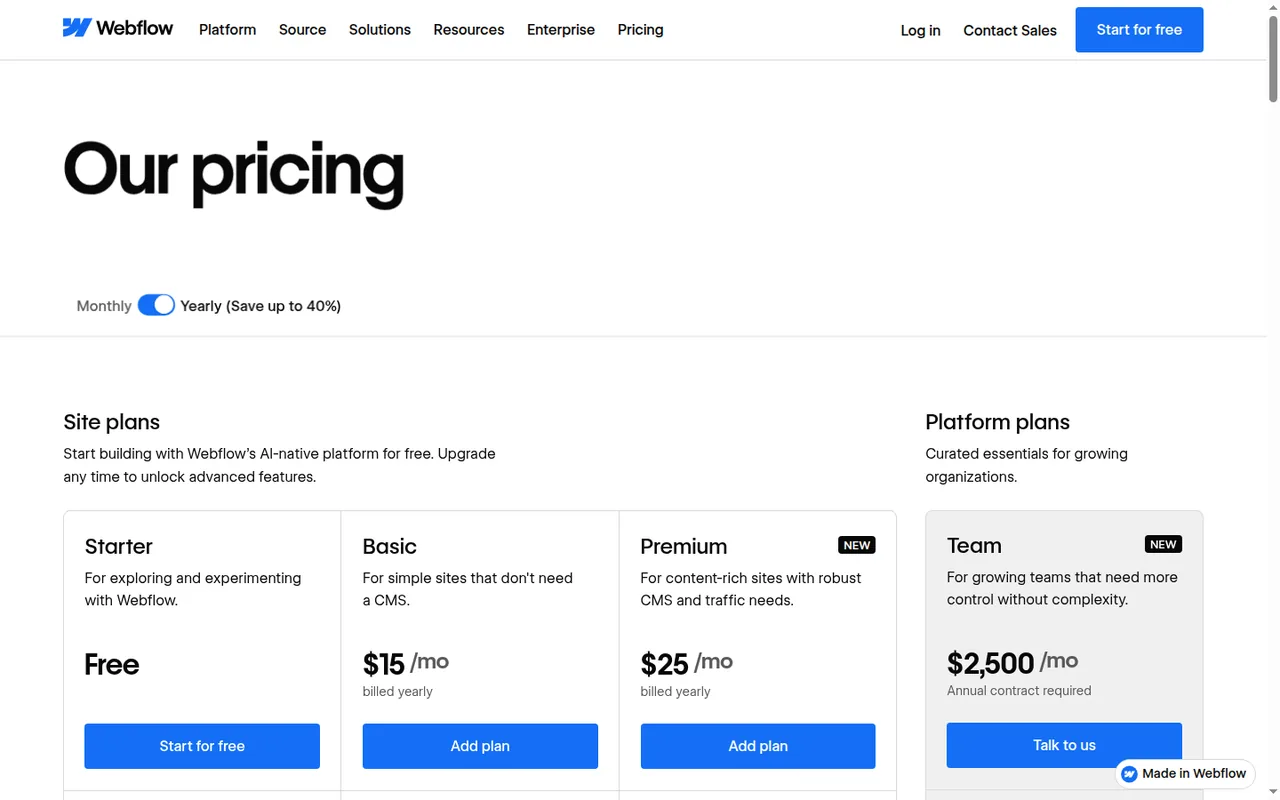
Webflow
Pricing review due · Oct 2, 2026- StarterFree
- BasicUSD 15 per site per monthbilled yearly · USD 25 billed monthly
- PremiumUSD 25 per site per monthbilled yearly · USD 39 billed monthly
- TeamUSD 2,500 per monthannual contract required
- Core WorkspaceUSD 19 per monthbilled yearly · USD 28 billed monthly
Emergent
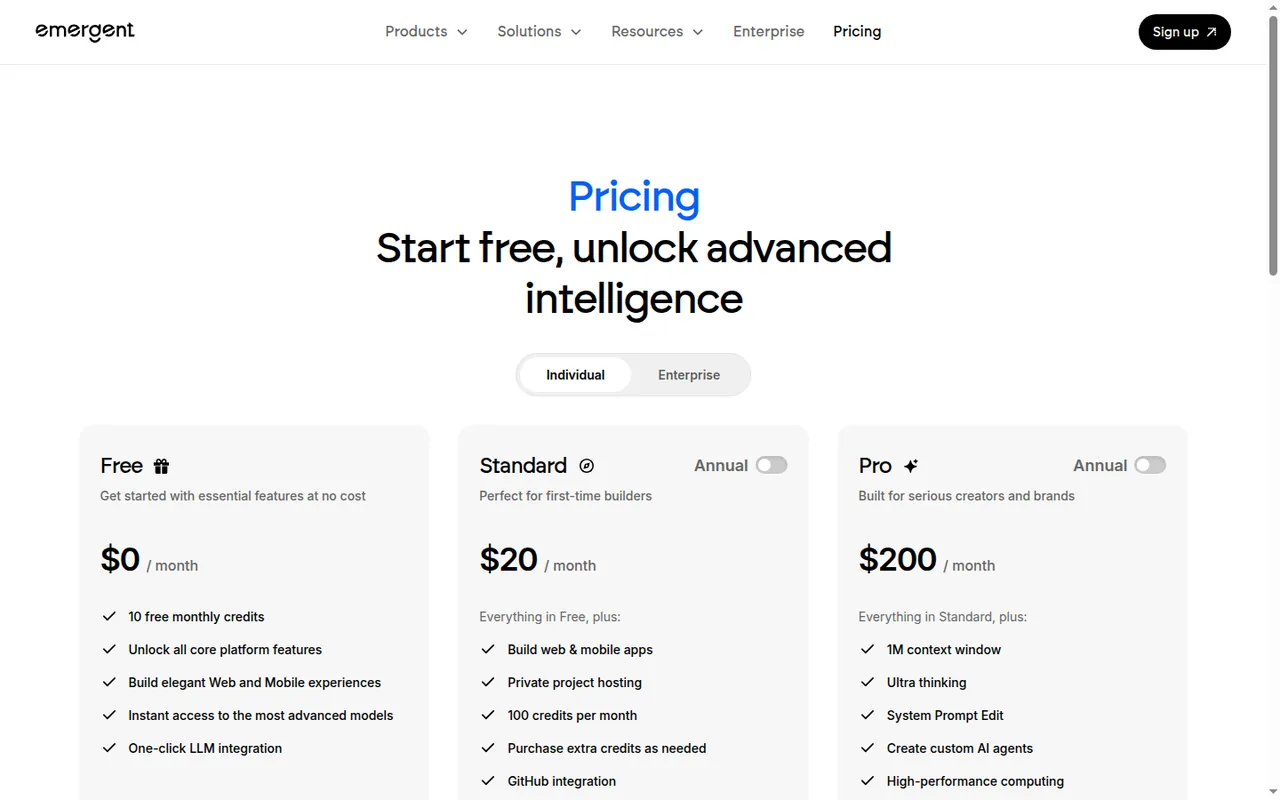
Prices confirmed · Oct 17, 2026- FreeUSD 0
- StandardUSD 20 per month; $17 per month on annual billingUSD 204 a year
- ProUSD 200 per month; $167 per month on annual billingUSD 2,004 a year
- Business and EnterpriseCustom
Strengths and limits
Webflow
Strengths
- Free plan without a time limit: The pricing page says you can try Webflow for as long as you like on the free Starter plan.
- AI builder costs no credits: The AI site builder, contextual help and section design are listed as features that do not consume AI credits.
- Code can leave the platform: Paid Workspace plans export HTML, CSS, JavaScript and assets, with no attribution required on your own server.
Limits to plan around
- Two separate bills: Site plans and Workspace plans are bought and cancelled separately, so a team can end up paying for both.
- Tight free limits: The free Starter site publishes only to a webflow.io subdomain and is limited to 2 static pages.
- Credits expire: Unused AI credits expire at the end of each period, and AI credits and add-ons are non-refundable.
Emergent
Strengths
- Free way to try it: The Free plan costs $0 and includes core platform features, so you can see how a described app turns out before paying.
- Cost guardrails: The help center describes a per-session budget that pauses the agent and a low-balance email alert at 20% of the monthly allowance.
- Credits you buy do not expire: The help center says one-time top-up credits never expire, while subscription credits refill each cycle.
Limits to plan around
- Free cannot publish: The help center says the Free tier cannot publish to production, and a published app needs at least 50 credits to start.
- Credit spend is hard to predict: The help center says a single prompt can cost from a handful of credits to hundreds, so the 100 credits on Standard can go in a few large requests.
- Content may be used for model training: The Terms say Emergent may use your content, including code, to train its AI models unless you opt out, which the Terms say is free on any plan.
See both products
Start from your task, not from a winner.
Run both tools on the same real task, then compare the result, how much editing it needs and how fast it uses your plan’s allowance.
How we reviewChange this pair
Choose tools
Choose two tools below. You can replace either selection at any time.
Audio & voice
Automation
Coding
Data & spreadsheets
Images & design
Presentations
Research & sources
Video & editing
Website builders
Writing & content
Comparing tools from different categories is fine, and often useful — a writing assistant and a research tool solve different halves of the same job. The table will show you exactly where they diverge.
Questions about comparing tools
How does the comparison work?
Add two tools to the comparison tray from any tool card, then open this page. The table pulls each tool's verified plan details, platforms, strengths and limits from its profile, so both columns carry the same kind of evidence, with a separate source-check date for each tool.
Do you declare a winner?
No. The table sets two tools against each other on documented facts, not on a score. Which one wins depends on your task, your budget and your usage volume — three things we cannot see from here.
Why are some cells empty or marked unverified?
Because we could not confirm that detail on the vendor's own pages. Rather than filling the gap with a figure from elsewhere, we mark it and say why on the tool's profile.
Can I compare more than two tools?
Not at once. Two columns keep the differences readable and force a real decision. Remove either selected tool to replace it, or clear both to start a new pair.
Every figure in the table above comes from the linked profile, where the source and the verification date are listed. Browse all tools or read the editorial policy.