AIWriteBook vs Dayora
Plans, free access, limits and intended use side by side, taken from each vendor’s own pages. No score and no winner: the facts show where the two differ.
Change tools
Plan, write, edit, format and publish a book with AI, with a cover and audiobook on higher plans

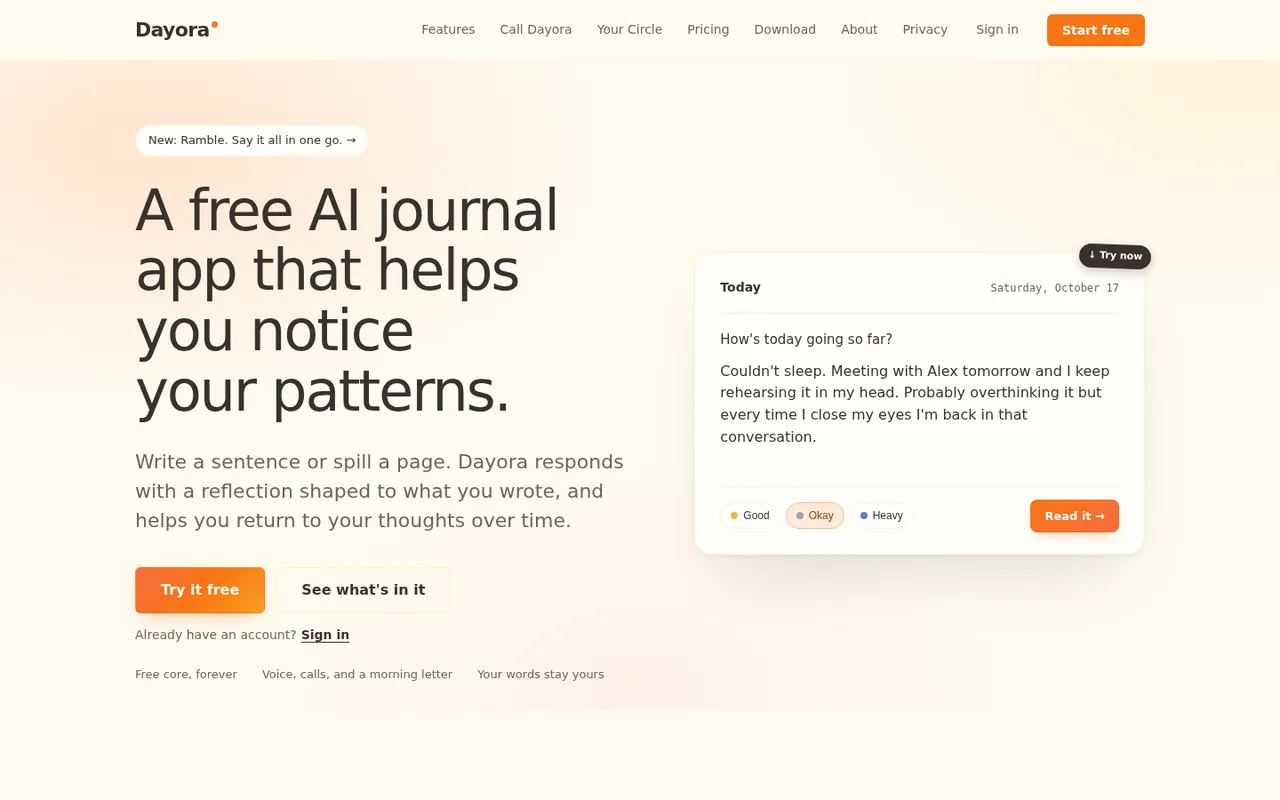
AI journaling app that writes a short reply to every entry, with a free core and an optional Plus plan
- Free access
- AIWriteBook: Free access
- Dayora: Free access
- Paid from
- AIWriteBook: USD 20 per month
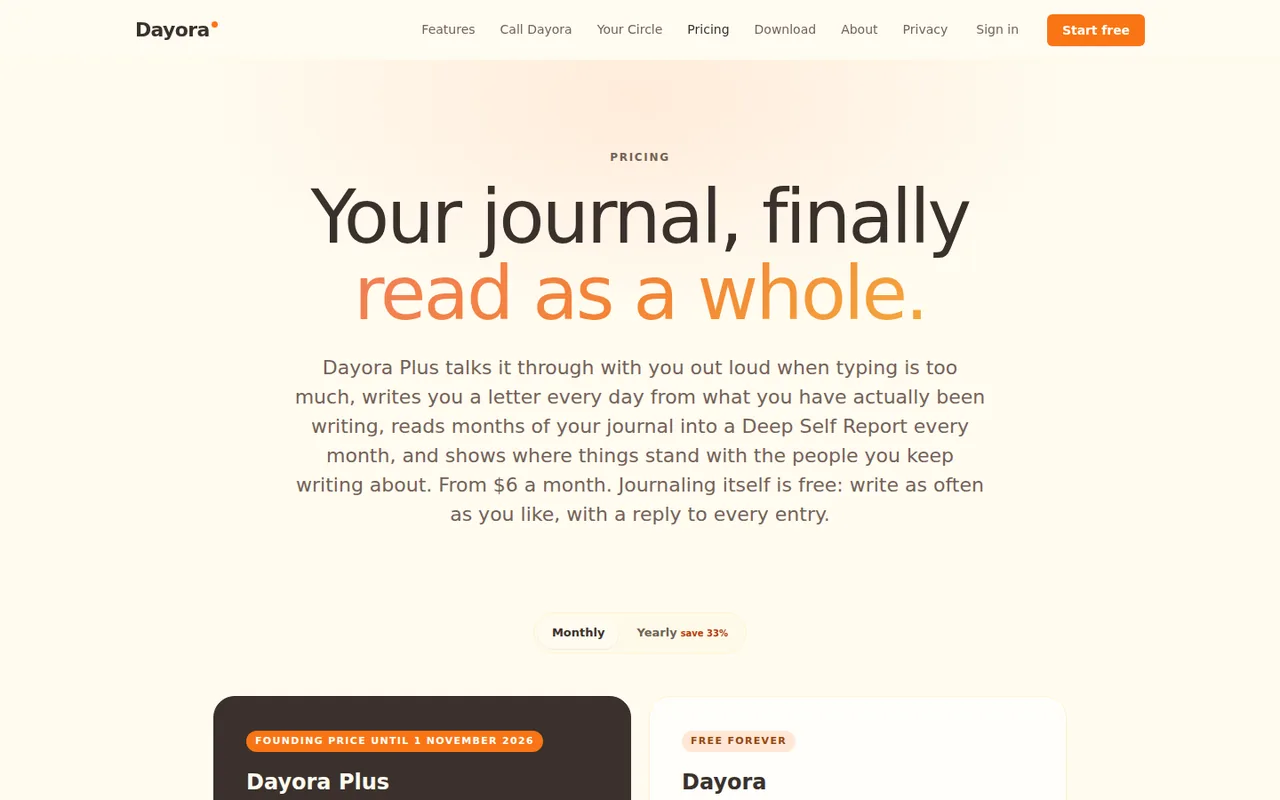
- Dayora: USD 6 per month
- Plans listed
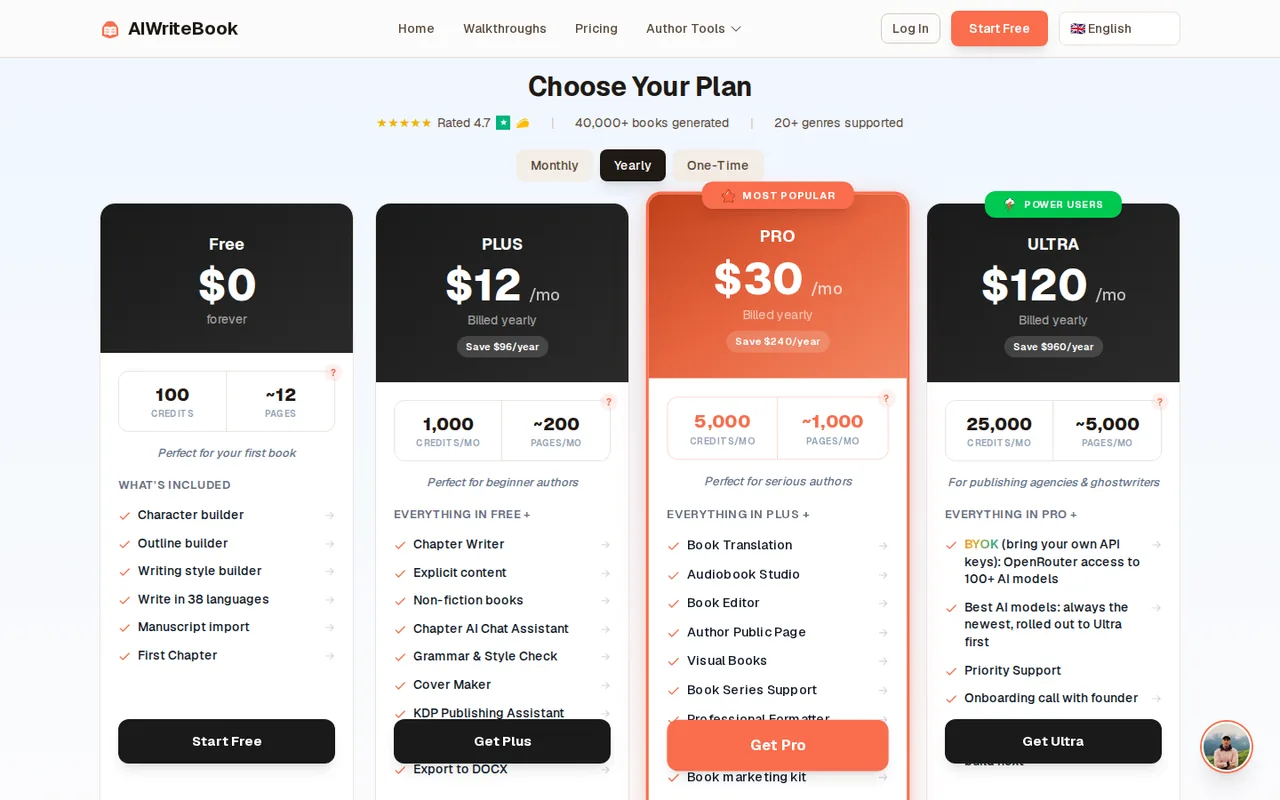
- AIWriteBook: 5
- Dayora: 4
- Public API
- AIWriteBook: Not confirmed
- Dayora: Not confirmed
Where AIWriteBook and Dayora differ
- PlansAIWriteBook lists 5 plans and Dayora lists 4.
Head to head
Each value from the tool’s profile and the vendor’s own pages
| AIWriteBook | Fact | Dayora |
|---|---|---|
| Access and price | ||
| Free access availableFree · USD 0 | Free accessSame | Free access availableFree · USD 0 forever |
| USD 20 per monthPlus · or $12 per month billed yearly · $144 a year | Lowest listed paid plan | USD 6 per monthDayora Plus (founding price) |
| Free plan (100 credits); paid from $12 a month billed yearly | Pricing model | Free core; Plus $6 a month founding price, then $9 |
| 5 | Plans listedDiffers | 4 |
| Not confirmed | Public API | Not confirmed |
| Not confirmed | Card to start | Not confirmed |
| Not confirmed | Open source | Not confirmed |
| What it is for | ||
| Self-publishing authors, ghostwriters and non-fiction writers who want one place to outline, draft in their own style, edit and prepare a book for Amazon KDP | Built for | People who want a private journal that answers back and spots patterns, and who accept that entries are sent to third-party AI providers |
| Writing & content | CategorySame | Writing & content |
| Platforms |
|
| Works with |
|
| How current | ||
| Profile sources checked | ||
| Prices confirmed · Oct 17, 2026 | Pricing checkSame | Prices confirmed · Oct 17, 2026 |
Official source check for both tools. No hands-on testing and no score: “Differs” marks a documented difference, not a better tool.
Plans and prices
AIWriteBook
Prices confirmed · Oct 17, 2026- FreeUSD 0
- PlusUSD 20 per monthor $12 per month billed yearly · $144 a year
- ProUSD 50 per monthor $30 per month billed yearly · $360 a year
- UltraUSD 200 per monthor $120 per month billed yearly
- One-time creditsUSD 20 for 250 creditsor $50 for 2,000 credits
Dayora
Prices confirmed · Oct 17, 2026- FreeUSD 0 forever
- Dayora Plus (founding price)USD 6 per month
- Dayora Plus (standard price)USD 9 per month or $72 per year
- Top-upsUSD 6 per 30 call minutes; $4 per extra Deep Self Report
Strengths and limits
AIWriteBook
Strengths
- Free plan with no card: The pricing FAQ says you can plan a full book and get a first chapter free, with no credit card required.
- Content stays yours: The terms say you keep ownership and commercial rights to what you create, and the privacy policy says your content is not used to train its models or by its AI providers.
- Credit costs are published: The terms list per-action credit costs, so you can estimate a book before paying.
Limits to plan around
- Pages disagree on credit expiry: The pricing FAQ says unused subscription credits expire after a month, while the terms say Pro credits roll over for up to 3 months.
- Audiobooks are credit-heavy: At the terms' rate a 2,000-word chapter costs about 880 credits, so a full audiobook can outrun a plan's monthly allowance.
- Refunds are narrow: The terms allow a refund only within 7 days of the first subscription purchase and with under 50% of credits used; renewals and one-time credit packs are non-refundable.
Dayora
Strengths
- Journaling itself is free: The pricing page and terms say entries, AI replies, voice journaling, mood tracking, Reflect chat, Your Circle and export are free, and free features will not be moved behind a paid plan.
- Allowance stated before you pay: The pricing FAQ lists what Plus includes each month and what pauses when it runs out; the journal itself is never limited.
- Purchased top-ups do not expire: The terms say bought call minutes and reports stay on the account until used.
Limits to plan around
- Entries go to third-party AI providers: The privacy policy says what you write, say and upload is sent to AI providers, which may use it to train models in exchange for lower-cost usage; the policy says your journal is not a sealed room.
- Staff can read content for set purposes: The privacy policy lets authorised staff review accounts for safety, support and reply-quality checks, and the founder gets a review copy of emails with the journal content and photos.
- Recordings are kept indefinitely: The privacy policy says saved voice notes and call audio are kept with no time limit until the account is deleted.
See both products
Start from your task, not from a winner.
Run both tools on the same real task, then compare the result, how much editing it needs and how fast it uses your plan’s allowance.
How we reviewChange this pair
Choose tools
Choose two tools below. You can replace either selection at any time.
Audio & voice
Automation
Coding
Data & spreadsheets
Images & design
Presentations
Research & sources
Video & editing
Website builders
Writing & content
Comparing tools from different categories is fine, and often useful — a writing assistant and a research tool solve different halves of the same job. The table will show you exactly where they diverge.
Questions about comparing tools
How does the comparison work?
Add two tools to the comparison tray from any tool card, then open this page. The table pulls each tool's verified plan details, platforms, strengths and limits from its profile, so both columns carry the same kind of evidence, with a separate source-check date for each tool.
Do you declare a winner?
No. The table sets two tools against each other on documented facts, not on a score. Which one wins depends on your task, your budget and your usage volume — three things we cannot see from here.
Why are some cells empty or marked unverified?
Because we could not confirm that detail on the vendor's own pages. Rather than filling the gap with a figure from elsewhere, we mark it and say why on the tool's profile.
Can I compare more than two tools?
Not at once. Two columns keep the differences readable and force a real decision. Remove either selected tool to replace it, or clear both to start a new pair.
Every figure in the table above comes from the linked profile, where the source and the verification date are listed. Browse all tools or read the editorial policy.