Make vs Power Automate
Plans, free access, limits and intended use side by side, taken from each vendor’s own pages. No score and no winner: the facts show where the two differ.
Change tools
Connect app modules in visual automation scenarios.

Microsoft's cloud and desktop flow automation, licensed per user or per process and metered in daily platform requests
- Free access
- Make: Free access
- Power Automate: Free access
- Paid from
- Make: No fixed price listed
- Power Automate: USD 15/user per month
- Plans listed
- Make: 3
- Power Automate: 7
- Public API
- Make: Yes
- Power Automate: Not confirmed
Where Make and Power Automate differ
- Pricing checkPricing review due for Make; some prices or terms not confirmed for Power Automate.
- PlansMake lists 3 plans and Power Automate lists 7.
Head to head
Each value from the tool’s profile and the vendor’s own pages
| Make | Fact | Power Automate |
|---|---|---|
| Access and price | ||
| Free access availableFree · USD 0 | Free accessSame | Free access availablePower Automate Free · USD 0 |
| No fixed price listed | Lowest listed paid plan | USD 15/user per monthPower Automate Premium · paid yearly |
| Free + paid; quote varies | Pricing model | Free with standard connectors (work or school accounts); Premium $15/user/month, Process $150/bot/month, Hosted Process $215/bot/month, paid yearly |
| 3 | Plans listedDiffers | 7 |
| Yes | Public API | Not confirmed |
| Not required | Card to start | Not confirmed |
| No | Open source | Not confirmed |
| What it is for | ||
| Visual automation for app workflows | Built for | Organisations on Microsoft 365 that want to automate Teams, SharePoint, Outlook and Excel work, with RPA for desktop apps |
| Automation | CategorySame | Automation |
| Platforms |
|
| Not listed | Works with |
|
| How current | ||
| Profile sources checked | ||
| Pricing review due · Sep 25, 2026 | Pricing checkDiffers | Some prices or terms not confirmed · Oct 24, 2026 |
Official source check for both tools. No hands-on testing and no score: “Differs” marks a documented difference, not a better tool.
Plans and prices
Make
Pricing review due · Sep 25, 2026- FreeUSD 0
- Paid automationConfirm current quote
- EnterpriseCustom pricing
Power Automate
Some prices or terms not confirmed · Oct 24, 2026- Power Automate FreeUSD 0
- Microsoft 365 / Office 365 (included)Included in eligible plans
- Free trialFree trial
- Power Automate PremiumUSD 15/user per monthpaid yearly
- Power Automate ProcessUSD 150/bot per monthpaid yearly
Show 2 more plans
- Power Automate Hosted ProcessUSD 215/bot per monthpaid yearly
- Process Mining add-onUSD 5,000/tenant per monthpaid yearly
Strengths and limits
Make
Strengths
- Visual scenario builder: Routers, filters and fallback routes are drawn as a diagram, so the path each record takes is visible before anything runs.
- Free plan with no time limit: Free does not expire, so a small scenario can keep running without a subscription as long as it stays within the Free limits.
- Countable billing unit: An ordinary non-AI module run normally uses one credit, so cost can be estimated by counting modules and bundles.
Limits to plan around
- Free scheduling floor: On Free, scheduled scenarios run at most every 15 minutes and only two scenarios can be active at once.
- Empty checks still count: A scheduled trigger uses an operation each time it looks for data, even when it finds nothing; budget for checks as well as records.
- Separate AI-provider charges: With an eligible custom AI-provider connection, the provider bills its tokens on top of the operation credits Make charges.
Power Automate
Strengths
- Included with Microsoft 365: Office 365 business and enterprise plans already include cloud flows with standard connectors, so many teams can start without a new purchase.
- Desktop and cloud in one product: The same licence family covers app-to-app flows and RPA on Windows desktops, including Microsoft-hosted machines.
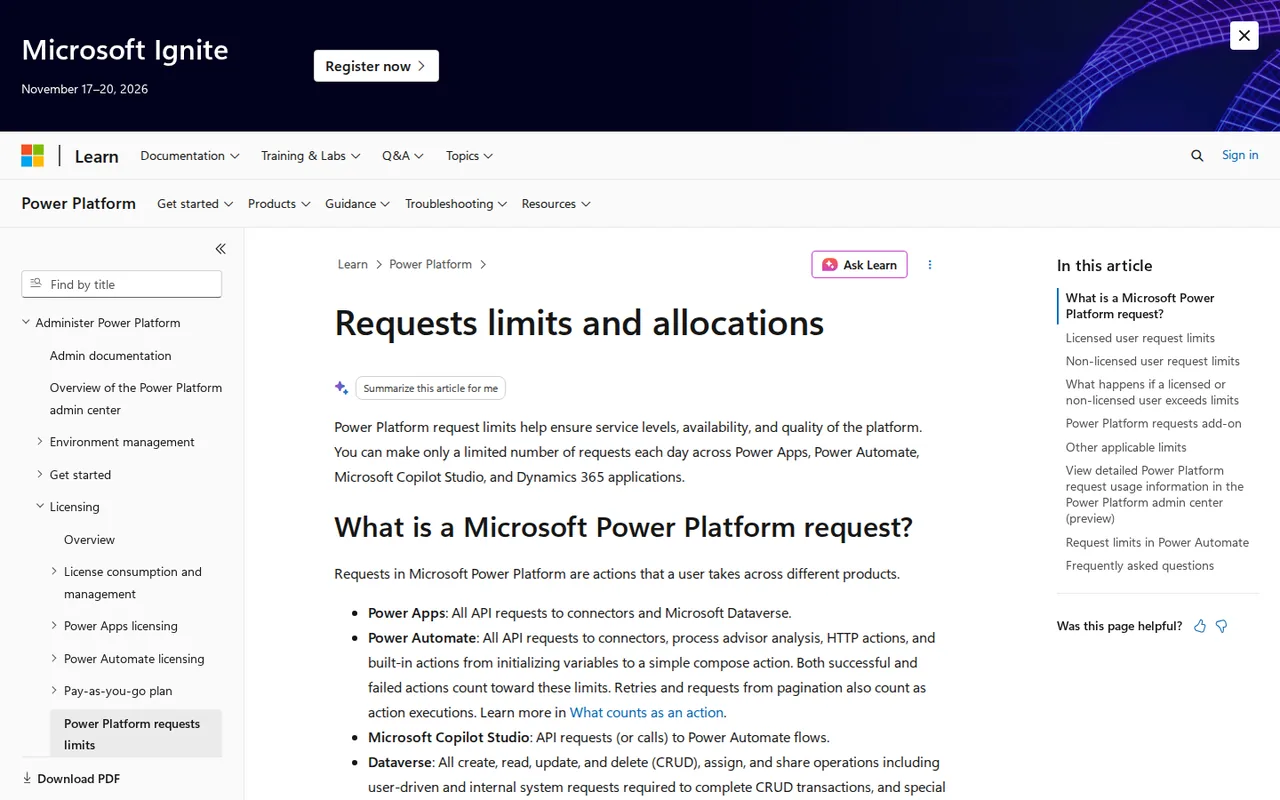
- Volume is rarely the limit: A Premium user gets 40,000 requests a day and a Process licence 250,000, which ordinary office flows stay far below.
Limits to plan around
- Premium connectors cost extra: Salesforce and HubSpot are not on the standard connector list, so flows that touch them need Premium or a Process licence.
- AI credits are changing: Premium's 5,000 seeded AI Builder credits end on 1 November 2026, and new customers must buy Copilot Credits for AI steps.
- Licensing is layered: Which limit applies depends on flow type, owner, app context and any Process licence, and limits from different licences do not add up.
See both products
Start from your task, not from a winner.
Run both tools on the same real task, then compare the result, how much editing it needs and how fast it uses your plan’s allowance.
How we reviewChange this pair
Choose tools
Choose two tools below. You can replace either selection at any time.
Audio & voice
Automation
Coding
Data & spreadsheets
Images & design
Presentations
Research & sources
Video & editing
Website builders
Writing & content
Comparing tools from different categories is fine, and often useful — a writing assistant and a research tool solve different halves of the same job. The table will show you exactly where they diverge.
Questions about comparing tools
How does the comparison work?
Add two tools to the comparison tray from any tool card, then open this page. The table pulls each tool's verified plan details, platforms, strengths and limits from its profile, so both columns carry the same kind of evidence, with a separate source-check date for each tool.
Do you declare a winner?
No. The table sets two tools against each other on documented facts, not on a score. Which one wins depends on your task, your budget and your usage volume — three things we cannot see from here.
Why are some cells empty or marked unverified?
Because we could not confirm that detail on the vendor's own pages. Rather than filling the gap with a figure from elsewhere, we mark it and say why on the tool's profile.
Can I compare more than two tools?
Not at once. Two columns keep the differences readable and force a real decision. Remove either selected tool to replace it, or clear both to start a new pair.
Every figure in the table above comes from the linked profile, where the source and the verification date are listed. Browse all tools or read the editorial policy.