
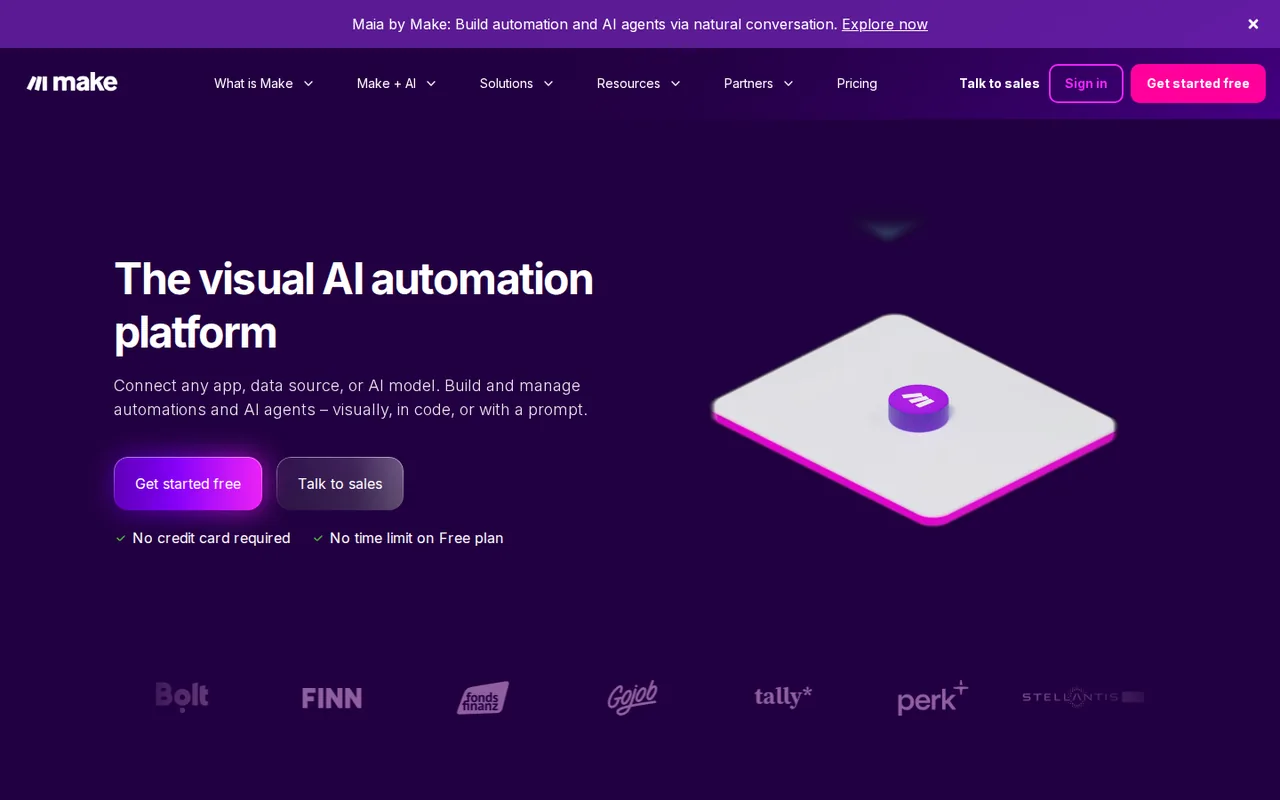
Make: visual scenarios billed in credits, with a Free plan capped at 1,000 credits and two active scenarios
Updated September 25, 2026 · By Elias Brandt · Documentation review, not tested hands-on
Pros
- Visual scenario builder
- Free plan with no time limit
- Countable billing unit
Cons
- Free scheduling floor
- Empty checks still count
- Separate AI-provider charges
- Short log history on Free
- Hosting requires a deployment check
Bottom line
Up to 1,000 monthly credits, 2 active scenarios and a 15-minute minimum scheduled interval.
You want to see how each record is routed through filters and fallbacks before it runs, because the scenario is drawn as a diagram.
You need a firm paid price today, because the public pricing views disagree and the quote has to be confirmed at checkout.
Best forOperations teams with a defined processTeams planning branching workflowsOwners who budget by usageBuilders starting from examples
Strengths, limits and who it suits, in full
Strengths
- Visual scenario builder Routers, filters and fallback routes are drawn as a diagram, so the path each record takes is visible before anything runs.
- Free plan with no time limit Free does not expire, so a small scenario can keep running without a subscription as long as it stays within the Free limits.
- Countable billing unit An ordinary non-AI module run normally uses one credit, so cost can be estimated by counting modules and bundles.
Limits
- Free scheduling floor On Free, scheduled scenarios run at most every 15 minutes and only two scenarios can be active at once.
- Empty checks still count A scheduled trigger uses an operation each time it looks for data, even when it finds nothing; budget for checks as well as records.
- Separate AI-provider charges With an eligible custom AI-provider connection, the provider bills its tokens on top of the operation credits Make charges.
- Short log history on Free Free keeps execution logs for 7 days, and longer retention or full-text search depends on the selected paid package.
- Hosting requires a deployment check For infrastructure you must control, ask Make to document the deployment and private-network options available under your contract before choosing a setup.
Who it suits
- Operations teams with a defined process a good match when the trigger event, data shape and destination are already clear and one person owns error follow-up.
- Teams planning branching workflows routers and filters make it easy to agree which records follow each path; try the routes with synthetic inputs first.
- Owners who budget by usage suits someone willing to count modules and bundles and to read run history when credit use jumps.
- Builders starting from examples the public template library helps when a common app-to-app process already resembles your case; adapt connections and settings afterwards.
How much does Make cost?
Some prices not published · checked
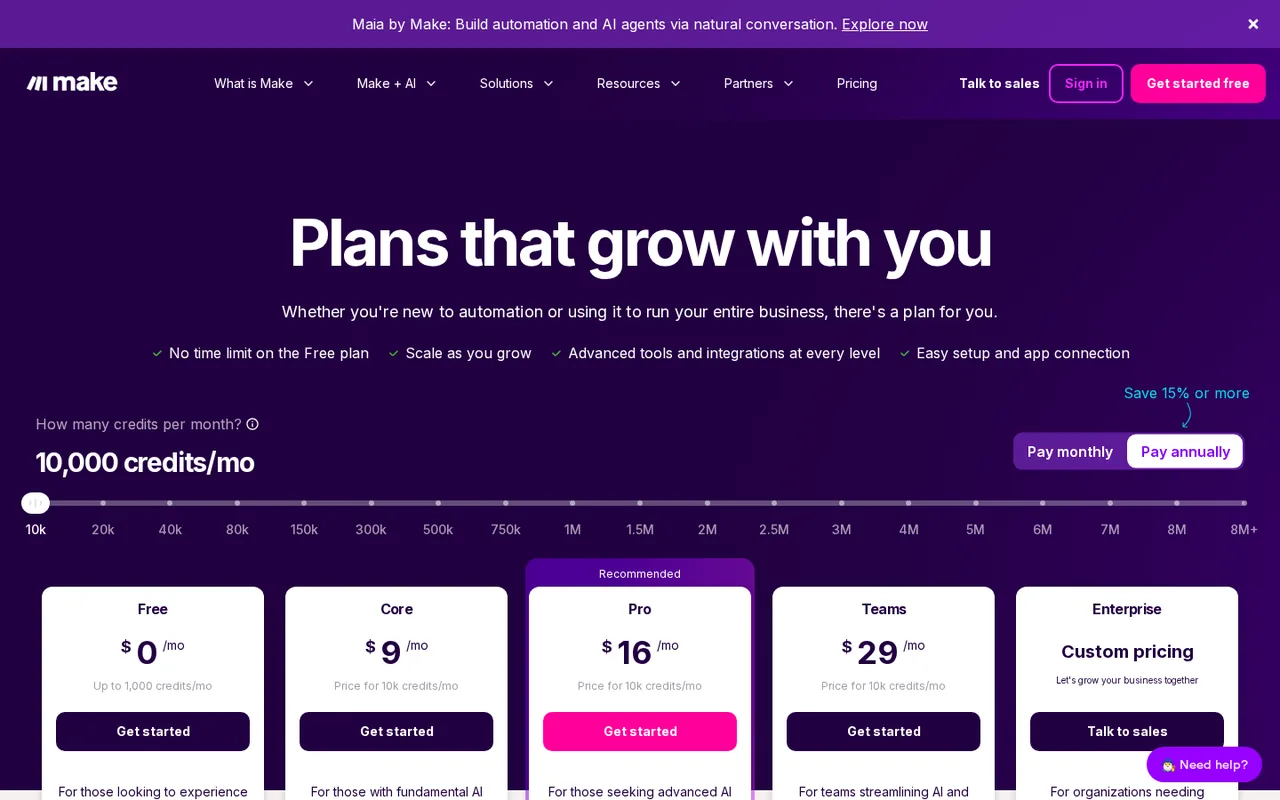
Regional prices: Public pricing views differ: one lists Core, Pro and Teams with a 10,000-credit entry package, while another shows a consolidated paid plan at 5,000 credits.
The billing selection is not reliably preserved in these views. Confirm the plan name, monthly or annual commitment, credit package, currency and tax together at checkout; the old entry prices are not a current quote.
| Plan | Price | What you get |
|---|---|---|
| Free | USD 0 sourceFrom make.com/en/pricing, checked Sep 25, 2026 (opens in a new tab) | Up to 1,000 monthly credits, 2 active scenarios and a 15-minute minimum scheduled interval. |
| Paid automation | Confirm current quote | The public page has shown different plan names, credit packages and prices; select the credit volume and billing term in your account. |
| Enterprise | Custom pricing | Contract terms for advanced security, support, custom libraries and overage protection. |
How far does it go?
- A 15-minute schedule on Make FreeA scenario that checks every 15 minutes runs about 2,880 checks in a 30-day month (4 × 24 × 30), nearly three times the Free plan's 1,000 monthly credits before any other module runs.
- An hourly check on Make FreeOne single-module check per hour uses about 720 credits over the same month (24 × 30), leaving about 280 credits for records that arrive, assuming ordinary non-AI modules at one credit each.
- An illustrative 10,000-credit budgetIf your selected package includes 10,000 credits, that month is about 333 credits a day (10,000 ÷ 30): roughly 333 single-module runs, or about 111 runs of a three-module scenario that handles one bundle per run.
Arithmetic from the published allowances above, not a usage test.
Taxes, currency and promotions can change the price you see at checkout.
Try Make free (opens in a new tab)
Key features
| Feature | What it does | Watch out |
|---|---|---|
| Visual scenario builder | Connect app modules in a visual workflow. | — |
| Conditional routing | Branch a scenario using routers and filters, with a fallback route for unmatched data. | — |
| Scheduled workflows | Choose when scenarios check for data; minimum scheduled intervals depend on the plan. | — |
| AI connections | Use Make-managed AI or eligible custom provider connections, with different credit and token billing. | — |
| Execution history | Inspect run status, module output bundles and credit use; history retention depends on the plan. | — |
| AI agents | Create agentic scenarios with the Make AI Agent (New) app, which is in open beta and uses Make's AI Provider or, on paid plans, custom provider connections.Agents work from instructions, knowledge files and run inputs, can call modules, scenarios, MCP server tools and other agents as tools, and show their reasoning steps for debugging. | The app is in open beta, so functionality and pricing may change, and custom AI provider connections require a paid plan. |
| MCP server | Let MCP clients such as Claude and ChatGPT run activated on-demand scenarios; management scopes require a paid plan.MCP clients can view and run activated scenarios, and management scopes let a client modify scenarios, teams, connections, webhooks and data stores. | Scenarios must be active with on-demand scheduling and defined inputs and outputs, and only OAuth connections can restrict access to one organization. |
| Webhooks | Start scenarios as soon as an app-specific or custom webhook URL receives a request, or queue requests for scheduled processing.Custom and app-specific webhooks trigger scenarios when a request arrives, and each webhook keeps its own request queue. | Instant webhook runs are processed in parallel by default, so ordered processing requires enabling Process data in order. |
| Error handlers | Choose Skip, Retry, Resume, Commit or Rollback handling for a module that fails. | — |
| Scenario templates | Start from public templates covering over 7,500 use cases or from your team's templates; templates are available on all plans. | — |
| Maia assistant | Describe a goal in chat and Maia creates, modifies or helps debug scenarios; it is in public beta on paid plans with a trial on Free.Maia builds or changes scenarios from prompts, reads the execution log after Run once to explain errors, and lets you revert to an earlier scenario version. | Chat sessions are stored for 15 days, and Free plans get a 30-day trial rather than ongoing access. |
| Make Code | Execute JavaScript or Python inside a paid scenario; code time has its own credit rate. | — |
| Code execution | Make Code supports JavaScript and Python with standard libraries on paid plans. | Custom library imports require Enterprise, and execution is billed at 2 credits per second. |
Which Make allowance fits your workload?
Editorial assessment
Choose by active scenarios, schedule and measured credit use. Free covers small workflows within its limits; paid access is needed for more active scenarios, faster schedules or Make Code. Public pricing views currently show different paid packages, so price your required allowance in the account before committing.
- Start on Free: up to two active scenarios, at least 15 minutes between scheduled runs and no more than the monthly credit allowance.
- Get a paid quote: when the process needs more capacity, code execution or account features absent from Free. Confirm that exact feature in the selected plan.
- Request Enterprise terms: when custom code libraries, contractual support or enterprise security are requirements.
How do Make credits add up in a real scenario?
An operation is one module run that processes or checks data, and an ordinary non-AI operation normally costs one credit. A scheduled trigger spends an operation on every check, including checks that find nothing new. An action module then runs once for each incoming bundle, so a trigger that returns ten records runs each later action ten times. Sources: Operations and bundles; Scheduled trigger usage; Make credits.
Applied to a simple case, a trigger that picks up 20 records and passes them through two action modules uses about 41 credits for that run (1 + 20 + 20), assuming no AI modules and no filters. Make-managed AI modules break the one-credit pattern because they can charge by tokens and other usage. Scenario history lists operations and credits for each run, which is the place to compare an estimate with real use. Sources: Make credits; Scenario history; Official scenario example and bundle accounting.
Can Make run code instead of a chain of modules?
Do routers and error handlers change the count or the order?
A router hands a bundle to its routes one after another rather than in parallel, so route order and the fallback route decide what runs first and what catches unmatched data. Make’s pricing FAQ lists router and error-handler modules as credit exceptions. Counting every box in the diagram as one credit therefore overstates the bill for branching scenarios. Sources: Router and conditional branches; Make pricing and plan limits.
What should a first trial scenario prove before real data flows?
Proposed evaluation · not performed yet
Feed the scenario ten synthetic records with a unique ID, one missing field and one duplicate. Route valid records to a test destination, send the same input again, then simulate a destination failure. Write down created records, duplicates, retries, credits used and cleanup time, and keep credentials and real customer data out of the sample.
Hold off on going live if nobody can say what should happen after a duplicate event, an expired credential or an unavailable destination. If those answers are unclear, automation will not fix them; it will only repeat the mistakes faster. If controlling the hosting environment matters, put a self-hosted tool on the shortlist as well.
Compare these options
Read the documented differences, then follow the links to each profile for its sources and plan details.


Is Make worth it?
Documentation review plus dated public user reports. Documentation review, not tested hands-on. Not scored.
Worth it if
- You want to see how each record is routed through filters and fallbacks before it runs, because the scenario is drawn as a diagram.
- Your automations are small enough to stay inside 1,000 monthly credits and two active scenarios, since the Free plan does not expire.
- You can count modules per run, because an ordinary non-AI module run normally uses one credit and cost follows the scenario's shape.
Probably not if
- You need a firm paid price today, because the public pricing views disagree and the quote has to be confirmed at checkout.
- You need schedules faster than every 15 minutes or longer log history, since the Free plan limits both.
Make alternatives
Other automation tools checked with the same method. Pick by the job, not by a score.
Self-hostable workflow and AI-agent automation
Connecting web apps without code

Building and enriching lead lists from websites

Agent tasks that need an inspectable file handoff

Delegating multi-step research and file tasks to an AI agent

Live calls where AI help is permitted

US consumers and small teams who want an assistant to make support calls, cancel subscriptions and negotiate bills, and who will check how credits and the 25% savings fee apply to their plan

Organisations on Microsoft 365 that want to automate Teams, SharePoint, Outlook and Excel work, with RPA for desktop apps
Used Make? Write the first review. Visitor opinions are moderated and kept separate from our source checks.
Frequently asked questions
Is Make Free a permanent plan?
Yes. The Free plan has no time limit, so it does not turn into a paid subscription after a trial period. What it caps is scale: two active scenarios at once, and execution logs kept for 7 days. Paid plans lift the scenario cap and allow scheduling down to the minute.
Can I stop paying credits for empty scheduled checks?
Often, by changing the trigger. A webhook gives the scenario its own URL and starts it the moment a request arrives, so there is no polling schedule running between events. Make offers app-specific webhooks for supported services and custom webhooks for anything able to send a request. Each webhook keeps its own queue of incoming requests.
Can Claude or ChatGPT run my Make scenarios?
Yes, through the Make MCP server. On every plan an MCP client can see and run scenarios that are active, set to on-demand scheduling and given defined inputs and outputs. Scopes that let a client change scenarios, teams, connections, webhooks or data stores need a paid plan, and only OAuth connections can limit access to a single organization.
Are scenario templates limited to paid plans?
No. Templates work on all plans, including Free. A team can also save its own templates and share them through a public link. A plan with shared organization templates adds that access, which helps when several builders should start from the same approved pattern rather than copying scenarios by hand.
Is the Make AI Agent app ready for production use?
Make labels it an open beta and says its functionality and pricing may change, so treat costs as provisional. Agents can use Make's own AI Provider on any plan, which draws on Make credits; connecting your own provider account needs a paid plan. Agents can call modules, scenarios, MCP tools and other agents, and they show reasoning steps for debugging.
Is Make.com free or paid?
Both. Make has a Free plan with no time limit, up to 1,000 monthly credits and two active scenarios, plus paid plans for more credits and faster schedules. Enterprise is custom-priced. Make's own AI features draw on the same credits, so a free account can try them within that monthly allowance.
How much does a Make subscription cost?
We cannot give one verified price. Free is USD 0. Make's public pricing views have shown different plan names, credit packages and prices, and the billing selection is not preserved reliably. Choose the credit volume and billing term in your account, and confirm plan, commitment, currency and tax at checkout.
How much does Make AI cost?
Make-managed AI uses credits, counted by tokens or other usage rather than one credit per run. If you connect your own eligible AI provider, the provider bills tokens separately from Make. The Make AI Agent app is in open beta, and Make says its functionality and pricing may change, so treat costs as provisional.
Sources and method16 official sources · 61 details checked · Sep 23–25, 2026
How we checked this profile
61 details on this page were checked against Make's own pages and help documentation (Sep 23–25, 2026). 9 are still open and listed below.
See the checks by section40 documented12 editorial assessment9 open
Still open
- The current paid-plan lineup is unresolved; older pricing views name Core, Pro and Teams.Not confirmed · checked · Source (opens in a new tab)
- Make is documented as a browser-based cloud service; desktop or self-hosted editions are not confirmed.Not confirmed · checked · Source (opens in a new tab)
- The billing term attached to older entry-price labels is unresolved.Not confirmed · checked · Source (opens in a new tab)
- The older $9/$16/$29 quotes cannot be treated as current checkout prices.Not confirmed · checked · Source (opens in a new tab)
- The current package containing one-minute scheduling and API access needs confirmation.Not confirmed · checked · Source (opens in a new tab)
- The paid package required for priority execution, custom variables and full-text search is unresolved.Not confirmed · checked · Source (opens in a new tab)
- Team roles, shared templates and audit logs need a current package check.Not confirmed · checked · Source (opens in a new tab)
- Log retention and paid full-text search need separate plan checks.Not confirmed · checked · Source (opens in a new tab)
- The applicable paid plan name, credit package and billing total require account confirmation because public pricing views differ.Not confirmed · checked · Source (opens in a new tab)
12 details are due for another source check.
Sources for this profile
- Make pricing and plan limitsmake.com
- Make creditshelp.make.com
- Official product landing pagemake.com
- Router and conditional brancheshelp.make.com
All 16 sources
- Scheduled trigger usagehelp.make.com
- Scenario historyhelp.make.com
- Operations and bundleshelp.make.com
- Official scenario example and bundle accountinghelp.make.com
- Make AI Agent (New) introductionhelp.make.com
- Make MCP serverhelp.make.com
- Webhookshelp.make.com
- Error handlershelp.make.com
- Scenario templateshelp.make.com
- Maia by Makehelp.make.com
- Make Help Center footer social linkshelp.make.com
- Official documentationhelp.make.com
Plan names, limits and prices come from Make's pricing page; credit rules, scheduling, routers, webhooks, the MCP server, AI agents and Maia come from the Make Help Center. Checkout, taxes, account-specific offers and real workflow results were outside the scope of these sources.
Sources checked Sep 23–25, 2026. Found something out of date? See how we correct profiles.