SlidesGPT vs OpenMAIC
Plans, free access, limits and intended use side by side, taken from each vendor’s own pages. No score and no winner: the facts show where the two differ.
Change tools
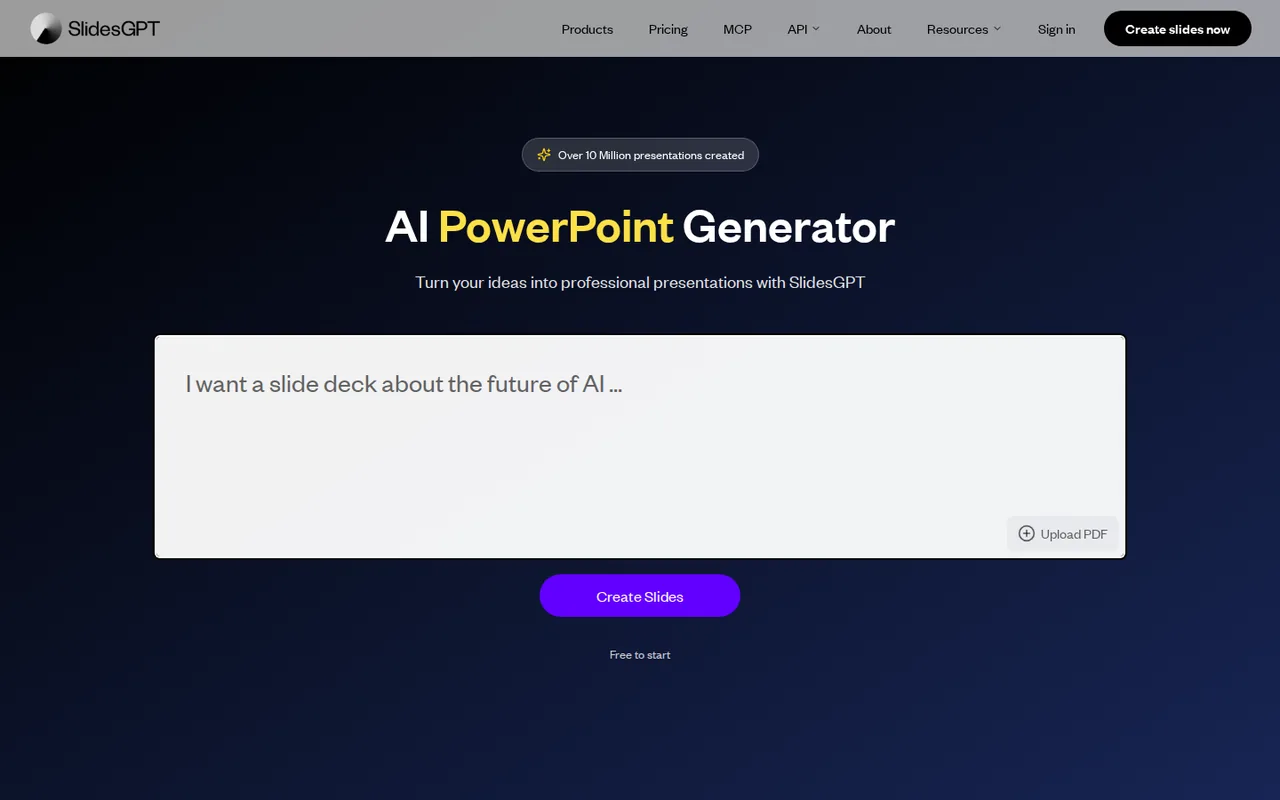
AI PowerPoint generator that builds a deck from a prompt, PDF, YouTube link or markdown and exports PPTX, PDF and Google Slides on paid plans

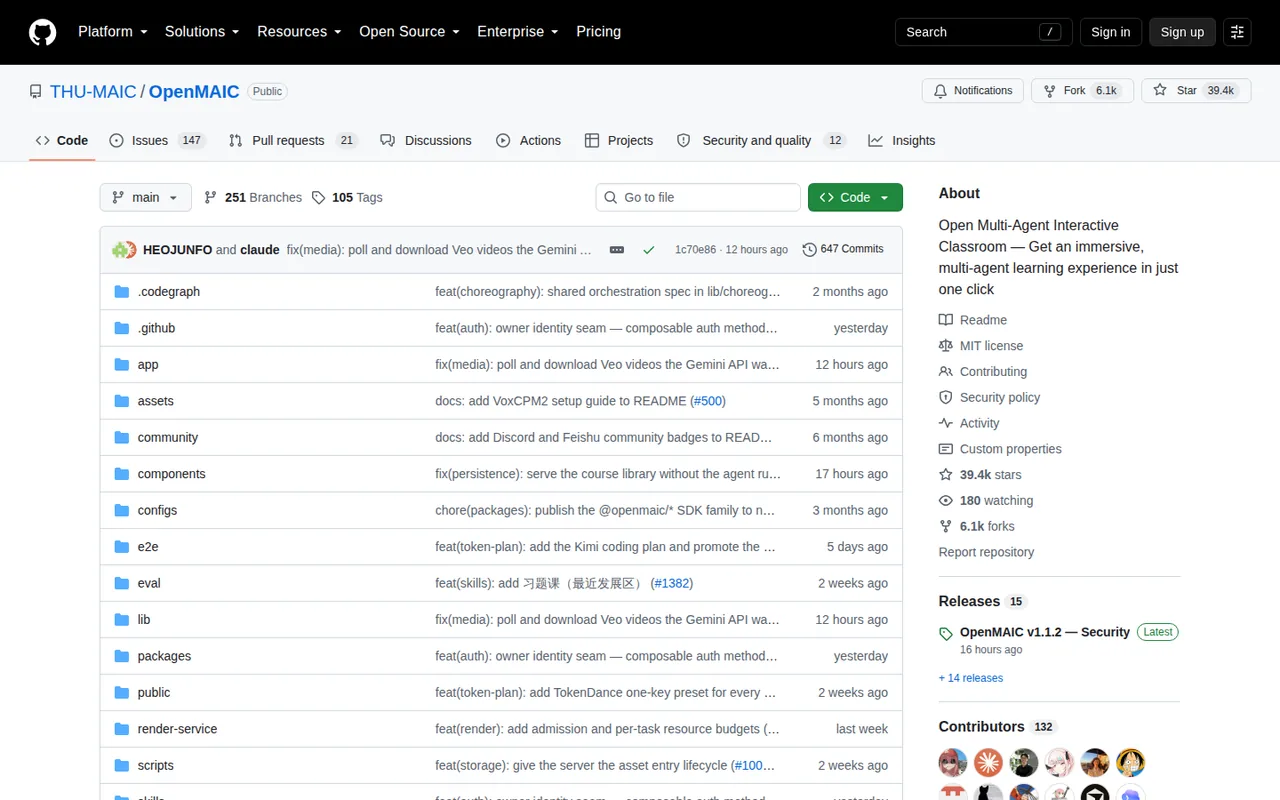
Free code, but the models are your bill
- Free access
- SlidesGPT: Free access
- OpenMAIC: Free access
- Paid from
- SlidesGPT: USD 9.99 per month billed monthly
- OpenMAIC: No fixed price listed
- Plans listed
- SlidesGPT: 7
- OpenMAIC: 1
- Public API
- SlidesGPT: Not confirmed
- OpenMAIC: Not confirmed
Where SlidesGPT and OpenMAIC differ
- Pricing checkPrices confirmed for SlidesGPT; pricing review due for OpenMAIC.
- PlansSlidesGPT lists 7 plans and OpenMAIC lists 1.
Head to head
Each value from the tool’s profile and the vendor’s own pages
| SlidesGPT | Fact | OpenMAIC |
|---|---|---|
| Access and price | ||
| Free access availableFree Starter · USD 0 | Free accessSame | Free access availableFree (open source, MIT) · 0 |
| USD 9.99 per month billed monthlyPro · or $89.99 per year · $7.49 per month equivalent | Lowest listed paid plan | No fixed price listed |
| Free plan without downloads; Pro from $9.99 a month, or $7.49 a month on annual billing | Pricing model | Free MIT-licensed code; model and hosting costs are yours |
| 7 | Plans listedDiffers | 1 |
| Not confirmed | Public API | Not confirmed |
| Not confirmed | Card to start | Not confirmed |
| Not confirmed | Open source | Yes |
| What it is for | ||
| Getting a first-draft PowerPoint deck from a prompt or a source document without opening a design tool | Built for | Turning a topic or document into an interactive AI-taught lesson |
| Presentations | CategorySame | Presentations |
| Platforms |
|
| Works with |
|
| How current | ||
| Profile sources checked | ||
| Prices confirmed · Oct 31, 2026 | Pricing checkDiffers | Pricing review due · Sep 29, 2026 |
Official source check for both tools. No hands-on testing and no score: “Differs” marks a documented difference, not a better tool.
Plans and prices
SlidesGPT
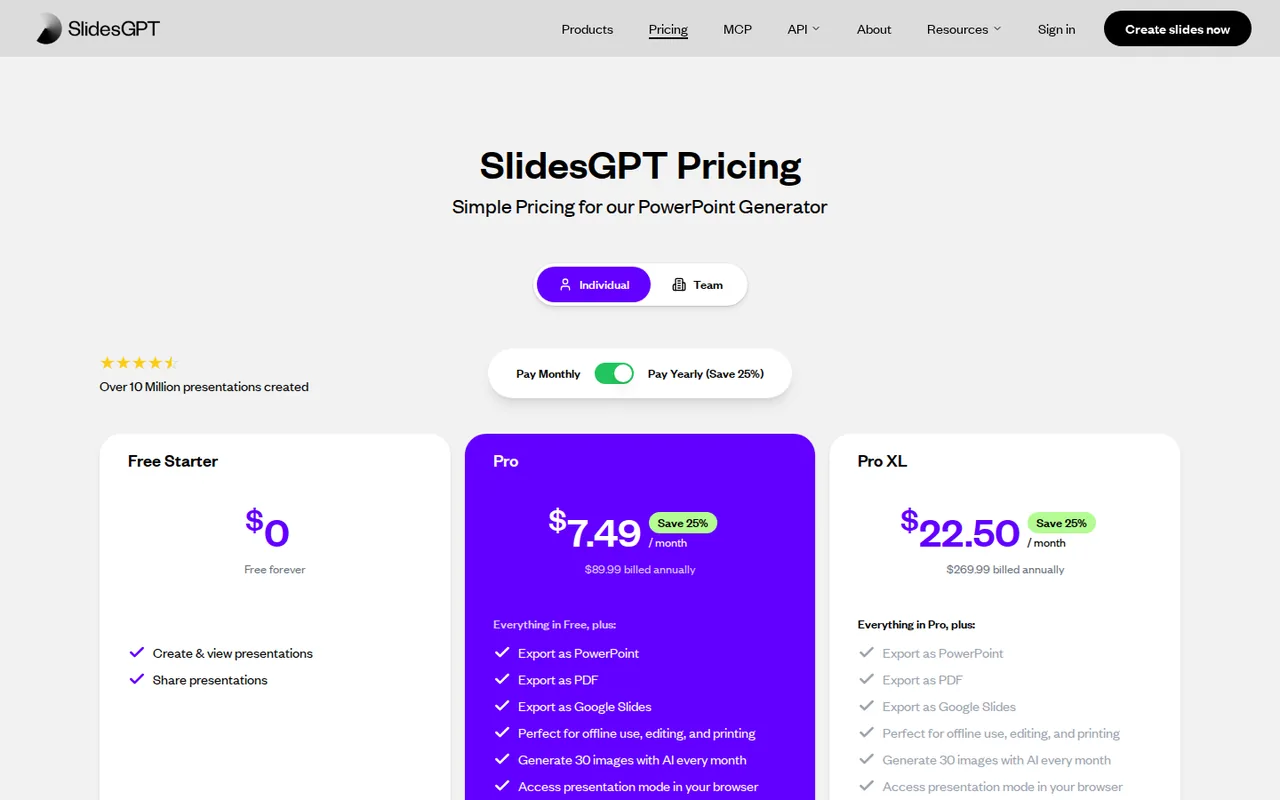
Prices confirmed · Oct 31, 2026- Free StarterUSD 0
- ProUSD 9.99 per month billed monthlyor $89.99 per year · $7.49 per month equivalent
- Pro XLUSD 29.99 per month billed monthlyor $269.99 per year · $22.50 per month equivalent
- Team€10 per seat per monthbilled monthly
- Custom ChatGPT AppUSD 19.99 per user per monthbilled monthly
Show 2 more plans
- APIUSD 0 to startthen usage-based
- EnterpriseCustom quote
Strengths and limits
SlidesGPT
Strengths
- Free preview of the result: You can generate a deck and present it from the browser before paying, so output quality can be judged first.
- Several input types: Prompt, PDF, YouTube URL, markdown and chat all start a deck, and output works in any language.
- Agent and API access: A keyless MCP server and a REST API with a free tier of up to 100 presentations a month are published.
Limits to plan around
- Free cannot export: PowerPoint, PDF and Google Slides files need Pro or Pro XL; Free stops at browser viewing and sharing.
- Low download quotas: Pro allows 10 downloads a month and Pro XL 50, and the unit of a download is not defined on the pricing page.
- Monthly prices are not on the plan cards: The cards show the annual-equivalent $7.49 and $22.50; the monthly $9.99 and $29.99 appear in the FAQ.
OpenMAIC
Strengths
- Permissive license: The MIT license allows commercial use free of charge, and the README says so directly.
- Bring your own models: Works with many cloud providers or local models, so data and cost stay under your control.
- Portable output: Editable .pptx, self-contained HTML and a classroom ZIP that can play offline after import.
Limits to plan around
- Not zero-cost in practice: Cloud models, image, video and voice providers bill you separately, and the project publishes no cost estimate per lesson.
- Open by default: Without an ACCESS_CODE, every route of a deployment, including the API, is reachable by anyone who finds it.
- Hosted terms are unclear: The demo sign-in runs through a Chinese-language MAIC account page, and hosted credit amounts are not published.
See both products
Start from your task, not from a winner.
Run both tools on the same real task, then compare the result, how much editing it needs and how fast it uses your plan’s allowance.
How we reviewChange this pair
Choose tools
Choose two tools below. You can replace either selection at any time.
Audio & voice
Automation
Coding
Data & spreadsheets
Images & design
Presentations
Research & sources
Video & editing
Website builders
Writing & content
Comparing tools from different categories is fine, and often useful — a writing assistant and a research tool solve different halves of the same job. The table will show you exactly where they diverge.
Questions about comparing tools
How does the comparison work?
Add two tools to the comparison tray from any tool card, then open this page. The table pulls each tool's verified plan details, platforms, strengths and limits from its profile, so both columns carry the same kind of evidence, with a separate source-check date for each tool.
Do you declare a winner?
No. The table sets two tools against each other on documented facts, not on a score. Which one wins depends on your task, your budget and your usage volume — three things we cannot see from here.
Why are some cells empty or marked unverified?
Because we could not confirm that detail on the vendor's own pages. Rather than filling the gap with a figure from elsewhere, we mark it and say why on the tool's profile.
Can I compare more than two tools?
Not at once. Two columns keep the differences readable and force a real decision. Remove either selected tool to replace it, or clear both to start a new pair.
Every figure in the table above comes from the linked profile, where the source and the verification date are listed. Browse all tools or read the editorial policy.