
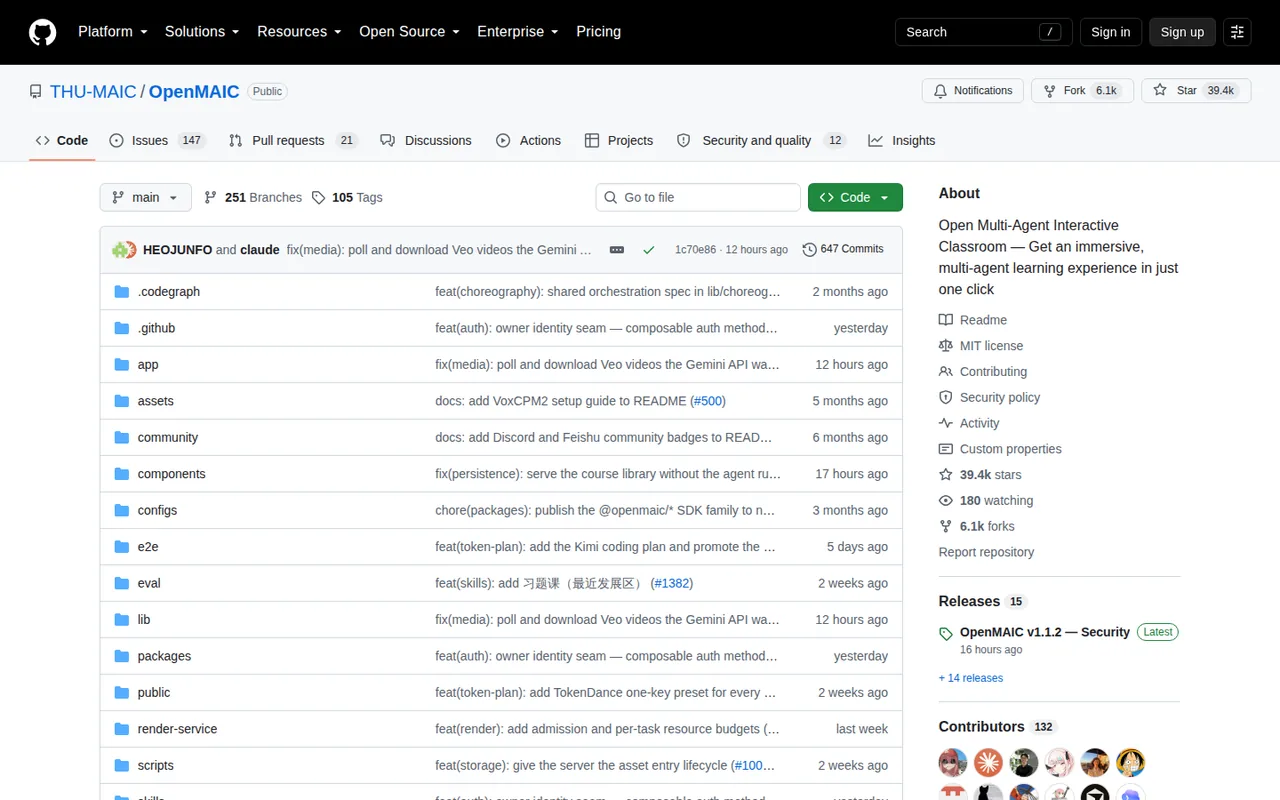
OpenMAIC: MIT-licensed code at no cost, but LLM keys, media providers and hosting are billed to you
Updated September 29, 2026 · By Elias Brandt · Documentation review, not tested hands-on
Pros
- Permissive license
- Bring your own models
- Portable output
Cons
- Not zero-cost in practice
- Open by default
- Hosted terms are unclear
Bottom line
Full repository code, including commercial use; you supply the LLM provider key or local model, optional image, video and voice providers, and hosting.
You want to turn lecture notes or a paper into a narrated lesson with a quiz and can read the output for errors before class, since the generated simulations are plain HTML you have to review.
You need a fixed monthly price per teacher, because OpenMAIC has no subscription and the cost per lesson depends on whichever model and media providers you connect.
Best forTeachers building revision lessonsSchools with an IT teamSelf-learnersEdtech developers
Strengths, limits and who it suits, in full
Strengths
- Permissive license The MIT license allows commercial use free of charge, and the README says so directly.
- Bring your own models Works with many cloud providers or local models, so data and cost stay under your control.
- Portable output Editable .pptx, self-contained HTML and a classroom ZIP that can play offline after import.
Limits
- Not zero-cost in practice Cloud models, image, video and voice providers bill you separately, and the project publishes no cost estimate per lesson.
- Open by default Without an ACCESS_CODE, every route of a deployment, including the API, is reachable by anyone who finds it.
- Hosted terms are unclear The demo sign-in runs through a Chinese-language MAIC account page, and hosted credit amounts are not published.
Who it suits
- Teachers building revision lessons useful for turning notes or a paper into a narrated deck plus quiz, provided the output is checked before class.
- Schools with an IT team self-hosting suits groups that can run Node.js or Docker, secure the deployment and manage API keys.
- Self-learners a local Ollama model or the hosted demo lets one person explore a topic without a subscription.
- Edtech developers the MIT code and the @openmaic/* packages suit teams building their own classroom product.
How much does OpenMAIC cost?
Prices confirmed · checked
Regional prices: There is no OpenMAIC subscription.
Token Plans in the settings are one-key presets for third-party providers such as TokenDance, MiniMax, Seed and Kimi, billed by those providers. The hosted demo at open.maic.chat mentions credits but does not publish amounts or terms in English. Two bundled packages keep their own licenses: mathml2omml is LGPL-3.0-or-later.
| Plan | Price | What you get |
|---|---|---|
| Free (open source, MIT) | 0 sourceFrom github.com/THU-MAIC/OpenMAIC, checked Sep 29, 2026 (opens in a new tab) | Full repository code, including commercial use; you supply the LLM provider key or local model, optional image, video and voice providers, and hosting. |
How far does it go?
- Storage ceiling for a shared class serverThe default ASSET_QUOTA_BYTES is 10 GiB per owner, and each browser without an account is its own anonymous owner. A class of 30 anonymous learners could therefore hold up to 30 x 10 GiB = 300 GiB of assets. Deleted media is removed after two grace periods: 2 x 1 hour = about 2 hours by default. Arithmetic from README defaults, not a measurement.
Arithmetic from the published allowances above, not a usage test.
Taxes, currency and promotions can change the price you see at checkout.
Try OpenMAIC free (opens in a new tab)
Key features
| Feature | What it does | Watch out |
|---|---|---|
| Topic or document to lesson in two stages: outline, then scenes | — | |
| Narrated slides with spotlight, laser pointer and whiteboard drawing | — | |
| Quizzes with AI grading and interactive HTML simulations | — | |
| Multi-agent discussion, roundtable debate and Q&A with AI classmates | — | |
| Export to editable .pptx, interactive HTML or a classroom ZIP | — | |
| Pro agent workbench that plans, builds and revises whole courses | A chat-first agent plans multi-lesson curricula, edits single scenes, imports .pptx decks and uses 24 built-in teaching skills. | It is off by default and needs PostgreSQL, two feature flags and an explicit model route before it starts. |
| Provider-neutral setup: OpenAI, Anthropic, Gemini, DeepSeek, Ollama and more | — | |
| OpenClaw skill for generating classrooms from Slack, Telegram or Feishu | — | |
| Lesson generation | Analyzes a prompt or uploaded PDF, Office file, text, image, audio or video and builds an outline, then turns each item into slides, quizzes, simulations or project activities. | Which file types work depends on the parser you configure; audio and video need ffmpeg plus a speech-recognition provider. |
| Deep Interactive Mode | Creates explorable pages such as simulations, games, mind maps and online programming, and the AI teacher can operate the page to guide a learner. | These pages are generated HTML, so check each simulation for correctness before using it in class. |
What does it actually cost to run OpenMAIC?
The repository is free, and the README states that the MIT license permits commercial use free of charge. The getting-started guide still asks for at least one LLM provider before the app will generate anything. Cloud providers such as OpenAI or Anthropic usually need a paid API key, while a local Ollama or Lemonade server needs no key.
The README recommends turning on every modality, including generated illustrations, narration, video clips and web search. Each of those can be a separate provider with its own bill. Budget per lesson from your provider dashboards, because the project publishes no cost estimate for a generated classroom.
Is the hosted demo the same thing as self-hosting?
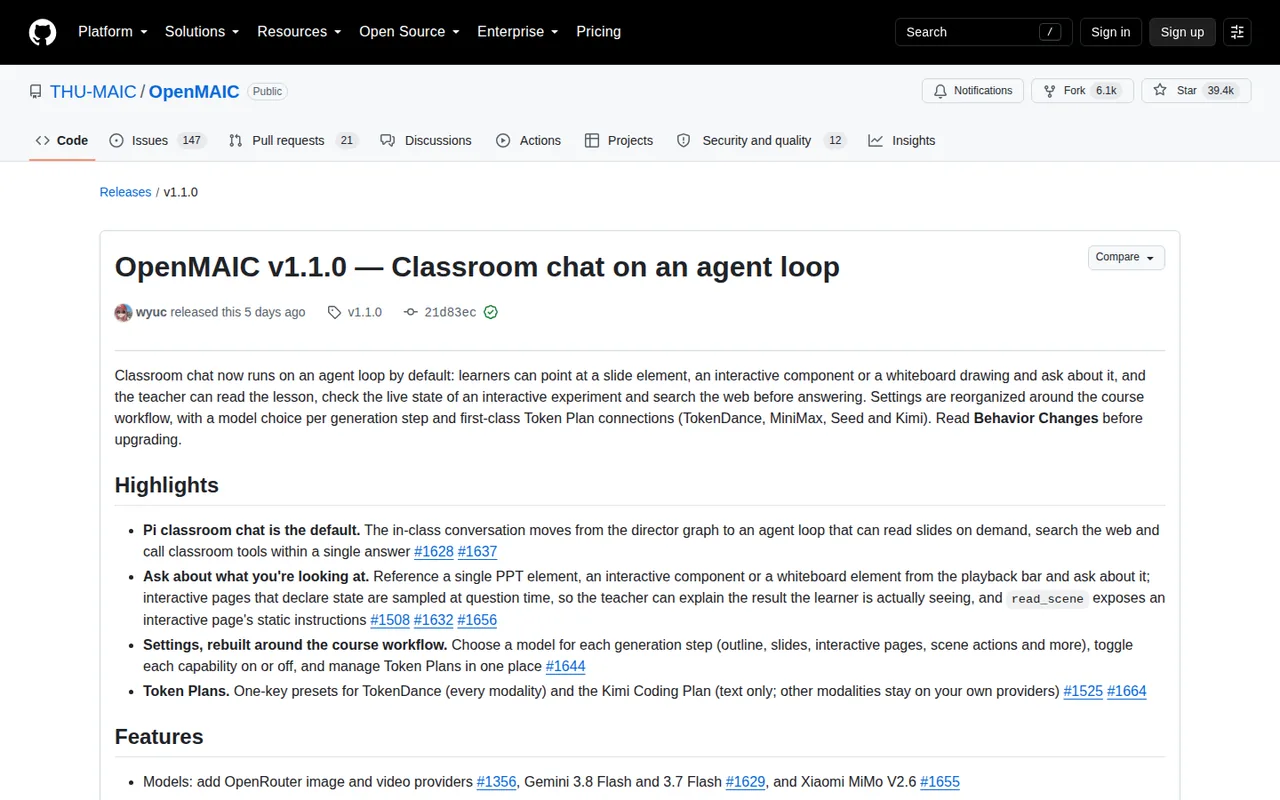
No. The demo at open.maic.chat is the only hosted address the README links. Its Login button opens a Chinese-language MAIC account page with password or phone-code sign-in, and the v1.1.0 notice on the demo says you can connect your own Token Plan when your credits run out.
Credit amounts and hosted terms are not published in English. Self-hosting avoids that dependency but moves the work to you: Node.js 22.19 or later, pnpm, provider keys and a server. The OpenClaw skill can use either route, with a hosted access code or a local checkout.
What changed with the move to the MIT license?
Version 0.3.0 relicensed the project from AGPL-3.0 to MIT, and the repository LICENSE file now carries the MIT text. Under MIT you may modify the code and ship it inside a paid product without publishing your changes, which the AGPL would have required for a network service.
Two bundled packages are outside the root license. The README lists mathml2omml under LGPL-3.0-or-later and a third-party pptxgenjs copy under MIT, so redistributing the whole repository means honoring each package license. Pages elsewhere that still describe OpenMAIC as AGPL predate the change.
What can you take away from a generated classroom?
Every classroom can be exported in three forms, so the result is not locked inside the app:
- Editable .pptx slides with images, charts and LaTeX formulas.
- Self-contained interactive HTML pages with the simulations.
- A classroom ZIP with course structure and media; exports inline external libraries and fonts so the course can play offline after import.
- MP4 video, only when the separate render-service container is running; otherwise you get a project ZIP to render locally.
What must you secure before sharing a deployment with a class?
The README describes the default as fail-open. When ACCESS_CODE is unset, every matched route, including the API, is reachable, so anyone with the URL can spend your model credits. Set a random code of at least 16 characters, and add TRUST_PROXY_HEADERS behind a trusted proxy to get its 10-attempts-per-minute throttle.
With server persistence on, anyone who can reach the endpoint and knows a course ID can read that course, and learners without accounts are anonymous owners tied to a 30-day cookie. The project shipped four security releases in September 2026 alone, so plan to update a shared deployment regularly.
Which features need extra servers or permissions?
Several advertised features are opt-in. The Pro agent workbench needs PostgreSQL, two feature flags and a model route; MP4 export needs the render-service container; complex-table parsing can use MinerU; and local speech recognition runs through FunASR.
Voice cloning through the optional VoxCPM2 adapter stores an uploaded reference clip in the browser and sends it to your voice server on each synthesis. Clone only voices whose owners have agreed, and treat recordings of students as personal data.
Can OpenMAIC turn one of your own documents into a usable lesson?
Proposed evaluation · not performed yet
Self-host the current release with one cloud model key and ACCESS_CODE set, then upload a 10-page lecture PDF you have the right to use, with two formulas and one table. Ask for a 20-minute lesson for first-year students.
- Record the release, model, parser and any media providers enabled.
- Check the generated outline against the PDF headings before scenes are built.
- Play the classroom and note factual errors in narration, quiz answers and the simulation.
- Export .pptx and the classroom ZIP, then open both on another machine.
- Read the provider dashboard for the tokens and cost of the run.
Accept a lesson whose formulas and table survive the .pptx export, whose quiz answers match the PDF and whose cost is recorded. Reject missing formulas, a quiz with wrong keys or an export that does not open. No lesson quality or cost is reported until the run is done.
If you only need a slide deck rather than a taught classroom, compare Gamma and Dokie AI. To study your own sources with cited answers instead, see NotebookLM.
Is OpenMAIC worth it?
Documentation review plus dated public user reports. Documentation review, not tested hands-on. Not scored.
Worth it if
- You want to turn lecture notes or a paper into a narrated lesson with a quiz and can read the output for errors before class, since the generated simulations are plain HTML you have to review.
- Your school or team can run Node.js or Docker and manage provider keys, because self-hosting is where the MIT code gives you control over data and cost.
- You prefer to experiment with a local Ollama or Lemonade model, which needs no API key, and accept that quality then depends on your hardware.
Probably not if
- You need a fixed monthly price per teacher, because OpenMAIC has no subscription and the cost per lesson depends on whichever model and media providers you connect.
- You plan to share a deployment with a class without setting an access code, since an open deployment lets anyone with the URL use your model credits.
- You need clear hosted terms in English, as the demo sign-in is in Chinese and hosted credit amounts are not published.
OpenMAIC alternatives
Other presentations tools checked with the same method. Pick by the job, not by a score.

Recurring decks and fast drafts

Generating an on-brand deck from a prompt and rehearsing it before you present

Turning notes and reports into diagrams inside one document

Turning existing documents into editable PowerPoint decks

Sales and client-facing decks

Drafting and reformatting slides without leaving Google Slides or PowerPoint

Turning a PDF, Word or Excel document into an editable PowerPoint deck

Sending personalized sales decks as tracked web links instead of PowerPoint files
Used OpenMAIC? Write the first review. Visitor opinions are moderated and kept separate from our source checks.
Frequently asked questions
Can I run OpenMAIC for free without paying for any API?
Yes, in principle. The getting-started guide says local Ollama or Lemonade servers need no API key, and FunASR offers a CPU-only speech recognition setup. Generation quality then depends on the local model and your hardware, and image or video generation may still need a separate provider.
Is openmaic.io the official OpenMAIC website?
The README links only the GitHub repository and the live demo at open.maic.chat. Other domains using the OpenMAIC name, including openmaic.io and openmaic.chat, are not linked from the README, and one still shows the older AGPL wording. Download the code from the THU-MAIC GitHub organization.
Which interface languages does OpenMAIC support?
The README lists 12 locales across 11 languages: Simplified and Traditional Chinese, English, Japanese, Korean, Russian, Arabic, Brazilian Portuguese, Mexican Spanish, French, Vietnamese and German. Lesson content language is inferred from your prompt, so an English prompt on a Chinese interface still produces an English lesson.
Can I generate a classroom from Slack or Telegram?
Yes, through the OpenMAIC skill for OpenClaw, which connects to messaging apps such as Slack, Telegram, Discord and Feishu. The skill uses either a hosted access code or your own local install, submits an asynchronous job and sends the link when it finishes. It asks for confirmation before each step.
Where are courses stored if I do not set up a database?
By default everything stays in browser storage, so a course created in one browser is not visible in another. To move it, export a classroom ZIP and import it on the other browser or server. Server storage needs PostgreSQL and a build-time switch that the README describes in detail.
Sources and method6 official sources · 6 details checked · Sep 29, 2026
How we checked this profile
6 details on this page were checked against OpenMAIC's own pages and help documentation (Sep 29, 2026).
See the checks by section6 documented
| Section | Checks | Last checked | Sources |
|---|---|---|---|
| Plans and prices | 2 documented | github.com/LICENSEgithub.com/v1.1.0 | |
| Other details | 1 documented | github.com/OpenMAIC | |
| Article text | 1 documented | open.maic.chat/getting-started | |
| Strengths and limits | 1 documented | github.com/OpenMAIC | |
| Features | 1 documented | github.com/OpenMAIC |
Sources for this profile
- Official OpenMAIC repository and READMEgithub.com
- MIT license filegithub.com
- Release historygithub.com
- v1.1.0 release notes (Token Plans, classroom chat)github.com
The GitHub repository and README are the primary sources; the README links only the repository and the live demo at open.maic.chat. Look-alike domains such as openmaic.io are not linked from the README and one still shows the former AGPL wording, so they were not used. The project relicensed from AGPL-3.0 to MIT in v0.3.0. The demo sign-in page and its user agreement are in Chinese; hosted credit amounts were not published. The README names v1.0.0 as current while the release page lists v1.1.2.
Sources checked Sep 29, 2026. Found something out of date? See how we correct profiles.