Rask AI vs Luma AI
Plans, free access, limits and intended use side by side, taken from each vendor’s own pages. No score and no winner: the facts show where the two differ.
Change tools
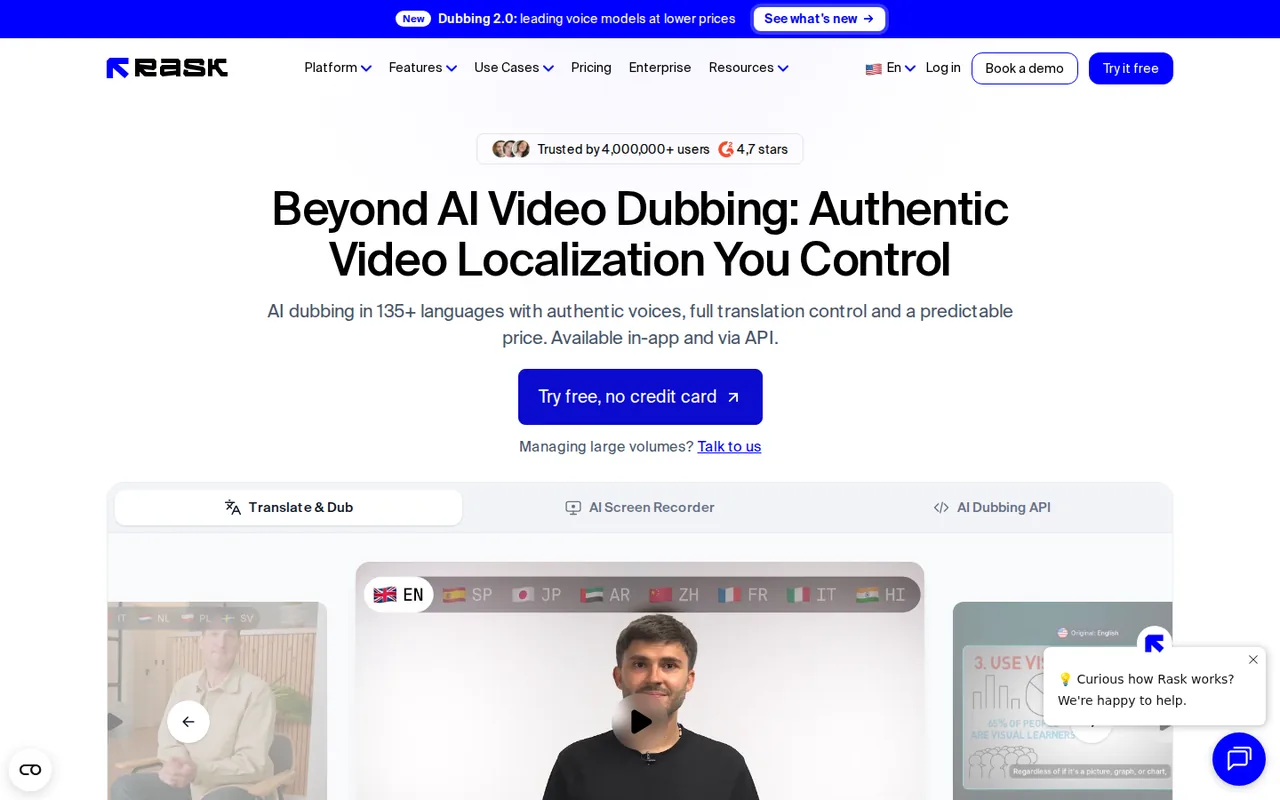
AI video dubbing and translation in 135+ languages with voice cloning, a line-by-line editor and a per-minute credit

Price the model and resolution before the plan
- Free access
- Rask AI: Free trial only
- Luma AI: Not verified
- Paid from
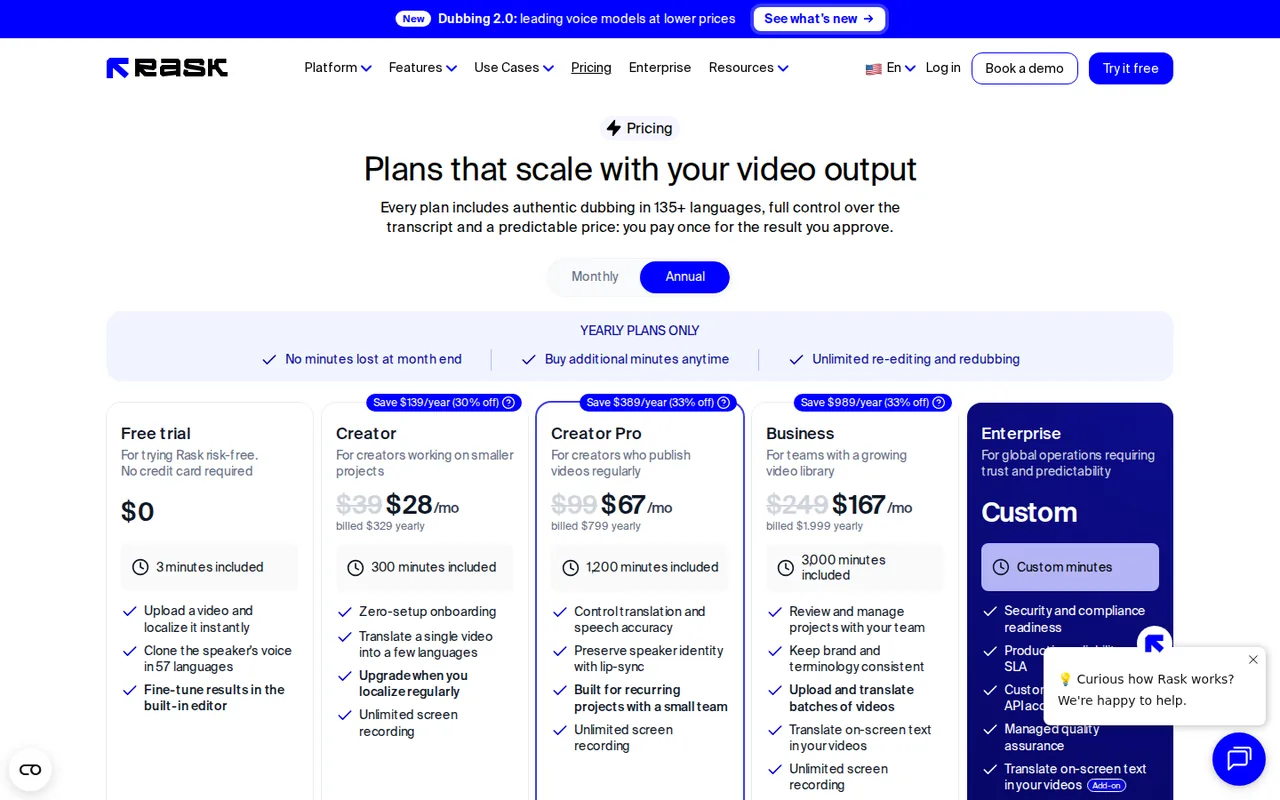
- Rask AI: USD 39 per month billed monthly
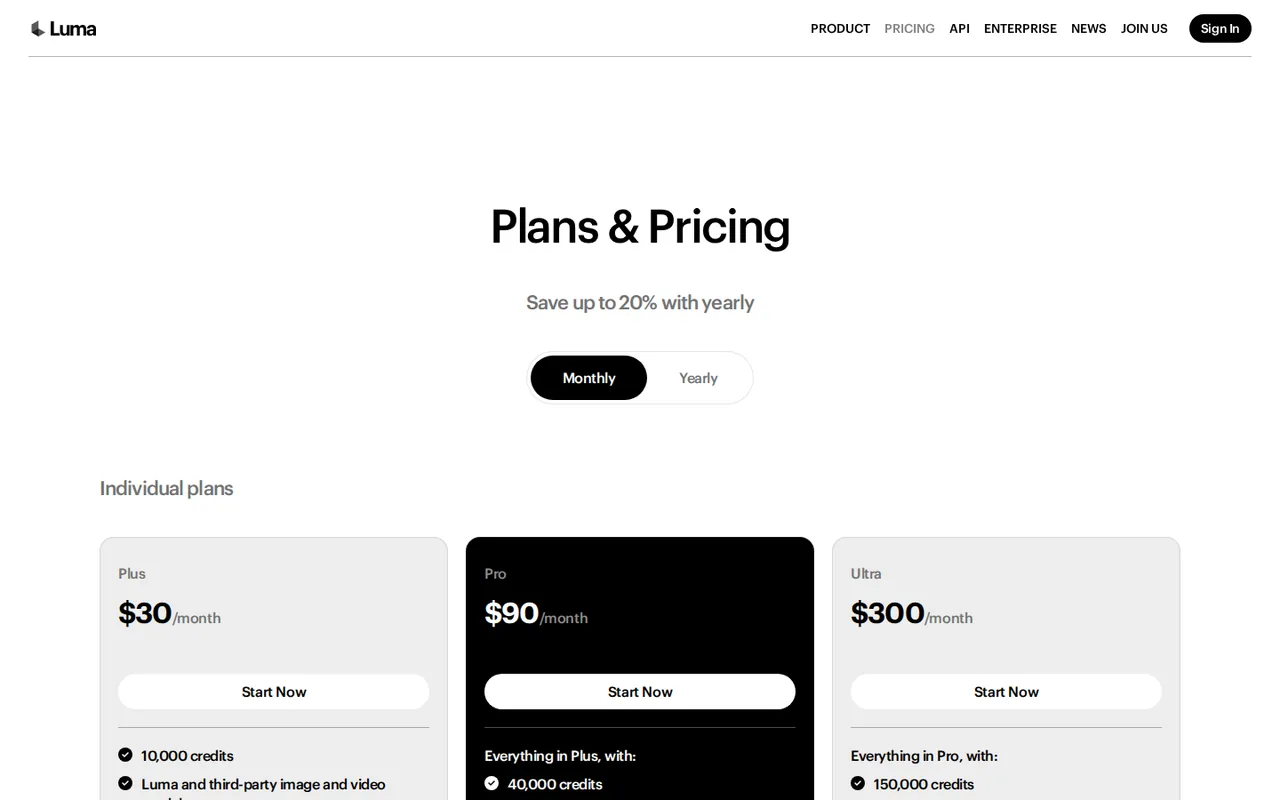
- Luma AI: USD 30 per month
- Plans listed
- Rask AI: 5
- Luma AI: 5
- Public API
- Rask AI: Not confirmed
- Luma AI: Not confirmed
Where Rask AI and Luma AI differ
- Pricing checkPrices confirmed for Rask AI; pricing review due for Luma AI.
Head to head
Each value from the tool’s profile and the vendor’s own pages
| Rask AI | Fact | Luma AI |
|---|---|---|
| Access and price | ||
| Free trial onlyFree trial · USD 0 | Free accessDiffers | Not verified |
| USD 39 per month billed monthlyCreator · $329 billed yearly, shown as $28 a month | Lowest listed paid plan | USD 30 per monthPlus · billed monthly · or $25 per month, $300 billed yearly |
| Free trial $0 (3 minutes); Creator $39, Creator Pro $99, Business $249 per month billed monthly; $329, $799, $1,999 billed yearly | Pricing model | Free allowance not confirmed; paid from $30/month |
| 5 | Plans listedSame | 5 |
| Not confirmed | Public API | Not confirmed |
| Not confirmed | Card to start | Not confirmed |
| Not confirmed | Open source | Not confirmed |
| What it is for | ||
| Course creators, YouTubers and small teams that dub or translate existing videos and want to edit the translation line by line before export | Built for | Short AI video and image variants across several models |
| Video & editing | CategorySame | Video & editing |
| Platforms |
|
| Works with |
|
| How current | ||
| Profile sources checked | ||
| Prices confirmed · Nov 16, 2026 | Pricing checkDiffers | Pricing review due · Sep 29, 2026 |
Official source check for both tools. No hands-on testing and no score: “Differs” marks a documented difference, not a better tool.
Plans and prices
Rask AI
Prices confirmed · Nov 16, 2026- Free trialUSD 0
- CreatorUSD 39 per month billed monthlyUSD 329 billed yearly, shown as $28 a month
- Creator ProUSD 99 per month billed monthlyUSD 799 billed yearly, shown as $67 a month
- BusinessUSD 249 per month billed monthlyUSD 1,999 billed yearly, shown as $167 a month
- EnterpriseCustom
Luma AI
Pricing review due · Sep 29, 2026- PlusUSD 30 per monthbilled monthly · or $25 per month, $300 billed yearly
- ProUSD 90 per monthbilled monthly · or $75 per month, $900 billed yearly
- UltraUSD 300 per monthbilled monthly · or $250 per month, $3,000 billed yearly
- TeamContact sales
- EnterpriseContact sales
Strengths and limits
Rask AI
Strengths
- Translation is editable before export: The homepage and pricing page describe a line-by-line editor for transcript, translation, timing, speed and voice settings, and the pricing FAQ says re-dubbing edited segments costs no extra minutes.
- Pricing is counted in minutes of final video: The pricing FAQ defines one minute as 1 minute of final translated video or audio, so a 5-minute video in 2 languages uses 10 minutes.
- Annual plans keep unused minutes: The pricing FAQ says unused minutes roll over on annual plans for as long as the subscription is active.
Limits to plan around
- Output rights are not clear for self-serve plans: The Terms (effective August 24, 2026) say you may not resell or commercially use any part of the Service or its contents and materials. A later section says commercial customers under an Order Form own their Video Output, and the homepage says AI voices come with commercial usage rights. No page says which applies to a self-serve plan.
- Lip-sync and on-screen text cost extra minutes: Enhanced lip-sync counts 4 minutes per video minute in total, the FAQ says its pricing is in beta and may change, and on-screen text translation counts 3 minutes per video minute.
- Monthly minutes expire: The FAQ and Terms say unused minutes on monthly plans are removed at the end of the billing cycle, and canceling removes remaining minutes.
Luma AI
Strengths
- Many models on one balance: Luma Ray, Uni-1 and third-party video, image and audio models share one credit pool.
- Published per-model rates: The pricing page lists credits per second or per image for each model and resolution.
- Output rights assigned: The terms assign Luma's rights in generated output to the customer, with commercial use on a paid plan.
Limits to plan around
- No confirmed free allowance: The homepage says Try for free, but the current pricing page shows no free plan or credit amount.
- Broad training license: Input and output from paid use may be used to train Luma models, and free-use output may also be publicly displayed.
- Refunds at Luma's discretion: The terms call fees final and non-refundable unless Luma decides otherwise.
See both products

Start from your task, not from a winner.
Run both tools on the same real task, then compare the result, how much editing it needs and how fast it uses your plan’s allowance.
How we reviewChange this pair
Choose tools
Choose two tools below. You can replace either selection at any time.
Audio & voice
Automation
Coding
Data & spreadsheets
Images & design
Presentations
Research & sources
Video & editing
Website builders
Writing & content
Comparing tools from different categories is fine, and often useful — a writing assistant and a research tool solve different halves of the same job. The table will show you exactly where they diverge.
Questions about comparing tools
How does the comparison work?
Add two tools to the comparison tray from any tool card, then open this page. The table pulls each tool's verified plan details, platforms, strengths and limits from its profile, so both columns carry the same kind of evidence, with a separate source-check date for each tool.
Do you declare a winner?
No. The table sets two tools against each other on documented facts, not on a score. Which one wins depends on your task, your budget and your usage volume — three things we cannot see from here.
Why are some cells empty or marked unverified?
Because we could not confirm that detail on the vendor's own pages. Rather than filling the gap with a figure from elsewhere, we mark it and say why on the tool's profile.
Can I compare more than two tools?
Not at once. Two columns keep the differences readable and force a real decision. Remove either selected tool to replace it, or clear both to start a new pair.
Every figure in the table above comes from the linked profile, where the source and the verification date are listed. Browse all tools or read the editorial policy.