Elicit vs Consensus: Extraction Tables or Cited Answers?
Both put AI on top of published research. Elicit pulls study details into columns, screens papers for formal reviews and backs every value with a quote. Consensus answers a research question from peer-reviewed papers, filters studies and writes Deep reviews. This page sets one literature review against each plan’s limits: columns, screening capacity, Deep review counts and API calls.
By Elias Brandt · Updated 9 Oct 2026 · About 8 min read · Plan terms taken from each tool profile
The short answer
Choose Elicit if the job ends in a data table: extraction columns backed by quotes, screening of up to 5,000 papers on Pro, and table exports from Academic Plus at USD 11 per user a month billed annually. Choose Consensus if you first need to know what studies say: filtered paper search, the Consensus Meter, and 15 Deep reviews a month on Pro at USD 12 billed annually.
Elicit or Consensus: which one, when?
Pick by what you hand over at the end
In shortA table of study data with a quote behind each value points to Elicit. A cited answer to a question, or a first map of what the literature says, points to Consensus.

Elicit when the deliverable is an evidence table
A review team can hand over a table of designs, populations and outcomes where every value traces to a quote, with exclusion reasons kept for each screened paper.

Consensus when you need the lie of the land first
Before you commit to a reading list, the Consensus Meter and study filters show how much published work exists and which way it points, and Pro's 15 Deep reviews a month cover a new question most weeks.
Consensus for developers on a small budget
API and MCP calls are included from the Free plan upward, while Elicit lists API access starting at Pro.
Five research jobs, side by side
In shortRead across a row: the job, then what each tool does and on which plan.
| If the job is… | Elicit | Consensus |
|---|---|---|
| Build an evidence table for 30 trials | Columns for design, population and outcomes, each with a quote; CSV or Excel export from Plus | Filter by study design and sample size, then export the 30 references as CSV or RIS |
| Answer a yes-or-no question before a meeting | Paper summaries and chat on Basic; Research Agent for multi-step questions, limited on Basic | Consensus Meter shows agreement across studies; limited Pro messages (official counts differ: 10 or 15) a month on Free |
| Screen a large search for a formal review | Pro screens up to 5,000 papers with recorded reasons; Enterprise up to 40,000 | Deep mode screens a large pool into one structured report, 200 reviews a month on Deep |
| Bring in an existing Zotero library | Library imports from Zotero on Basic, plus EndNote or Mendeley, and flags duplicates | Save papers into My Library collections and export them as RIS for your reference manager |
| Check whether a claim came from the full paper | Column answers quote the passage used, including table text | A checkmark beside a Deep report citation marks full-text use; no checkmark means abstract only |
Using both on one review
The two meet through a reference manager. Consensus exports search results as RIS, CSV or a formatted bibliography, and Elicit’s library imports references from Zotero, EndNote or Mendeley, looks up abstracts and full texts from the metadata and flags duplicates. A list built in Consensus with its study filters can therefore become the starting library for extraction columns in Elicit. Zotero import is part of Elicit’s free Basic plan.
Sources: Consensus advanced filters, Elicit Library, Elicit pricing.
The basics
In shortRead live from each profile.
| What do you need? | Elicit | Consensus |
|---|---|---|
| In short | Find research papers and extract structured information from studies. | Explore research papers with cited answers and study filters. |
| Free access | Free access available | Free access available |
| Plans |
|
|
| Price check | Pricing review due · Sep 24, 2026 | Pricing review due · Sep 24, 2026 |
| Full profile | Elicit profile | Consensus profile |
Values come from each tool’s profile and update with it, in the currency each vendor shows.
Visit Elicit (opens in a new tab) Visit Consensus (opens in a new tab)
What does each one do with the papers?
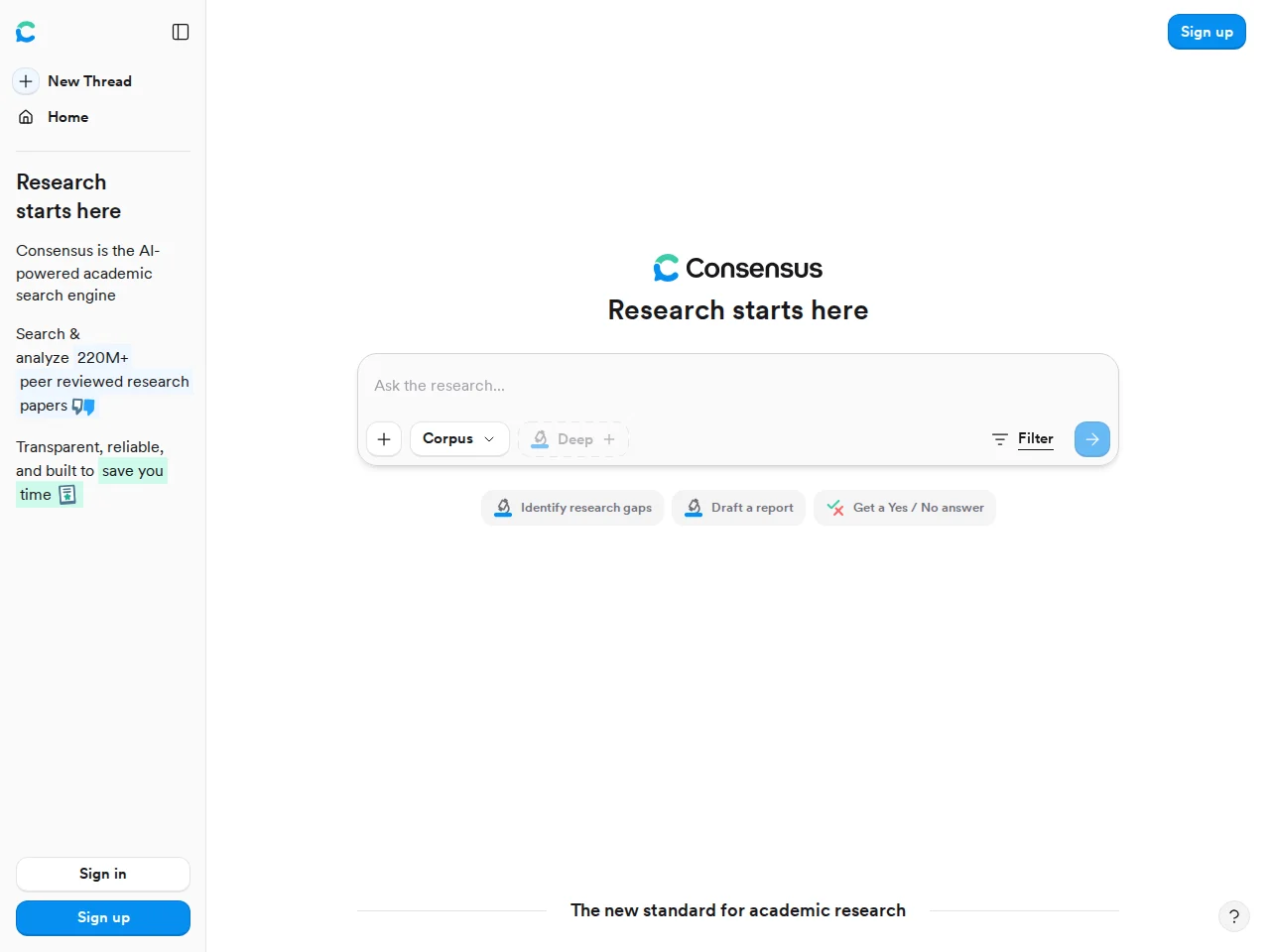
In shortElicit works paper by paper: search, extract into columns, screen, report. Consensus works question by question: search, filter, answer, and in Deep mode a structured review.
Six differences that decide it
- Core job
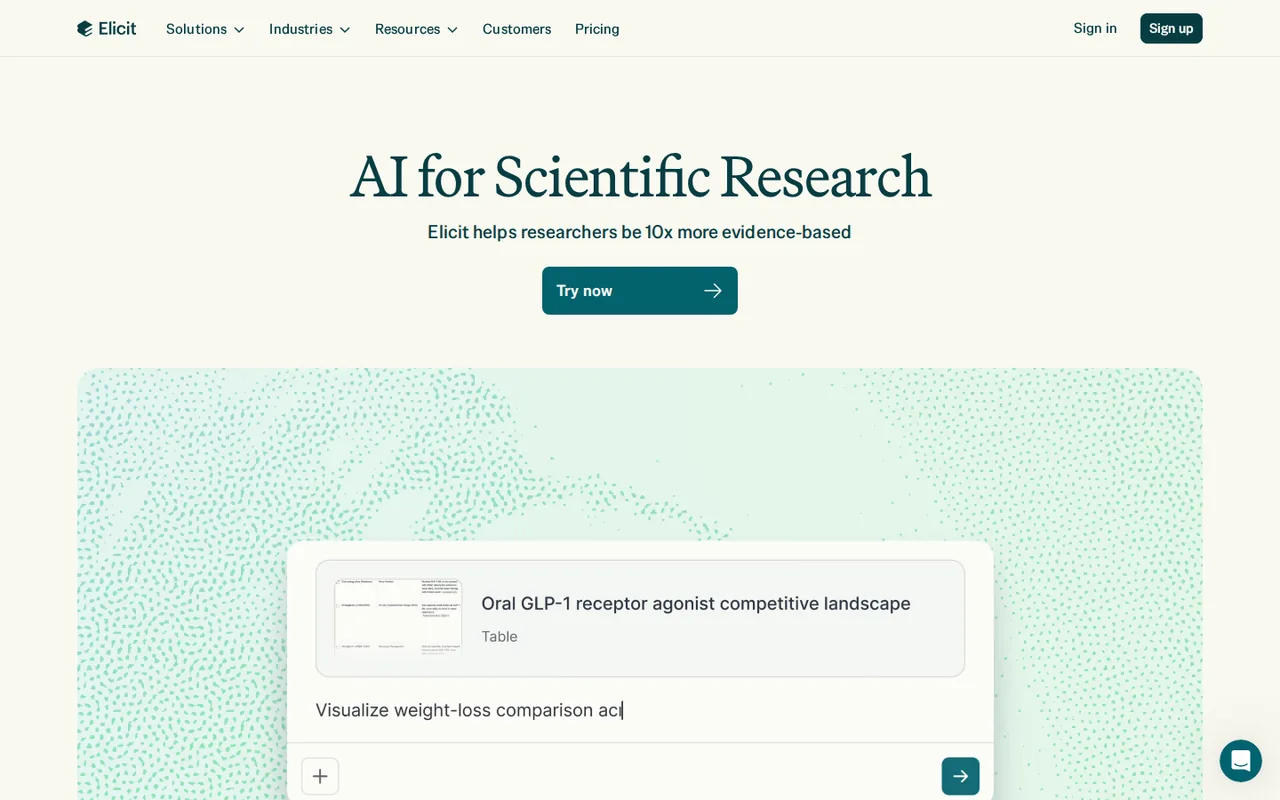
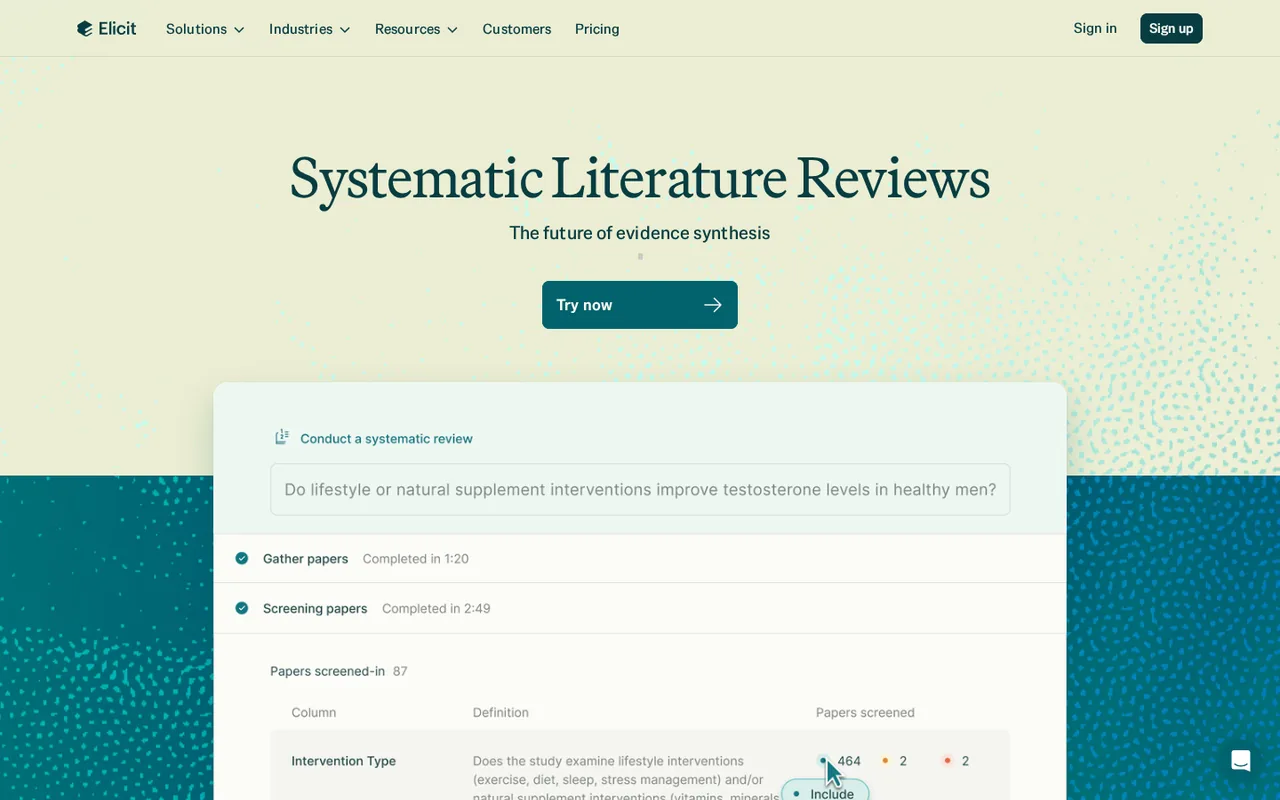
- Elicit extracts study details into columns with a supporting quote per cell and runs a Systematic Review workflow for screening. Consensus answers a research question from peer-reviewed papers and builds Deep reviews that synthesize a large pool of studies. Source: elicit.com
- Search pool
- Elicit searches more than 138 million papers and adds clinical-trial search from Plus. Consensus lists more than 220 million peer-reviewed papers and filters by study design, population, sample size, journal rank and preprint status. Source: consensus.app
- Free access
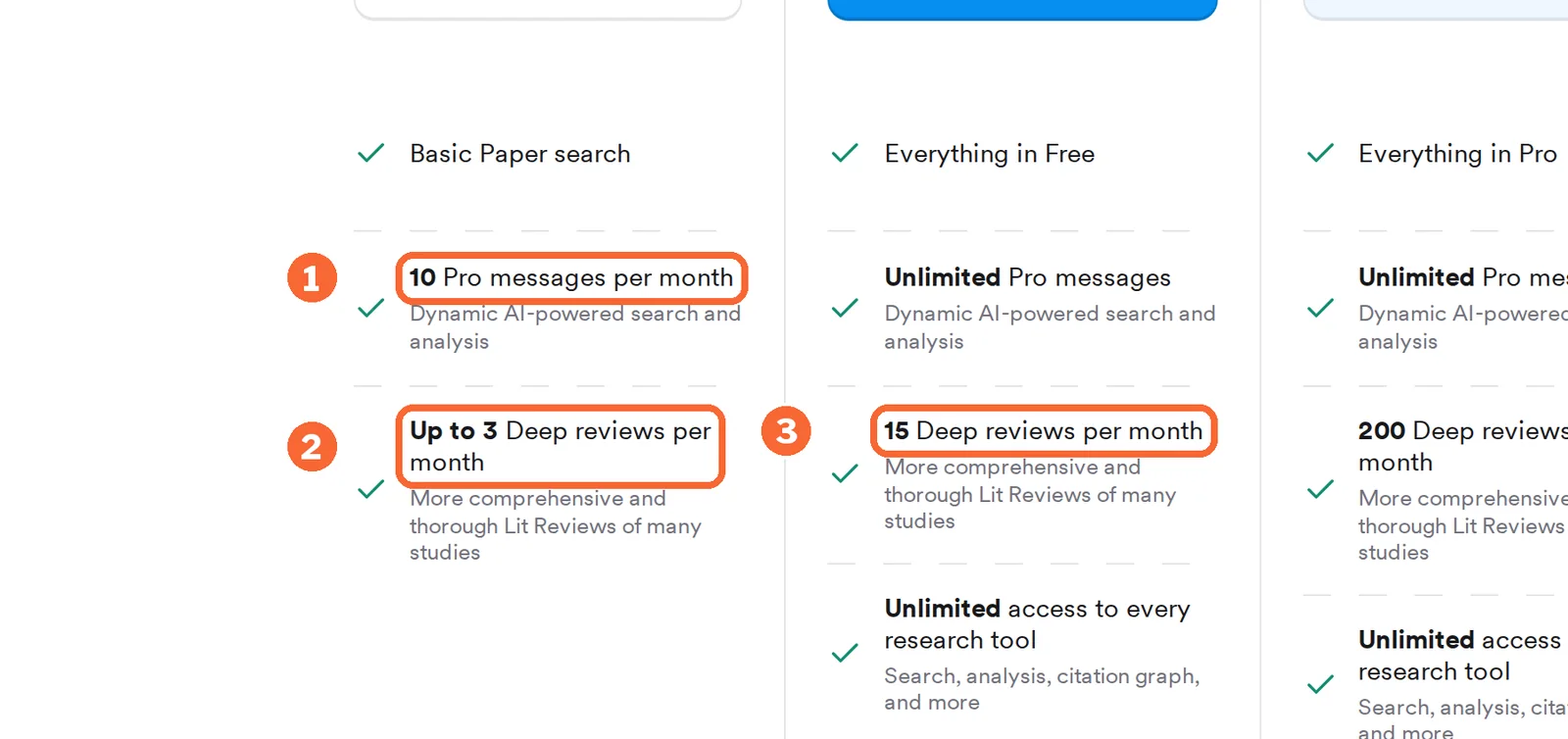
- Elicit Basic has unlimited search, summaries and paper chat, and Research Reports still download as PDF or Word. Consensus Free has unlimited paper search but only limited Pro messages (official counts differ: 10 or 15), up to 3 Deep reviews and 30 API or MCP calls a month. Source: elicit.com
- Worked example
- Assuming one academic user on annual billing, Elicit Academic Plus costs USD 132 a year and Consensus Pro USD 144 a year before any student discount. At 20 Deep reviews a month, Pro's 15 fall short, so Consensus Deep at USD 540 a year becomes the relevant price. Source: consensus.app
- Usage metering
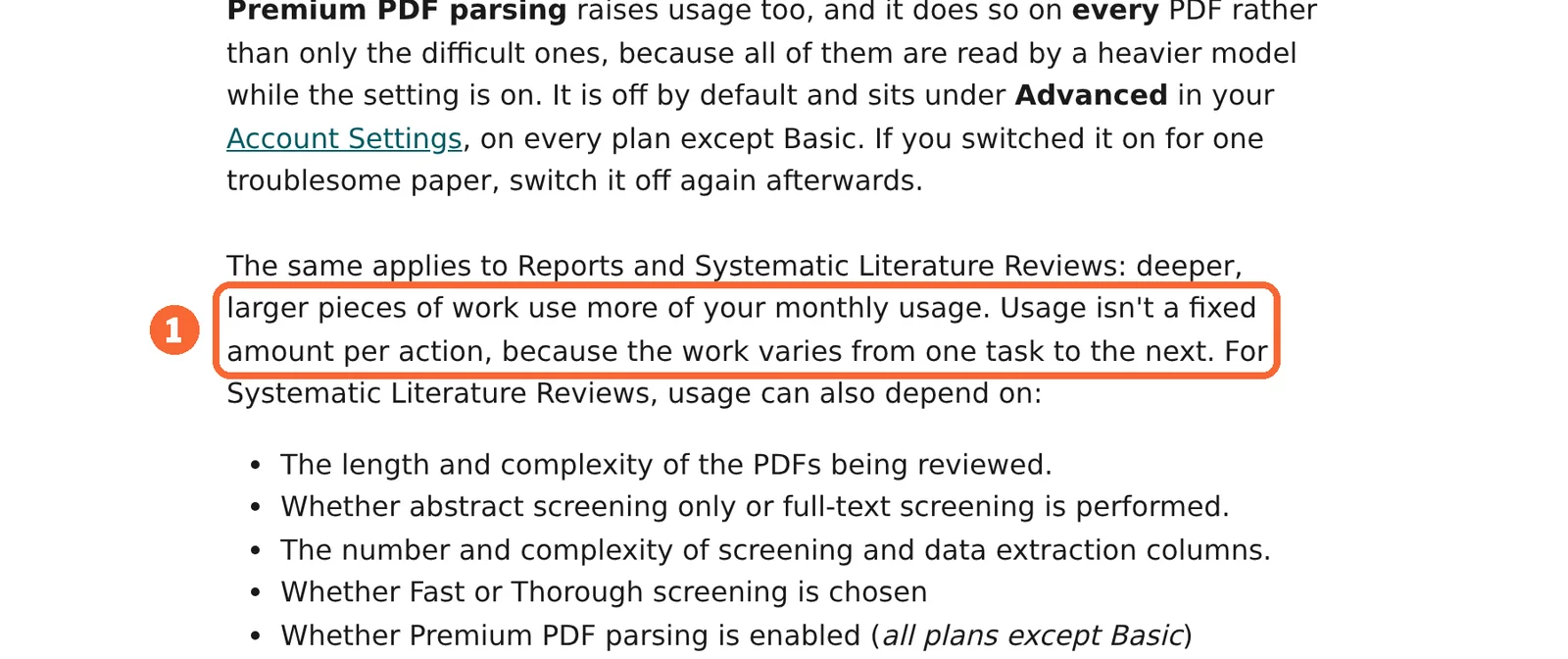
- Elicit states heavy-feature usage as multiples (standard, 5x, 9x) with no fixed count, and Pro or Scale users can cap extra usage with a monthly limit. Consensus publishes counts per plan and bills API or MCP calls past the included amount at USD 0.05 each. Source: support.elicit.com
- Academic versus company pricing
- Elicit charges companies more: Industry Pro is USD 49 per user a month billed annually against USD 39 for Academic Pro, and Plus is sold only at academic prices. Consensus offers up to 40% off to students and faculty with a school email and to US clinicians with an NPI number. Source: support.elicit.com
From a question to an output
In Elicit you define the columns, such as study design, population or outcome, and each cell is filled from the paper. The Systematic Review workflow refines a protocol, combines searches across PubMed, ClinicalTrials.gov and Elicit’s own corpus, then screens and extracts. Research Alerts screen newly published papers against a rubric generated from your question.
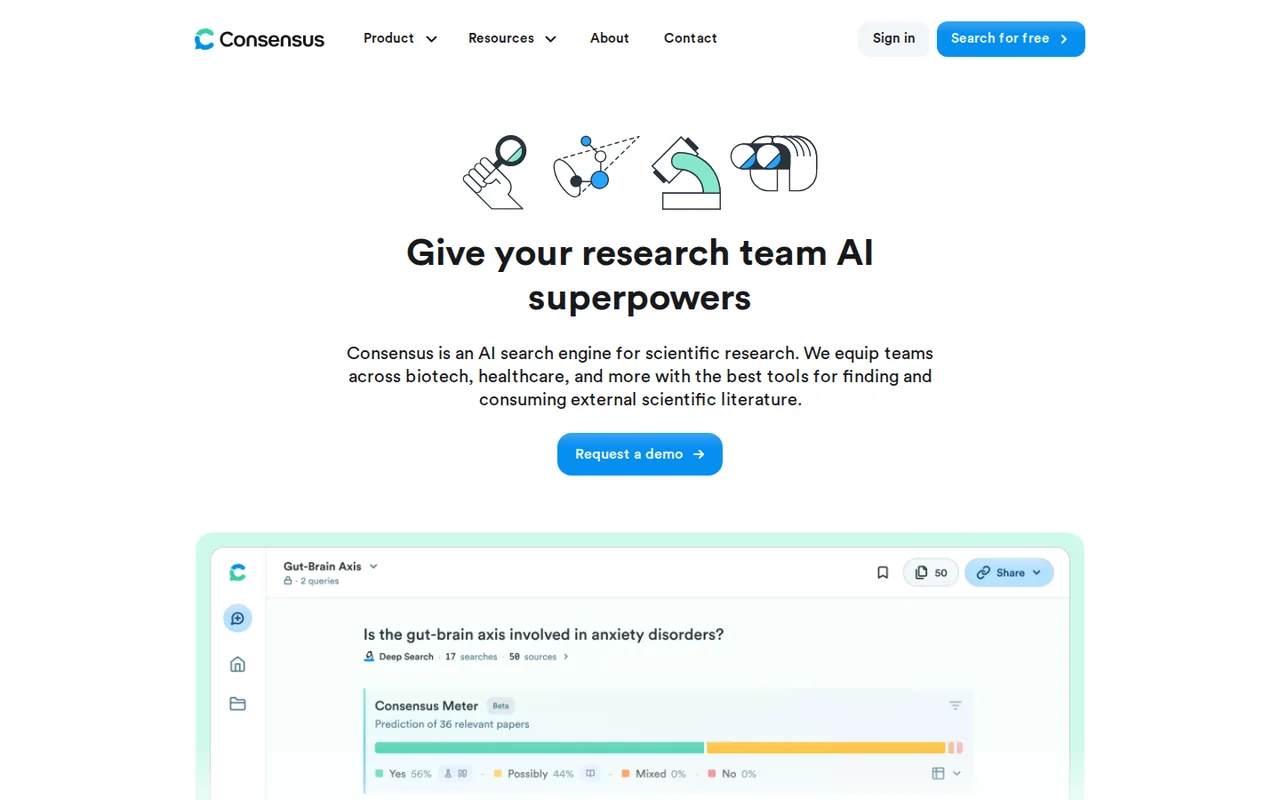
In Consensus you ask a question and narrow the results with filters for year, design, population, sample size, duration, journal rank and preprints. Deep mode splits the question into sub-questions and builds a structured report with interactive visuals; the Research Agent adds DOI look-up and citation-graph traversal, with a trace of each step.
Sources: Elicit systematic reviews, Elicit Alerts, How Consensus works, Consensus Deep review guide.
Feature matrix
In shortSixteen capabilities marked from the two profiles. A dash means the profile does not cover it, not that the tool lacks it.
| Capability |  Elicit |  Consensus |
|---|---|---|
| Finding papers | ||
| Paper search | Offeredmore than 138 million papers; unlimited on Basic | Offeredmore than 220 million peer-reviewed papers; basic search on Free |
| Filters for design, population and sample size | Not listednot covered in the sources checked | Offeredplus journal rank and a preprint switch |
| Clinical-trial search | Partlyfrom Plus | Not listednot covered in the sources checked |
| Agreement meter for yes-or-no questions | Not listednot covered in the sources checked | OfferedConsensus Meter |
| Alerts on newly published papers | Partlyfrom Pro | Not listednot covered in the sources checked |
| Reading and extracting | ||
| Chat with a paper | Offeredaccessible full text, Basic | Not listednot covered in the sources checked |
| Extraction columns with a quote per cell | Offered5, 20 or 30 columns by plan | Not listednot covered in the sources checked |
| Figure extraction | PartlyScale and Enterprise | Not listednot covered in the sources checked |
| Screening with a reason kept per paper | PartlySystematic Review; 5,000 papers on Pro | Not listednot covered in the sources checked |
| Synthesis and output | ||
| Multi-step research agent | Offeredclaims linked to passages | Offeredtrace of each step |
| Structured report | OfferedResearch Reports, PDF or Word on every plan | OfferedDeep reviews: 3, 15 or 200 a month |
| Reference file export | PartlyRIS, CSV or BIB from Plus | OfferedCSV, RIS or APA, MLA and other styles |
| Library, team and access | ||
| Import from Zotero, EndNote or Mendeley | Offeredduplicates flagged | Not listednot covered in the sources checked |
| Real-time team collaboration | PartlyScale | Not listednot covered in the sources checked |
| API | PartlyPro and higher; call allowance not covered in the sources checked | OfferedAPI and MCP: 30, 500 or 2,000 calls a month |
| Single sign-on | PartlyEnterprise, SSO/SAML | Not listednot covered in the sources checked |
offered partly or with limits not listed on the profile.
How far does each plan stretch on one literature review?
In shortElicit’s limits sit in columns, screening capacity and a usage level it states only as a multiple. Consensus counts Deep reviews and API calls. Fit your review to those units before comparing prices.
How each price list steps up
Price per month on yearly billing, from the Elicit profile. Bars compare plans of this tool only.
Price per month on yearly billing, from the Consensus profile. Bars compare plans of this tool only.
Elicit’s bars are its academic prices, which nonprofits can also use. Industry plans keep the same features at a lower usage level; Industry Scale is USD 169 per user a month on annual billing. Consensus bars are its annual-billing prices.
Sources: Elicit pricing, Elicit academic and nonprofit pricing, Consensus pricing.
One review, step by step, against each plan’s limits
In shortAn example review: 3,000 search results, 12 data fields per included study, four new questions a week and a small script. Swap in your own numbers.
| Step | Elicit | Consensus |
|---|---|---|
| Find candidate papers | Basic: unlimited search and summaries | Free: basic paper search |
| Screen 3,000 results, keeping a reason for each exclusion | Pro: the review workflow screens up to 5,000 papers. Plus includes systematic reviews at standard usage; its cap is not covered in the sources checked | A per-paper screening record is not covered in the sources checked; Deep mode screens a pool into one report |
| Screen 12,000 results | Beyond Pro’s 5,000; Enterprise lists up to 40,000. Scale’s cap is not covered in the sources checked | As above |
| Extract 12 fields from each included study | Plus: three passes at 5 columns (5 + 5 + 2). Pro, 20 columns, or Scale, 30: one table | Column extraction is not covered in the sources checked |
| Take the extraction table out | Find Papers and Paper Chat tables from Plus; Systematic Review tables from Pro | Search results as CSV or RIS; the plan is not covered in the sources checked |
| Synthesise four new questions a week, about 17 a month (4 × 30 ÷ 7) | Reports and Research Agent at standard, 5x or 9x usage; no fixed count is published | Free’s 3 and Pro’s 15 fall short; Deep’s 200 cover it |
| A script running 25 searches a day, 750 a month | API from Pro; the call allowance is not covered in the sources checked | Pro: 500 included plus 250 × USD 0.05 = USD 12.50 extra. Deep: inside 2,000 |
Arithmetic on the plan limits on each profile; the record, field, question and call counts are assumptions. Consensus also lists a monthly overage ceiling, up to 1,000 uses on Pro and 10,000 on Deep, without saying whether it includes the calls already in the plan.
For a formal review the binding limit on Elicit is screening capacity and column count, which points to Pro: it is the first plan with a stated screening capacity, and Systematic Review tables export only from Pro. On Consensus the binding limit is the Deep review count: up to 15 Deep reviews a month fit Pro, more need Deep. Elicit states Research Agent and Reports usage only as standard, 5x or 9x, so a heavy month cannot be planned against a fixed number.
Sources: Elicit usage limits, Consensus subscription plans, Consensus Deep review guide.
Monthly or a year upfront
In shortAnnual billing is cheaper over a year, but a review that needs a tier for a few months can cost less on monthly payments.
| Plan | A year, billed annually | Monthly billing | Months after which a year upfront costs less |
|---|---|---|---|
| Elicit Plus, academic | USD 132 | USD 19 | 7 (7 × 19 = 133) |
| Elicit Pro, academic | USD 468 | USD 69 | 7 (7 × 69 = 483) |
| Elicit Pro, industry | USD 588 | USD 75 | 8 (8 × 75 = 600) |
| Consensus Pro | USD 144 | USD 20 | 8 (8 × 20 = 160) |
| Consensus Deep | USD 540 | USD 65 | 9 (9 × 65 = 585) |
Arithmetic on the prices on each profile, before tax and any student or clinician discount. Cancellation and refund terms are not covered in the sources checked.
At the entry tier the two save the same amount: a year of Elicit Plus costs USD 228 on monthly payments against USD 132 upfront, and Consensus Pro USD 240 against USD 144, a USD 96 difference on each.
How do you check what each one cites?
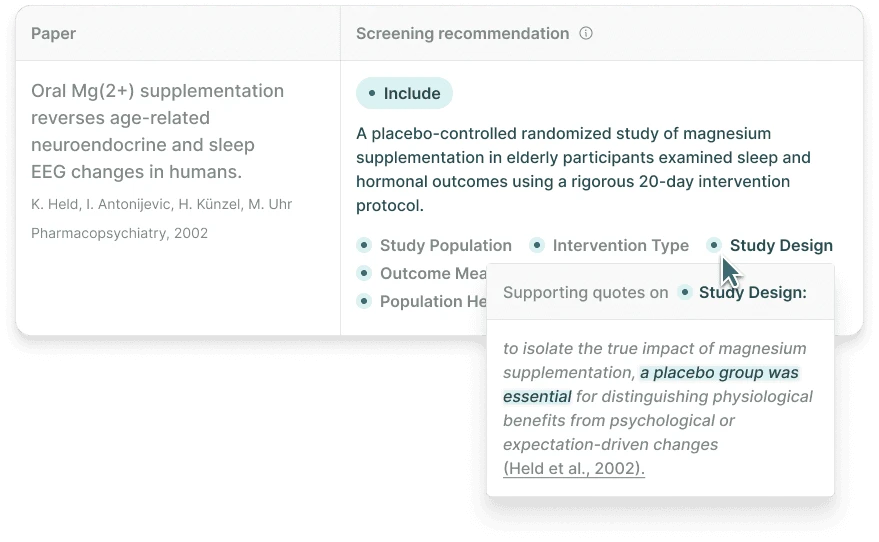
In shortElicit shows the quote it used. Consensus marks whether a citation was read in full or only from the abstract. Both say where that trail can break.
Where the trail to the source thins
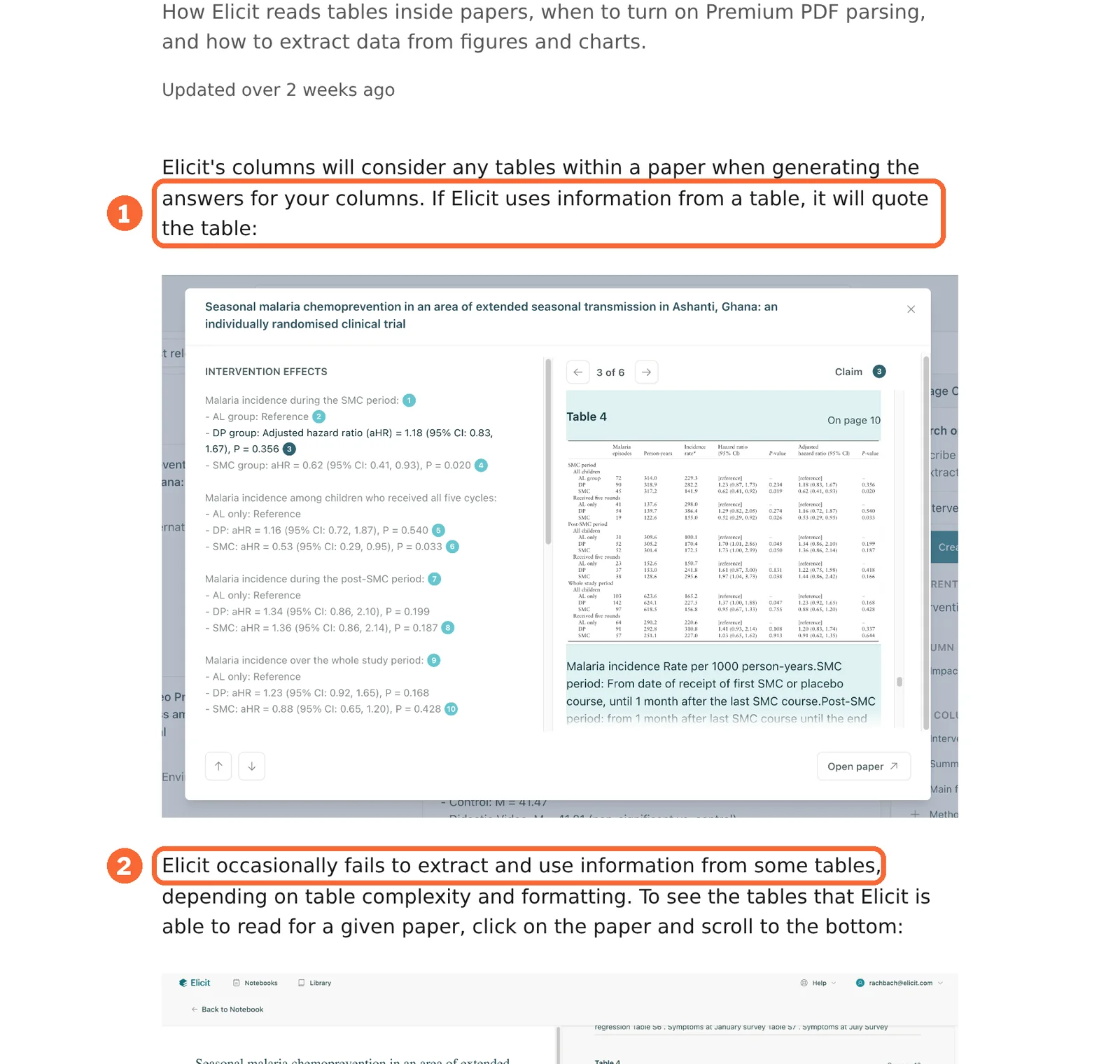
Elicit quotes the passage behind each extracted value, including the table a column answer came from, yet its guide warns that some table layouts are missed or parsed wrongly. Premium PDF parsing copes better with formulae, figures and tables, but it is unavailable on Basic and raises usage on every PDF.
Consensus Deep reports cite fewer papers than they analyze, and where full text was unavailable a cited paper may have been read from its abstract alone, so methods and caveats can be missing.
| Before you cite… | Elicit | Consensus |
|---|---|---|
| A value or claim | Open the quoted passage beside it | Look for the full-text checkmark on the citation |
| A number from a table | Compare it with the table in the PDF; complex layouts can be misread | Not applicable: no column extraction in the sources checked |
| A paper not in English | Expect uneven quality outside English | Language support is not covered in the sources checked |
| A heavily cited study | Not covered in the sources checked | A high citation count is no sign of validity, per the filter guide |
For a step-by-step method, see Check AI research claims against the original source.
Sources: Elicit table and figure extraction, Elicit language support, Consensus Deep review guide, Consensus advanced filters.
Videos, questions and what this page does not judge
Official videos
In shortFrom each vendor’s YouTube channel. They load only when you press play.
Common questions
Which is cheaper, Elicit or Consensus?
On monthly billing the entry tiers sit close together: Elicit Academic Plus at USD 19 per user and Consensus Pro at USD 20. A step up, Elicit Academic Pro costs USD 69 monthly and Consensus Deep USD 65. Company buyers cannot use Plus, so Elicit's first Industry tier is Pro at USD 75 a month, well above Consensus Pro.
What happens when I need more Elicit usage than my plan includes?
Pro and Scale users can set a monthly limit for extra usage. In Elicit's own example with a USD 250 limit, charges arrive in steps of USD 100, USD 100 and then USD 50 as usage grows, and work that needs more stops until the next reset. Without a limit you stay within the plan's pooled allowance.
Can a lab or department share one plan?
Elicit Scale pools monthly usage across the team, so four members get four times an individual allowance, and each added seat raises the pool even before anyone joins. Consensus sells Pro and Deep directly to small teams and quotes licences above 200 users through sales, with an API service for enterprise applications mentioned on its research-organizations page.
Which suits clinical or medical questions?
Elicit adds clinical-trial search from Plus, and its review workflow can pull records from PubMed and ClinicalTrials.gov next to its own corpus. Consensus can restrict results to human studies and by sample size or duration, and its Deep plan is pitched at frequent reviews, with a discount of up to 40% for US healthcare professionals holding an NPI number.
What does API access cost beyond the included calls?
Consensus keeps paid plans running past the included calls at USD 0.05 per use, up to a monthly ceiling of 1,000 uses on Pro and 10,000 on Deep, and the API and MCP server draw on one shared allowance. Elicit lists API access as a feature of Pro and higher plans, so for developers its entry cost is a Pro seat at the academic or industry price.
What this page does not judge
Pages ranking for this comparison also rank answer accuracy, how well each index covers a field, summary quality, speed, ease of learning and audio or video support. That needs hands-on runs on the same questions, which neither profile holds, so none of it is ranked here; help with writing the paper is outside both profiles. The check below measures accuracy and coverage on your own topic.
Pick one published systematic review in your field and keep its list of included studies. Ask its question in both tools and count how many of those studies appear in the first 20 results. Extract sample size and outcome into Elicit columns and compare them with the review’s own table, then count how many citations in one Consensus Deep report carry the full-text checkmark.
How this comparison was made
Plans, limits and export terms come from the Elicit and Consensus profiles on this site, which cite the vendors’ pricing and help pages and carry their own check dates; tables marked as live are read from those profiles each time the page loads. Sections follow the topics the pages ranking for this search cover, limited to what the vendors document. No rating is given and no price is converted. See our editorial policy.