
Key features
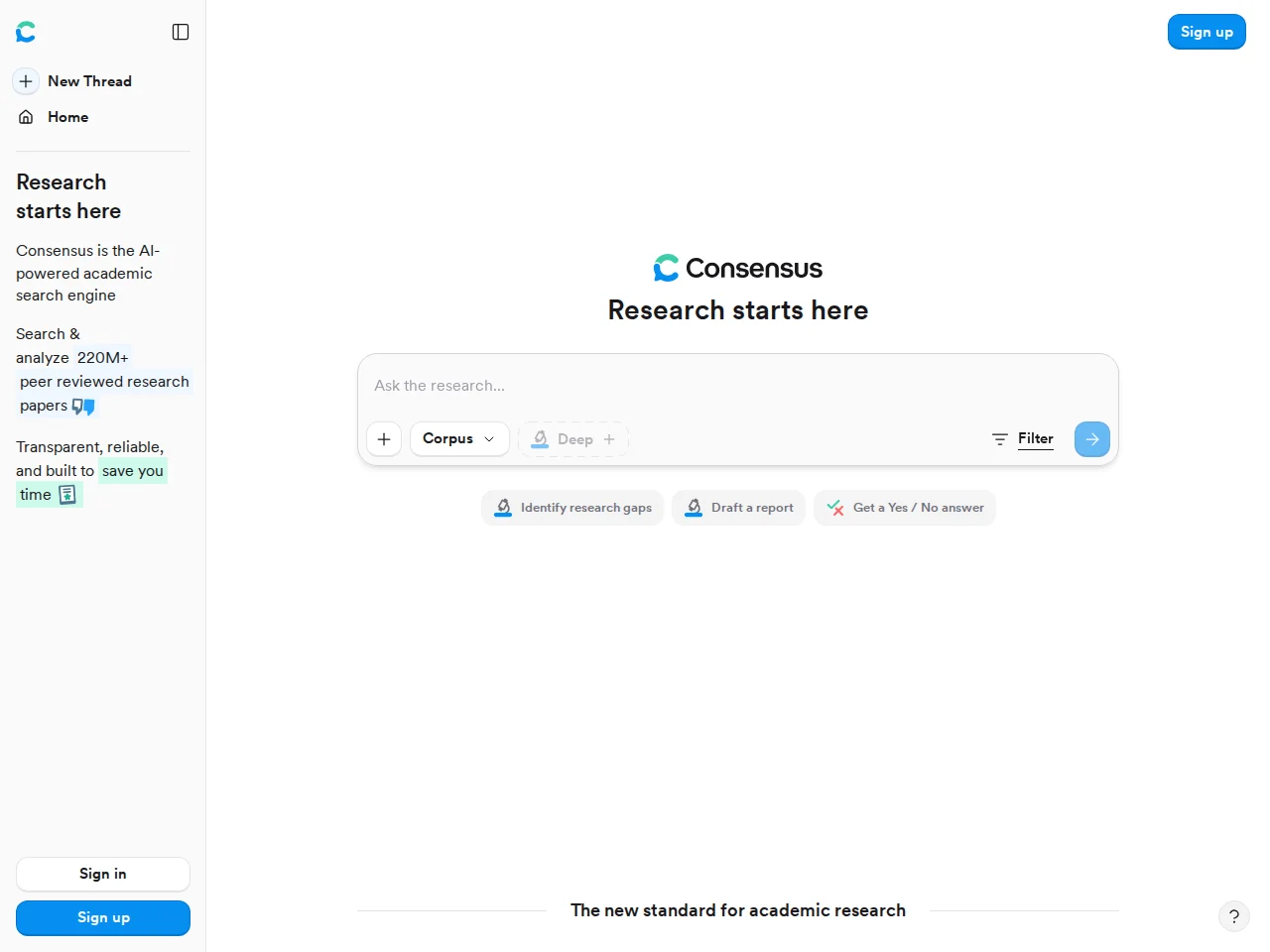
- Research paper searchSearch research papers using questions, keywords and other query forms.
- Deep research reportsUse Deep mode for a structured synthesis of relevant papers, subject to plan allowances.
Breaks a question into sub-questions and screens a large pool of papers to build a structured report with interactive visuals.
Falls short Reports cite fewer papers than they analyze, and a citation without a checkmark was read from the abstract only.
- Study filtersNarrow results by publication date, study design, population and other criteria, including preprint exclusion.
Filters cover publication year, open access, citation count, SJR journal rank, study design, human or animal population, sample size, duration, publisher, field, country and preprint exclusion.
Falls short The filter guide warns that a high citation count is no sign of validity, so filters narrow results without appraising each study.
- Saved research collectionsOrganize saved papers in My Library collections.
- Research exportsExport search references or download a Deep report; the formats differ by output type.
Search results export as CSV, RIS or a bibliography in APA, MLA, Chicago, Harvard, BibTeX or AMA/Numeric; Deep reports can be copied with citations or exported as PDF.
Falls short Search results and Deep reports use different export paths, so a reference file and a formatted report need separate exports.
- Research AgentPlan and run multi-step research tasks using semantic search, paper search, DOI look-up and citation graph traversal, with a trace of each step.
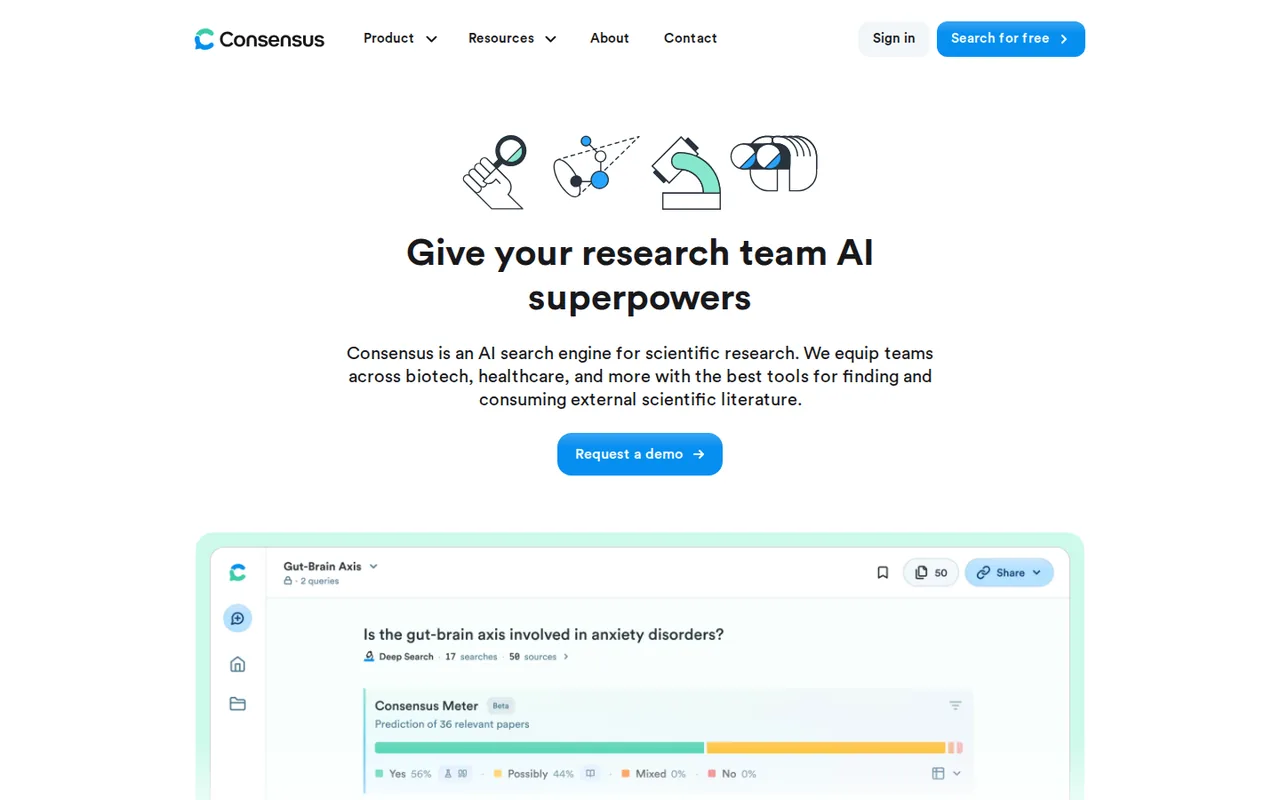
- Consensus MeterVisualize the level of agreement or disagreement in the literature for yes-or-no questions.
- API and MCP accessCall Consensus paper search from your own software, with a monthly allowance of calls included on each plan.
The API and MCP expose plain-language search, and the September 2026 announcement lists full-text querying through publisher partnerships and study metadata such as DOI, study design and journal rank on every paid plan.
Falls short Included calls are capped per plan (30 on Free, 500 on Pro, 2,000 on Deep per month), and extra use is billed at USD 0.05 each.
Strengths and limits
Strengths
- Large research index: Answers draw on a search of more than 220 million peer-reviewed papers, per the pricing page.
- Fine-grained study filters: Filters for study design, population, sample size and journal rank, plus a preprint switch, narrow results before you read.
- Reference-manager exports: Search results export to CSV, RIS or formatted bibliographies, and Deep reports export to PDF.
- Low entry price: Paper search costs nothing, and Pro, the cheapest paid tier, unlocks unlimited AI answers.
More limits to plan around
- Metered API overage: API and MCP use past the included amount is charged per use, with a monthly ceiling on each paid plan.
Who else is it for?
Editorial assessment, based on documented features
- Clinicians keeping up with evidenceThe Deep plan is aimed at frequent literature reviews, and US healthcare professionals with an NPI number qualify for a discount.
- Developers building research toolsUse the API and MCP when you need paper search inside your own software; estimate monthly calls first.
- Institutions with more than 200 usersTake the Enterprise route for a sitewide or large-team license and get terms in writing.
How much does Consensus cost?
Prices confirmed · checked
Prices are in US dollars. Annual billing saves 40%: USD 96 a year on Pro and USD 240 on Deep compared with paying monthly. Students and faculty with a school email, and US healthcare professionals with an NPI number, can get up to 40% off. Extra API and MCP use costs USD 0.05 each; the pricing page adds "up to 1,000 per month" on Pro and "up to 10,000" on Deep without saying whether that ceiling includes the 500 or 2,000 included uses.
Free
Free
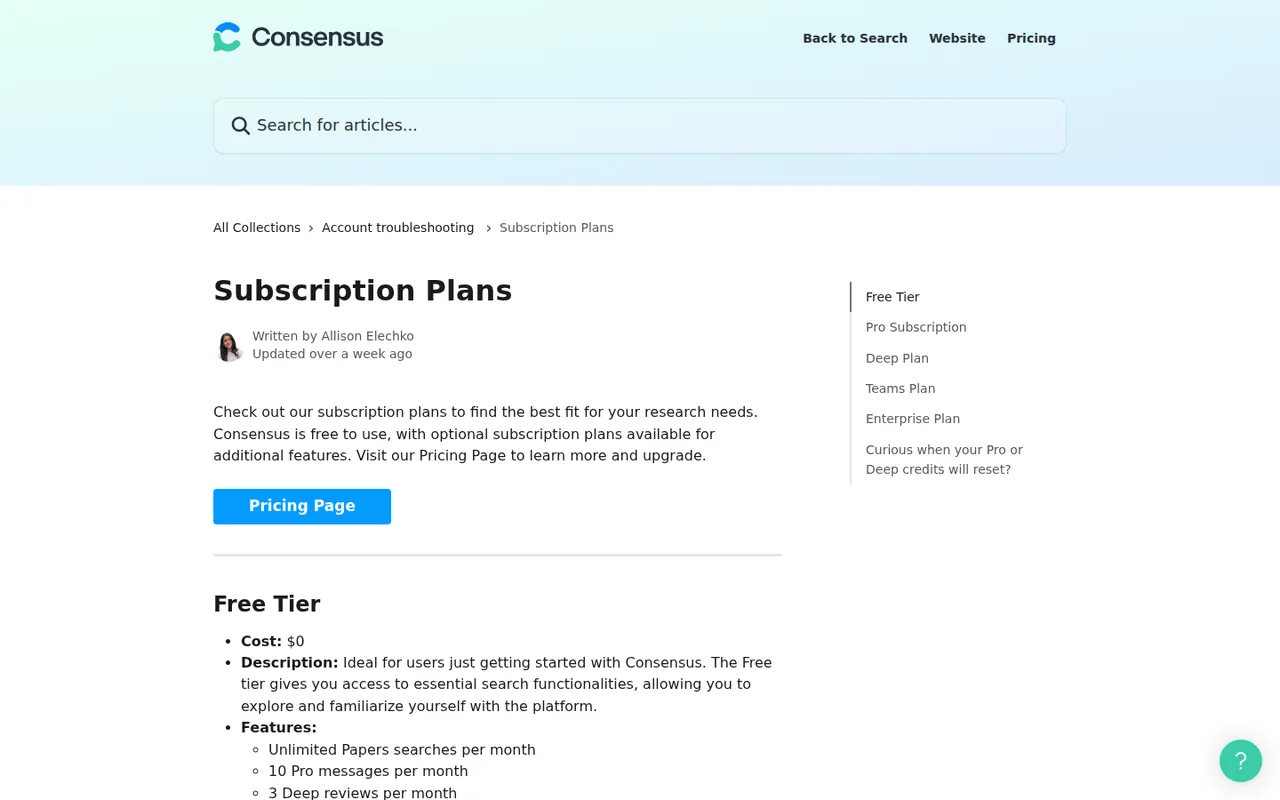
Basic paper search with 10 Pro messages, up to 3 Deep reviews, 10 Study Snapshots and 30 API and MCP calls a month.
Pro (annual)
USD 12/monthbilled annually · USD 144 a year
Unlimited Pro messages and Study Snapshots, 15 Deep reviews and 500 API and MCP uses a month.
Pro (monthly)
USD 20/monthbilled monthly
Same allowances as annual Pro.
Deep (annual)
USD 45/monthbilled annually · USD 540 a year
Everything in Pro with 200 Deep reviews and 2,000 API and MCP uses a month.
Deep (monthly)
USD 65/monthbilled monthly
Same allowances as annual Deep.
Team and Enterprise
Contact sales
Prices on request from sales; smaller teams can buy Pro or Deep directly.
How far does it go?
- Cost per Deep review on annual plansPro gives 15 Deep reviews a month, 180 a year, so USD 144 works out to about USD 0.80 per review if every one is used; Deep gives 2,400 a year for USD 540, about USD 0.23 each. This counts Deep reviews only and ignores other features.
- A developer making 800 API calls a month on Pro800 calls minus the 500 included leaves 300 paid uses at USD 0.05, about USD 15 a month on top of the plan.
Arithmetic from the published allowances above, not a usage test.
Taxes, currency and promotions can change the price you see at checkout.
Which Consensus plan fits your research load?
Editorial assessment
The choice turns on how many Deep reviews you run each month, because paper search itself is unlimited on every individual plan. Chat-style Pro messages are the second limit, and API use the third. Sources: Consensus pricing; Subscription plans.
- Stay on Free if you mainly search for papers and need no more than a handful of AI answers and up to three literature reviews a month.
- Move to Pro once you ask follow-up questions daily or need between four and fifteen Deep reviews a month; annual billing brings it to USD 12 a month.
- Choose Deep if you run a literature review most working days: its allowance is more than thirteen times Pro’s for less than four times the annual price.
- Talk to sales when a university, hospital or company needs one license for a whole organization.
- Use a source-based notebook instead, such as Gemini Notebook (formerly NotebookLM), if you already hold a fixed set of documents and only need answers from them.
How does a Deep review pick and cite papers?
A Deep review splits your question into sub-questions, runs up to 20 targeted searches and screens over 1,000 papers. It typically analyzes up to 50 of them, and up to 100 when a larger set would improve the answer. General questions tend to produce a structured literature review, while specific prompts may return a comparison, critique, reading list or evidence map.
The final report cites only a selection of the papers it analyzed, so the reference list is shorter than the reading list behind it. Search itself is grounded in research papers, and full text contributes when it is available. Sources: Deep review guide; How Consensus works.
Continue reading · 3 more sectionsShow lessHow can you narrow a search before relying on it? · Can you use Consensus results in other tools? · What should a trial run measure?
How can you narrow a search before relying on it?
Filters include publication date, open access, study design and population, and a switch excludes preprints so unpublished manuscripts drop out. Citation counts show influence, not whether a finding holds up. For a formal evidence review you still need a written search strategy, inclusion decisions and an audit trail outside the tool.
Can you use Consensus results in other tools?
Consensus said in September 2026 that its API and MCP server are live for all users, with requests included on every plan and a per-request charge beyond that. The same update lets you share libraries with colleagues and upload grants, manuscripts and book chapters. Sources: Summer 2026 product update; Consensus pricing.
What should a trial run measure?
Proposed evaluation · not performed yet
Prepare five narrow, non-sensitive research questions with known reference papers. Record retrieved studies, missed references, contradictory results and whether each citation supports the claim beside it. Repeat with one filter changed, so coverage is judged rather than writing style.
Consensus alternatives
Other research & sources tools profiled with the same source-checked method. Pick by the job, not by a score.
| Tool | Free access | Paid plans from | Consider it for |
|---|---|---|---|
| ConsensusThis profile | Free access available | USD 12/month | Finding and synthesizing published research |
| Gemini Notebook | Free access available | USD 4.99 per month | Cited answers from your own documents |
| Elicit | Free access available | USD 49 per user per month | Extracting study data from research papers |
| Perplexity | Free access available | USD 17 per month | Web research with linked sources |


Consensus user reviews
Visitor opinions, moderated before publishing. Separate from our source checks; we do not score tools.
Frequently asked questions
Is there a student or clinician discount?
Yes. The pricing page offers up to 40% off a subscription to students and faculty who sign up with a valid school email address, and to US healthcare professionals with a valid NPI number. The discount is claimed through a separate link on the pricing page, so check the final amount at checkout before paying.
How many free Pro messages do I get?
The pricing page and the subscription guide list 10 Pro messages a month on Free. The Deep review guide gives 15 instead and adds that each Free Deep review uses one Pro message, so three Free reviews leave fewer messages for chat. Your usage and reset date appear under Settings, Subscription.
Does a citation mean the full paper was read?
Not always. In a Deep report, a checkmark next to a citation means the full text was used; a citation without it was analyzed from the abstract only. An abstract can omit methods, sample details and qualifications, so open the paper before carrying a precise number or claim into your own work.
What happens when I use up the API allowance?
Paid plans keep working past the included calls at USD 0.05 per use. The pricing page sets a monthly ceiling of 1,000 uses on Pro and 10,000 on Deep; see the plan note on how it relates to the included uses. Free accounts get 30 calls a month. The per-plan limits apply to both the API and the MCP server, which share one allowance.
Can a whole department or company buy Consensus?
Yes. Small teams can buy the individual plans directly, while larger organizations above the 200-user mark contact Consensus for a license, and the research-organizations page also mentions an API service for plugging Consensus into enterprise applications. Team prices are not shown on the public pricing page.
How we checked this profile
58 details on this page were checked against Consensus's own pages and help documentation (Sep 23–24, 2026). 1 is still open and listed below.
See the checks by section47 documented10 editorial assessment1 open
Still open
- The Deep review guide gives Free 15 Pro messages a month, not the 10 on the pricing page.Not confirmed · checked · Source (opens in a new tab)
Sources for this profile
- Consensus pricingconsensus.app
- How Consensus workshelp.consensus.app
- Subscription planshelp.consensus.app
- Deep review guidehelp.consensus.app
All 8 sources
Help-center articles, the pricing page, the summer 2026 product update and the research-organizations page were read. Monthly Pro and Deep prices come from the subscription guide; annual prices, discounts and API overage rates come from the pricing page. No searches were run in the product.
Sources checked Sep 23–24, 2026. We read the vendor's documentation; we did not test the product or score it. Found something out of date? See how we correct profiles.


