
What is Undermind, in short?
Updated October 11, 2026 · By Elias Brandt · Documentation review, not tested hands-on
Pros
- Free plan with agent access
- Coverage is reported
- Full-text search on Pro
- Works inside Claude and ChatGPT
Cons
- Unnumbered limits
- Single source database
- No refunds
- Unclear Academic eligibility
- Outputs must be verified
Best forResearchers looking for papers on a narrow questionPeople who already work in Claude or ChatGPTNot for anyone needing a number of free searches up frontNot for decisions that need guaranteed accuracy
Strengths, limits and who it suits, in full
Strengths
- Free plan with agent access The pricing section lists agent connections and shared workspaces at $0, with abstracts and metadata searched.
- Coverage is reported The provider says the report summary states when a search has probably not found everything, so you can extend it.
- Full-text search on Pro The FAQ says Pro adds search of the full texts of nearly all open-access and preprint papers.
- Works inside Claude and ChatGPT An MCP server exposes search, PDF reading and notes to agents you already use.
Limits
- Unnumbered limits Free has standard rate limits and Pro 10x higher limits, but no page gives the base numbers.
- Single source database Search draws on Semantic Scholar; the FAQ says a specific paper may not be in it.
- No refunds The refund policy calls charges non-refundable once a billing period has begun, except where required by law.
- Unclear Academic eligibility The pricing tabs show Academic and Industry prices, but no page checked says how Academic status is determined.
- Outputs must be verified The terms say content may be inaccurate or incomplete and that you must verify it before relying on it.
Who it suits
- Researchers looking for papers on a narrow question a staged search that follows citations suits a topic where keyword search keeps missing papers.
- People who already work in Claude or ChatGPT the MCP server lets those agents run the search and read PDFs.
- Not for anyone needing a number of free searches up front No page checked gives the Free plan's rate limits.
- Not for decisions that need guaranteed accuracy The terms rule out reliance for medical, legal, financial or regulatory decisions.
How much does Undermind cost?
Prices confirmed · checked
Regional prices: Prices are in USD as shown on the pricing section on 11 Oct 2026; the pages do not list tax or the total charged for annual billing, and the annual Academic Team figure for monthly billing is printed as $18.7.
The same page changes prices with the Industry or Academic tab and the monthly or annual switch, and the pages do not say how Academic status is checked. The pricing page also lists per-seat prices that fall at larger seat counts, without saying which audience or billing period the list refers to. Pro shows a Try for Free button, but no page checked states a trial length; the terms say a free trial converts to paid unless cancelled before it ends. The terms say paid subscriptions renew automatically and the refund policy says charges are non-refundable once a billing period has begun.
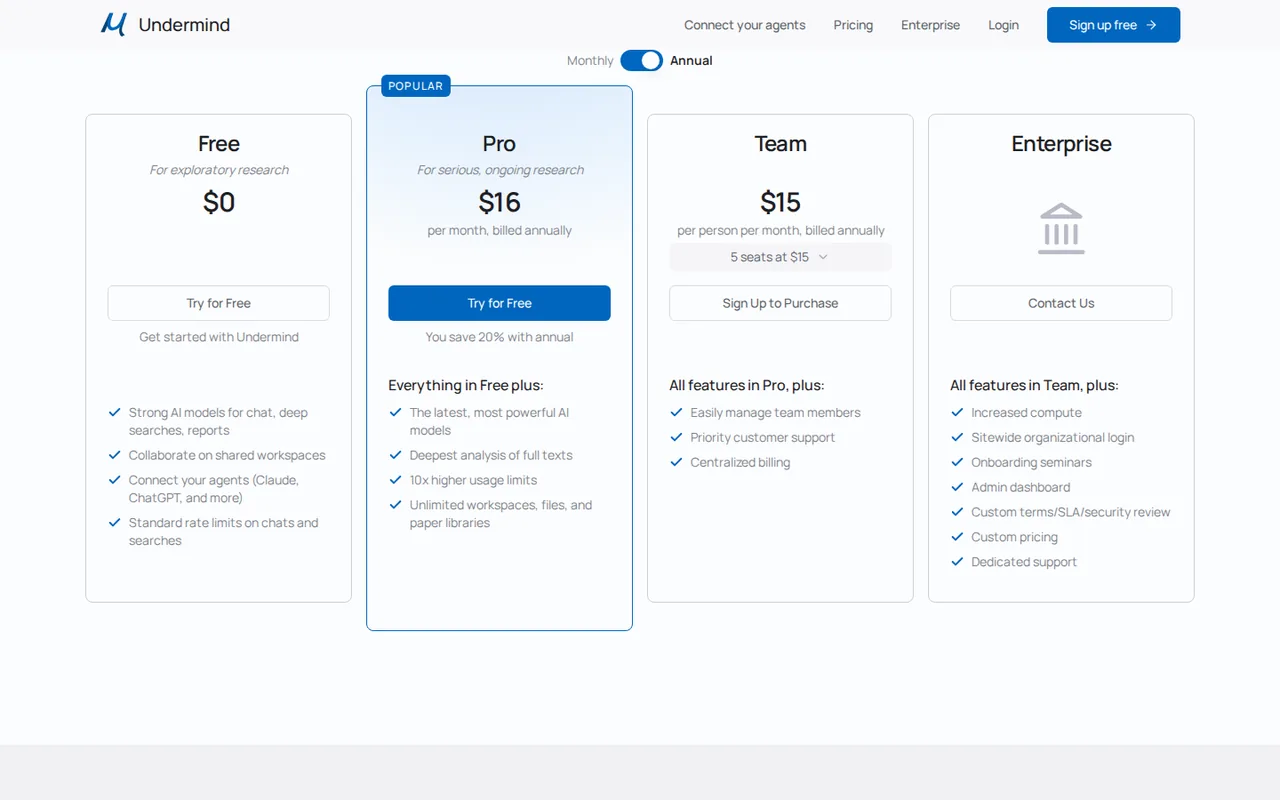
| Plan | Price | What you get |
|---|---|---|
| Free | $0 sourceFrom undermind.ai, checked Oct 11, 2026 (opens in a new tab) | Strong AI models for chat, deep searches and reports; shared workspaces; connect agents (Claude, ChatGPT and more); standard rate limits (not quantified); abstracts and metadata searched. |
| Pro (Academic) | $20 per monthor $16 per month billed annually sourceFrom undermind.ai, checked Oct 11, 2026 (opens in a new tab) | Latest AI models, deepest analysis of full texts, 10x higher usage limits, unlimited workspaces, files and paper libraries; full-text search of open-access and preprint papers. |
| Pro (Industry) | $75 per monthor $60 per month billed annually sourceFrom undermind.ai, checked Oct 11, 2026 (opens in a new tab) | Same features as Pro (Academic), shown on the Industry tab. |
| Team (Academic) | $18.70 per person per monthor $15 per person per month billed annually sourceFrom undermind.ai, checked Oct 11, 2026 (opens in a new tab) | All Pro features plus team management, priority support and centralized billing; the selector starts at 5 seats. |
| Team (Industry) | $75 per person per monthor $60 per person per month billed annually sourceFrom undermind.ai, checked Oct 11, 2026 (opens in a new tab) | Same Team features, shown on the Industry tab. |
| Enterprise | Custom | All Team features plus increased compute, sitewide organizational login, onboarding seminars, admin dashboard, custom terms, SLA or security review; contact sales. |
How far does it go?
- What annual billing saves on ProAcademic Pro is $20 a month or $16 a month billed annually; across 12 months that is $240 against $192, a difference of $48, or 20%. Industry Pro is $75 against $60 a month, $900 against $720 over 12 months, a difference of $180, also 20%. Arithmetic on the published monthly figures, not a statement by Undermind: the pages do not print the annual total, and charges are non-refundable once a billing period begins.
Arithmetic from the published allowances above, not a usage test.
Taxes, currency and promotions can change the price you see at checkout.
Try Undermind free (opens in a new tab)
Key features
| Feature | What it does | Watch out |
|---|---|---|
| Staged deep search from a plain-language research goal, with follow-up questions and citation trails (homepage) | — | |
| Coverage of the Semantic Scholar database of over 200 million articles, including PubMed and arXiv (FAQ) | — | |
| Full-text search of nearly all open-access and preprint articles on Pro; Free searches abstracts and metadata (FAQ) | — | |
| Reports where each statement links back to a source paper, plus relevance sorting and filtering (homepage) | — | |
| Alerts that notify you when relevant papers are published (homepage) | — | |
| MCP server for Claude, ChatGPT and other agents, with tools for deep search, PDF reading and workspace notes (MCP page) | Core tools launch a deep search, search papers, read full-text PDFs and write cited notes that stay in the workspace across sessions. | Open-access PDFs are fetched automatically; paywalled PDFs can be read only after you upload them to the workspace. |
| Search that reports its own coverage | A search runs in stages and the provider says it statistically models how many relevant papers it has likely found; the report summary says when it has not converged. | You can extend the search with more compute; the whitepaper explains the method, which we did not review. |
What does Undermind do differently from a paper search box?
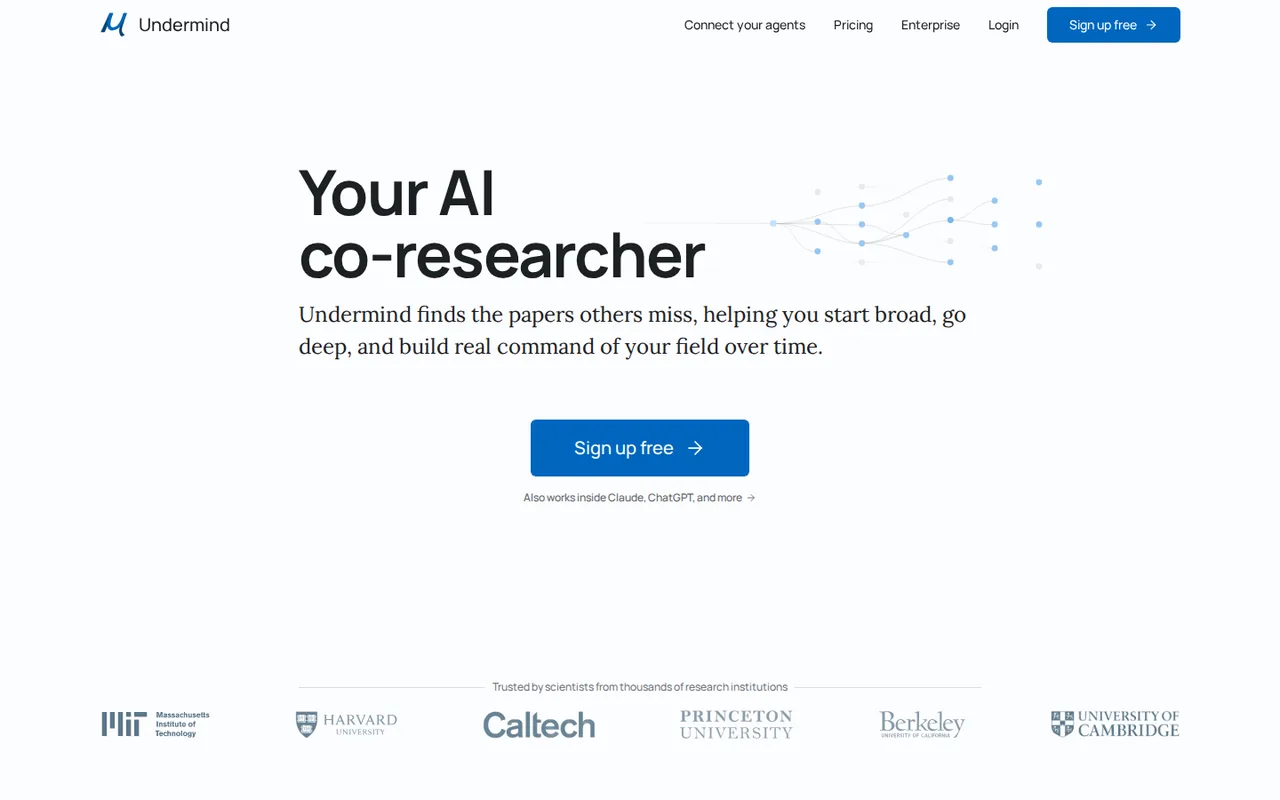
The homepage describes a four-step flow: you describe the research goal, Undermind asks follow-up questions, searches the literature while following citation trails, and then lets you iterate on reports and open full texts. The FAQ puts a typical search at about 2 minutes, because it works in stages rather than returning one ranked list, and says the report summary will tell you when the search has probably not found everything yet so you can extend it with more compute.
The source is the Semantic Scholar database of over 200 million articles. If a specific paper is not in that database it will not appear, whatever the search does.
What does Free leave out?
Depth, mainly. The FAQ says the Free tier searches abstracts and metadata, and that Pro adds compute to search the full texts of nearly all open-access and preprint articles. The pricing section lists the same AI models for chat, deep searches and reports on Free, then adds “the latest, most powerful AI models”, deeper full-text analysis, 10x higher usage limits and unlimited workspaces and paper libraries to Pro. No page gives a number for Free’s “standard rate limits”, so how many deep searches a free account gets is unknown.
Which price applies to you?
The pricing section has separate Industry and Academic tabs and a monthly or annual switch, and the Pro price changes with each. Industry Pro is $75 monthly or $60 a month billed annually; Academic Pro is $20 monthly or $16 a month billed annually. The pricing page and homepage do not say how Academic status is checked, so confirm eligibility before paying. Team is per person and Enterprise is custom, with the terms noting that organisations may be under a separate written agreement.
Can agents like Claude or ChatGPT use it?
Yes. The MCP page lists tools that launch a deep search, search papers by author, journal or year, read full-text PDFs in parallel, and write cited Markdown notes into your workspace. Open-access PDFs are fetched automatically; paywalled ones must be uploaded first. Because the terms make you responsible for having the right to upload or retrieve content through your own subscriptions, that upload step is a licensing decision for you, not a setting.
How far can you trust the benchmark?
The homepage benchmark compares Undermind with three agentic web-search setups on 23 research goals drawn from its own users’ queries, and reports 85% of the 20 key papers found at 10 minutes against 50%, 47% and 43%. The vendor ran and described it, and we did not reproduce it. Its own terms also say outputs may be inaccurate and must be verified before reliance, so treat the ranked list as a starting set to check, not a complete record. See the refund policy before buying: charges are non-refundable once a billing period begins.
How could you check Undermind before paying?
Proposed evaluation · not performed yet
Test whether a free search finds papers you already know on a narrow topic.
- Pick a research question in a field you know and list five relevant papers, at least two of them open-access and two older than five years.
- Describe the question in plain language on a free account and let the deep search finish; note how long it takes and whether the report summary says the search has converged.
- Check which of your five papers appear, and whether each cited statement links to the paper it claims to come from.
- Count how many deep searches the free account allows before it stops, since no page publishes the limit.
- Note whether the results mention full-text details, which the FAQ says Free does not search.
Accept if at least four of the five known papers appear and the cited statements trace back to the right sources. Reject if known papers are missing without the summary saying the search is incomplete. No result is recorded here.
Undermind alternatives
Other research & sources tools checked with the same method. Pick by the job, not by a score.

Comparing AI model answers by voting, without a paid plan

Finding and synthesizing published research

Extracting study data from research papers

K-12 schools piloting an AI tutor that teachers can monitor

Quick cited answers and page summaries for study questions

Web research with linked sources

Checking whether a startup idea has demand and room before building it

Widening a literature review from a few known papers through citations and co-authors
Used Undermind? Write the first review. Visitor opinions are moderated and kept separate from our source checks.
Frequently asked questions
Is Undermind free?
Yes, with limits. The Free plan costs $0 and includes the AI models for chat, deep searches and reports, shared workspaces and agent connections, but the FAQ says the Free tier searches abstracts and metadata only, and rate limits are called standard without numbers. Pro adds full-text search of nearly all open-access and preprint papers.
How much does Undermind cost?
Pro is $20 a month, or $16 a month billed annually, on the Academic tab, and $75 a month, or $60 billed annually, on the Industry tab. Team is priced per person at $18.70 or $15 (Academic) and $75 or $60 (Industry) per month, shown from 5 seats. Enterprise is custom. The pages do not say who qualifies for Academic pricing.
Does Undermind work inside Claude or ChatGPT?
Yes. Undermind runs an MCP server, so Claude, ChatGPT and other agents can launch deep searches, read PDFs and write notes in your workspace. Free includes agent connections, per the pricing page. Cards with ranked papers render in agents that support MCP Apps; others get the papers as text with links.
Which papers does Undermind search?
It draws on the Semantic Scholar database of over 200 million articles, which covers sources such as PubMed and arXiv. The FAQ warns that a specific paper may be missing, and that a search that has not converged will say so in its report summary so you can extend it.
Can I get a refund on a paid plan?
Generally no. The refund policy calls charges non-refundable once a billing period has begun, except where required by law or for a billing error reported to support. You can cancel from account settings and keep access until the period ends.
Sources and method6 official sources · 15 details checked · Oct 11, 2026
How we checked this profile
15 details on this page were checked against Undermind's own pages and help documentation (Oct 11, 2026). 1 is still open and listed below.
See the checks by section14 documented1 open
| Section | Checks | Last checked | Sources |
|---|---|---|---|
| Article text | 2 documented | undermind.ai | |
| Features | 2 documented | undermind.ai | |
| Plans and prices | 6 documented 1 open | undermind.ai | |
| Platforms and integrations | 1 documented | undermind.ai/mcp | |
| Strengths and limits | 2 documented | undermind.ai/refundundermind.ai/terms | |
| Questions | 1 documented | undermind.ai/privacy |
Still open
- The page shows a Pro Try for Free button but no page checked states the length or terms of any free trial.Not confirmed · checked · Source (opens in a new tab)
Sources for this profile
- Undermind homepage, pricing section, benchmark and FAQundermind.ai
- Pricing page (team seat selector)undermind.ai
- Connect your agents (MCP) pageundermind.ai
- Terms of Use, version 1.3, revised July 31, 2026undermind.ai
All 6 sources
Official pages read on 11 Oct 2026: homepage with pricing section, benchmark and FAQ, pricing page, MCP page, Terms of Use version 1.3, Privacy Policy and Refund & Cancellation Policy. The pricing section renders in the browser, so it was read with a headless browser in both the Academic and Industry tabs and both billing views. We did not create an account or run a search. The benchmark and the 10x comparison with Google Scholar are the provider's own claims; the benchmark figures are reported as described on the page and not reproduced. The privacy policy and terms do not state separately whether individual users' content is used to train models; the no-training statement is in the enterprise section. The whitepaper and the GSK case study were not reviewed. Third-party reviews, prices and limits were not used.
Sources checked Oct 11, 2026. Found something out of date? See how we correct profiles.