
What is ResearchRabbit, in short?
Updated October 24, 2026 · By Elias Brandt · Documentation review, not tested hands-on
Pros
- Unlimited searches on Free
- Stated data stance
- Standard exports
- Country pricing
Cons
- Metadata-only coverage
- One-way Zotero link
- Monthly price stated two ways
- No refund terms
- No reading or summaries
Best forStudents starting a literature review from a few known papersResearchers checking a large review for gapsSupervisors and lab groupsNot for questions about what papers sayNot for literature without open metadata
Strengths, limits and who it suits, in full
Strengths
- Unlimited searches on Free Searches, the library and collections are unlimited at $0; the limit is the number of seeds per search.
- Stated data stance The help center says ResearchRabbit does not sell articles or notes and does not train AI models on them.
- Standard exports Collections export to BibTeX, RIS or CSV, so a reference manager can take them over.
- Country pricing More than 100 countries get an RR+ discount code in the upgrade menu.
Limits
- Metadata-only coverage Only articles with open access metadata can be indexed, so some papers, citations and references are missing.
- One-way Zotero link Zotero collections import, but papers go back only as a BibTeX export; two-way sync is still in development.
- Monthly price stated two ways The pricing FAQ calls $10 a month the default price, while the plan card shows $12.50 for monthly billing and $10 a month only on the annual plan.
- No refund terms The terms describe cancellation at the end of the paid term but contain no refund provision.
- No reading or summaries Search works on citations, authors, titles and abstracts; the help pages describe no chat, summary or question-answering feature.
Who it suits
- Students starting a literature review from a few known papers Seed-based searches widen a small starting set through citations and co-authors.
- Researchers checking a large review for gaps the 300-seed cap on RR+ lets a whole reference list act as one search.
- Supervisors and lab groups Shared collections let invited editors or viewers see the papers and the notes on them.
- Not for questions about what papers say Recommendations come from citation and authorship links, not from reading the papers.
- Not for literature without open metadata Papers whose publishers do not expose metadata cannot appear.
How much does ResearchRabbit cost?
Prices confirmed · checked
Regional prices: The terms say payments are in US dollars and sales tax is added where required.
RR+ renews automatically and can be cancelled at any time from the account, with access continuing to the end of the paid term. A country discount code, revealed in the upgrade menu for eligible countries, cannot be combined with another promotional code. The help center gives $120 a year as a 20% saving on monthly billing.
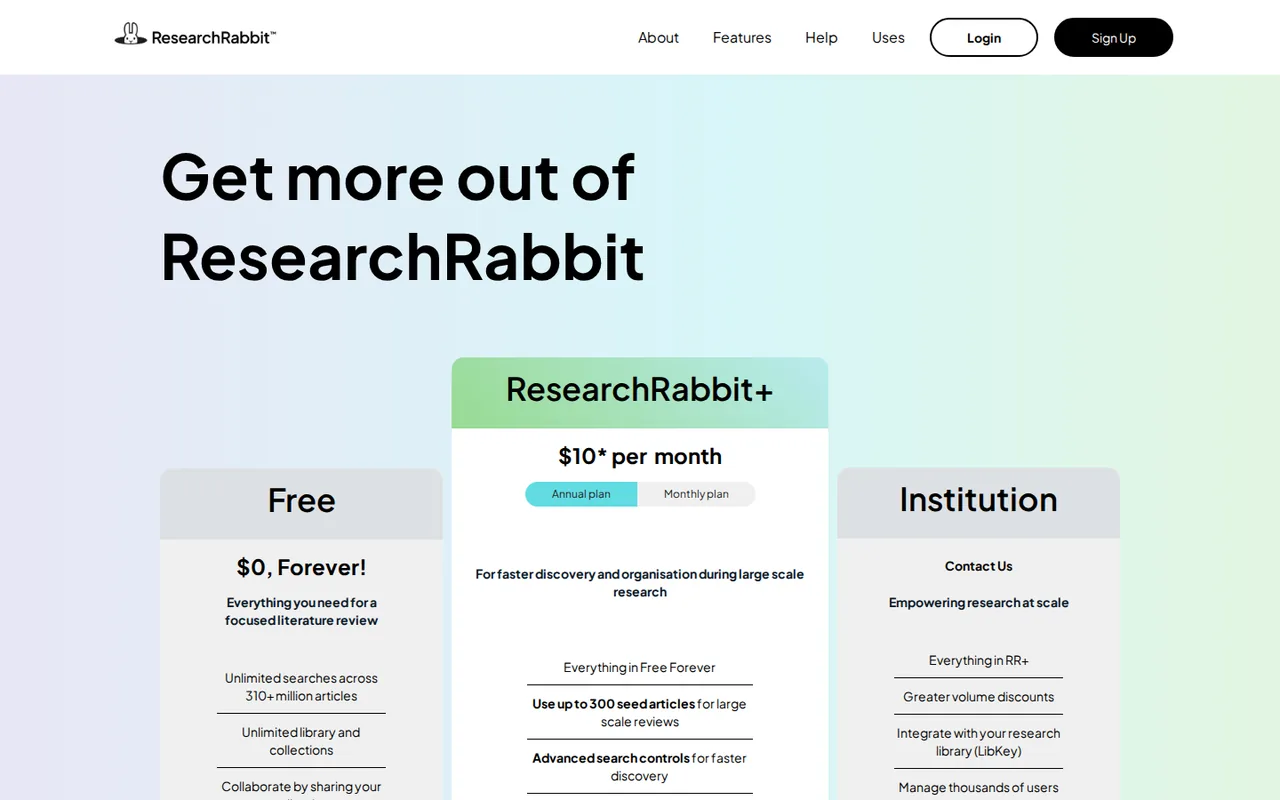
| Plan | Price | What you get |
|---|---|---|
| Free | $0 sourceFrom researchrabbit.ai/pricing, checked Oct 24, 2026 (opens in a new tab) | Unlimited searches across 310+ million articles, unlimited library and collections, shared collections, up to 50 seed articles per search, core search settings, Zotero import and BibTeX, RIS or CSV export. |
| ResearchRabbit+ (annual) | $120 per year$10 a month sourceFrom researchrabbit.ai/pricing, checked Oct 24, 2026 (opens in a new tab) | Up to 300 seed articles per search, advanced filters (keyword, date, journal quartile and h-index, open access, retractions), multiple projects, Signals alerts and faster support. |
| ResearchRabbit+ (monthly) | $12.50 per month sourceFrom researchrabbit.ai/pricing, checked Oct 24, 2026 (opens in a new tab) | The same RR+ features billed monthly; country discount codes apply in more than 100 countries. |
| Institution | Customcontact sales | Everything in RR+, volume discounts, LibKey integration with the research library, management of thousands of users, usage statistics and dedicated support. |
How far does it go?
- Annual against monthly RR+Twelve months at $12.50 cost $150 against $120 for the annual plan, a $30 (20%) difference. Monthly stays cheaper for up to 9 months of use (9 x $12.50 = $112.50); from the 10th month ($125) the annual plan costs less. Country discount codes change both figures. Arithmetic on published prices, not a statement by ResearchRabbit.
- Gap check on a 180-paper reviewUsing all 180 included papers as seeds takes one search on RR+ (cap 300) but four on Free (50 + 50 + 50 + 30), each ranked against its own seeds only. Whether four separate rankings surface the same papers as one combined search is not documented. Arithmetic on published limits, not a statement by ResearchRabbit.
Arithmetic from the published allowances above, not a usage test.
Taxes, currency and promotions can change the price you see at checkout.
Try ResearchRabbit free (opens in a new tab)
Key features
| Feature | What it does | Watch out |
|---|---|---|
| Seed-based search that starts from keywords, a DOI, a saved collection or an imported BibTeX file and grows as you select results (search guide) | — | |
| Similar, Earlier and Later Work views and the citations and references of any paper, with maps of how papers connect (help guides) | — | |
| Author exploration across a paper's own authors or authors of connected papers (search algorithm article) | Candidates cite or are cited by your seeds, share references or citations, share authors, or are inferred as similar from their titles and abstracts; they are ranked by how connected each is to the whole seed set. | The extra ranking adjustments that keep papers from being unfairly promoted or demoted are not documented. |
| Collections with nested subcollections, notes, stickers and colours, plus a Recently Found list of everything explored (collections guide) | Every seed and every paper you open lands in Recently Found, so exploring does not require filing papers as you go. | Autosave can file every seed into a collection automatically. |
| Zotero importer and BibTeX, RIS or CSV export (Zotero and sharing guides) | — | |
| RR+ filters for keyword, publication date, journal quartile and h-index, open access and retractions (RR+ article) | — | |
| Keyword filter behaviour | RR+ keyword filters match loosely in titles and abstracts, so a filter on fish diversity also returns papers with only one of the two words. | Boolean operators are not available in the filter. |
How does a search grow from seed papers?
Every search starts from seed articles. The search algorithm article says ResearchRabbit builds a candidate list from papers connected to those seeds: one cites the other, they share a reference or citation, they share authors, or their titles and abstracts look semantically similar. It then ranks the candidates by how connected each is to the whole seed set, which is why results shift as you select more papers.
Search settings decide where candidates come from: all connections, references only or citations only, which the guides call Similar, Earlier and Later Work, plus the seeds’ authors or authors of related papers. The AI article states that large language models do not power the core recommendations. That keeps the method explainable, but the tool does not read full texts or write about them; for an agent that reads papers and drafts a cited report, the Undermind profile covers that case.
Which papers can it find, and which can it miss?
The database article counts 310+ million articles, drawn mainly from Crossref, Semantic Scholar and OpenAlex and updated weekly. Only articles with open access metadata, meaning a publicly available title, author list, date, abstract and reference list, can be indexed; the paper itself may still sit behind a paywall. A paper can be missing because its metadata is closed, because none of the three providers has it, or because it is too new.
Citation and reference counts can run lower than on Google Scholar, which counts differently, and recent citations can lag. Versions of a paper with different DOIs appear separately. Papers with thin metadata can still be saved and their details filled in by hand.
When does the 50-seed limit matter?
For most searches it does not. The free tier article lists unlimited searches with up to 50 starting articles, citation maps, collections and subcollections, the Zotero importer, shared collections, BibTeX import and export, and notes. The cap bites when a whole reference list should act as one search, such as a gap check before submission, where RR+ takes up to 300 seeds. The RR+ article lists the filters that come with it:
- Keyword, for a word or phrase in the title or abstract.
- Publication date, to find foundational work or the current state of a field.
- Journal quality by quartile and h-index.
- Open access, so every result has a free PDF.
- Retractions, to exclude or review retracted articles.
RR+ also adds multiple projects, each with its own notes and articles, and Signals alerts.
How do papers move in and out?
A search can start from keywords, a DOI, an existing collection, or a BibTeX file exported from Zotero, Mendeley or EndNote. The Zotero importer links an account once and then imports chosen collections without erasing existing ones, from more than one Zotero account if needed. The way back is a file: the sharing guide lists BibTeX, RIS and CSV exports, and the Zotero guide says two-way sync is still being built.
Collections can be shared with a view-only public link or with invited editors and viewers, who also see your notes and any subcollections. If a citation map goes into a paper or slide as a figure, ResearchRabbit notes that many publishers expect the tool to be cited.
Who runs it and what happens to your notes?
The Terms of Service name Litmap Limited, doing business as Litmaps, registered in Wellington, New Zealand. New Zealand law governs, disputes go to arbitration under the European Arbitration Chamber in Brussels, and users must be 18 or older. The data summary in the help center says ResearchRabbit does not sell or expose articles or notes and does not train AI models on them.
The Privacy Notice, shared across Litmap Limited’s services, says AI features run through third-party providers including Databricks and OpenAI for natural language processing and AI insights, and that servers are in the United States. It does not say which ResearchRabbit features, if any, send data to those providers.
How could you check ResearchRabbit before paying?
Proposed evaluation · not performed yet
Test whether a free search surfaces papers you know but did not use as seeds.
- Pick a topic you know and list ten relevant papers.
- Use five of them as seeds in a free search, by DOI or through a BibTeX import.
- Open Similar, Earlier and Later Work and record which of the other five appear in the first results.
- Search the DOI of each paper that did not appear, to see whether it is in the database at all.
- Export the collection as RIS and import it into your reference manager to confirm the records arrive complete.
Accept if most held-back papers surface and the export is clean. Reject if papers that are in the database still do not appear from five related seeds. No result is recorded here.
ResearchRabbit alternatives
Other research & sources tools checked with the same method. Pick by the job, not by a score.

Comparing AI model answers by voting, without a paid plan

Finding and synthesizing published research

Extracting study data from research papers

K-12 schools piloting an AI tutor that teachers can monitor

Students and researchers reading a small set of papers who will check every cited passage

Researchers and students checking how a paper has been cited

Searching and monitoring scientific literature for free, by hand or through an API

Quick summaries of articles, papers and videos
Used ResearchRabbit? Write the first review. Visitor opinions are moderated and kept separate from our source checks.
Frequently asked questions
Is ResearchRabbit free?
Yes. ResearchRabbit says a feature-complete free tier will stay available, paid for by ResearchRabbit+ subscribers. The free account covers the core literature-review workflow, from citation chasing and maps to collections, sharing and notes. The main reason to upgrade is a search seeded with more than 50 papers, or the advanced filters.
How much does ResearchRabbit+ cost?
The pricing page lists $12.50 a month on monthly billing or $10 a month on the annual plan, and the help center puts the annual total at $120. More than 100 countries, including India, Brazil and Turkey, get a parity discount code in the upgrade menu; it cannot be stacked with another promotional code.
Is ResearchRabbit owned by Litmaps?
Yes. ResearchRabbit pages carry a Litmap Limited copyright, and the terms name Litmap Limited, doing business as Litmaps, as the company you contract with. Litmaps is a separate citation-mapping product from the same company, with its own website, plans and pricing page, so an account or subscription on one does not cover the other.
Can I cancel or get a refund on ResearchRabbit+?
You can cancel at any time by logging into your account, and RR+ access continues until the paid term ends. The terms set out automatic renewal and cancellation but no refund right or window, and they allow fee changes communicated under applicable law. Questions go to support@researchrabbit.ai.
Does ResearchRabbit offer an institution plan?
Yes. The Institution plan is priced on request and adds volume discounts, LibKey integration with a library's holdings, management of thousands of users, usage statistics about how researchers use the tool, and dedicated support. Libraries contact ResearchRabbit through an institutions form on the website.
Sources and method16 official sources · 22 details checked · Oct 24, 2026
How we checked this profile
22 details on this page were checked against ResearchRabbit's own pages and help documentation (Oct 24, 2026). 1 is still open and listed below.
See the checks by section20 documented1 editorial assessment1 open
| Section | Checks | Last checked | Sources |
|---|---|---|---|
| Plans and prices | 4 documented 1 editorial | researchrabbit.ai/pricinglearn.researchrabbit.ai/12454495-what-is-researchr… | |
| Strengths and limits | 3 documented 1 open | researchrabbit.ai/pricinglearn.researchrabbit.ai/12796770-data-responsibili…learn.researchrabbit.ai/12796541-using-the-zotero-…researchrabbit.ai/terms-of-service | |
| Article text | 8 documented | learn.researchrabbit.ai/12454495-what-is-researchr…learn.researchrabbit.ai/12865509-researchrabbit-fr…learn.researchrabbit.ai/12454605-the-researchrabbi…learn.researchrabbit.ai/13545485-how-researchrabbi…learn.researchrabbit.ai/13192798-how-to-share-pape…researchrabbit.ai/terms-of-serviceresearchrabbit.ai/privacy-policy | |
| Questions | 1 documented | learn.researchrabbit.ai/12874287-rr-country-discou… | |
| Features | 3 documented | learn.researchrabbit.ai/12875619-what-s-behind-res…learn.researchrabbit.ai/12454528-how-to-search-in-…learn.researchrabbit.ai/12454600-organizing-your-a… | |
| Official channels and media | 1 documented | researchrabbit.ai |
Still open
- The terms contain no refund provision.Not confirmed · checked · Source (opens in a new tab)
Sources for this profile
- Pricing page and pricing FAQresearchrabbit.ai
- ResearchRabbit homepageresearchrabbit.ai
- RR+ country pricing pageresearchrabbit.ai
- Help center: ResearchRabbit Free Tier (May 13, 2026)learn.researchrabbit.ai
All 16 sources
- Help center: ResearchRabbit+ (April 25, 2026)learn.researchrabbit.ai
- Help center: The ResearchRabbit Database (June 14, 2026)learn.researchrabbit.ai
- Help center: search algorithmlearn.researchrabbit.ai
- Help center: How ResearchRabbit uses AIlearn.researchrabbit.ai
- Help center: Data Responsibility TLDRlearn.researchrabbit.ai
- Help center: Zotero Importerlearn.researchrabbit.ai
- Help center: sharing papers and collections (June 30, 2026)learn.researchrabbit.ai
- Help center: how to searchlearn.researchrabbit.ai
- Help center: collectionslearn.researchrabbit.ai
- Help center: RR+ country discountslearn.researchrabbit.ai
- Terms of Service, last updated November 07, 2025researchrabbit.ai
- Privacy Notice, last updated November 07, 2025researchrabbit.ai
Official pages read on 24 Oct 2026 with plain HTTP requests, and the embedded Terms of Service and Privacy Notice with a local browser: homepage, pricing page and FAQ, country pricing page, and help center articles on the free tier, ResearchRabbit+, the database, the search algorithm, AI use, data responsibility, Zotero, sharing, searching, collections and country discounts. We did not create an account or run a search. Article counts differ across official pages (310+ million on the pricing page and database article, over 320 million on the homepage); the profile uses 310+ million. The privacy notice covers Litmap Limited's services as a whole. User counts, institution logos and testimonials on ResearchRabbit pages were not used. Third-party prices and reviews were not used.
Sources checked Oct 24, 2026. Found something out of date? See how we correct profiles.