
Key features
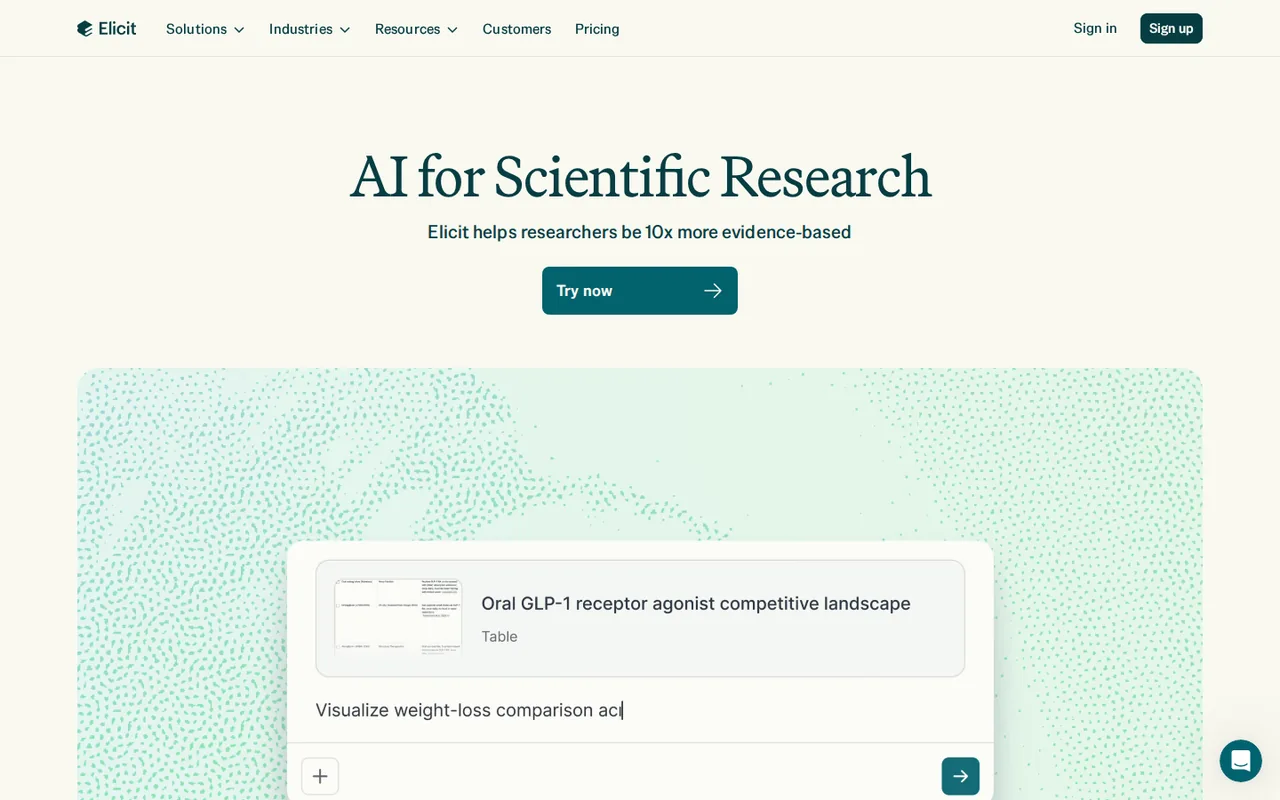
- Paper discoverySearch academic literature and read generated paper summaries.
- Paper chatAsk questions about accessible full-text papers.
- Structured extractionExtract study information into columns, including text and tables inside a paper.
Column answers consider tables inside a paper and quote the table when they use it; optional Premium PDF parsing copes better with complex formulae, figures and tables.
Falls short Some tables are still missed depending on layout, Premium PDF parsing is unavailable on Basic and raises usage on every PDF, and figure extraction needs Scale or Enterprise.
- Research Reports and exportsCreate research reports and export them to PDF or Word; table export has separate plan rules.
Reports link each claim to the source passage and export as PDF or Word on any plan; tables export as CSV or Excel and references as RIS or BIB.
Falls short The free report download does not include table data, which follows separate plan rules.
- Research librarySave and organize sources for reuse in later projects; the pricing page also lists Zotero import.
Imports references from Zotero, EndNote or Mendeley, looks up abstracts and full texts from metadata and flags duplicates with semantic deduplication.
Falls short Sharing curated collections with collaborators is marked as coming soon on the library page.
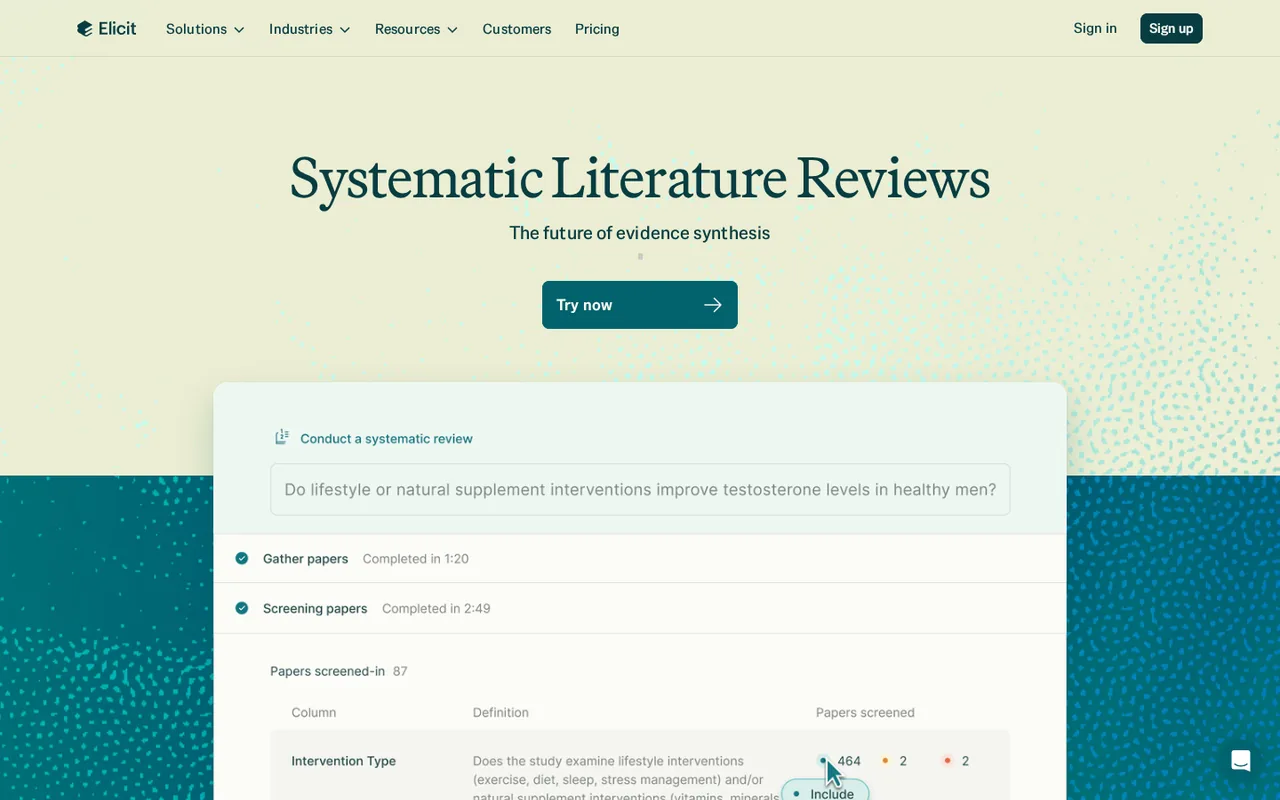
- Systematic Review workflowRefine a protocol, screen papers against suggested criteria and extract data into tables backed by source quotes.
Combines searches across PubMed, ClinicalTrials.gov and Elicit's paper corpus, then screens and extracts with exclusion reasons and supporting quotes recorded for each decision.
Falls short Screening capacity is set by the plan, and review tables export only on Pro, Scale or Enterprise.
- Research AgentWork through multi-step research questions across papers, clinical trials and other sources, with each claim linked to a supporting passage.
- Research AlertsTurn a research question into an alert that screens newly published papers against a generated rubric.
Strengths and limits
Strengths
- Free paper discovery: Basic includes unlimited paper search, summaries and chat with accessible full text.
- Quotes behind the output: Extracted values, screening decisions and report claims point to the supporting passage in the source paper.
- Report export on every plan: Research Reports download as PDF or Word even on the free Basic plan.
- Lower academic prices: Academic plans cost less than Industry plans for the same tier, and nonprofits can use them.
More limits to plan around
- Usage pool size unpublished: Elicit describes usage per plan only in relative terms, so heavy users cannot plan against a fixed number.
Who else is it for?
Editorial assessment, based on documented features
- Company research teamsOn Industry pricing the first paid plan is Pro, so compare its price with how often the team exports tables.
- Research teams tracking new evidenceConsider Research Alerts and the Research Agent when a project needs ongoing monitoring rather than a one-off search.
How much does Elicit cost?
Prices confirmed · checked
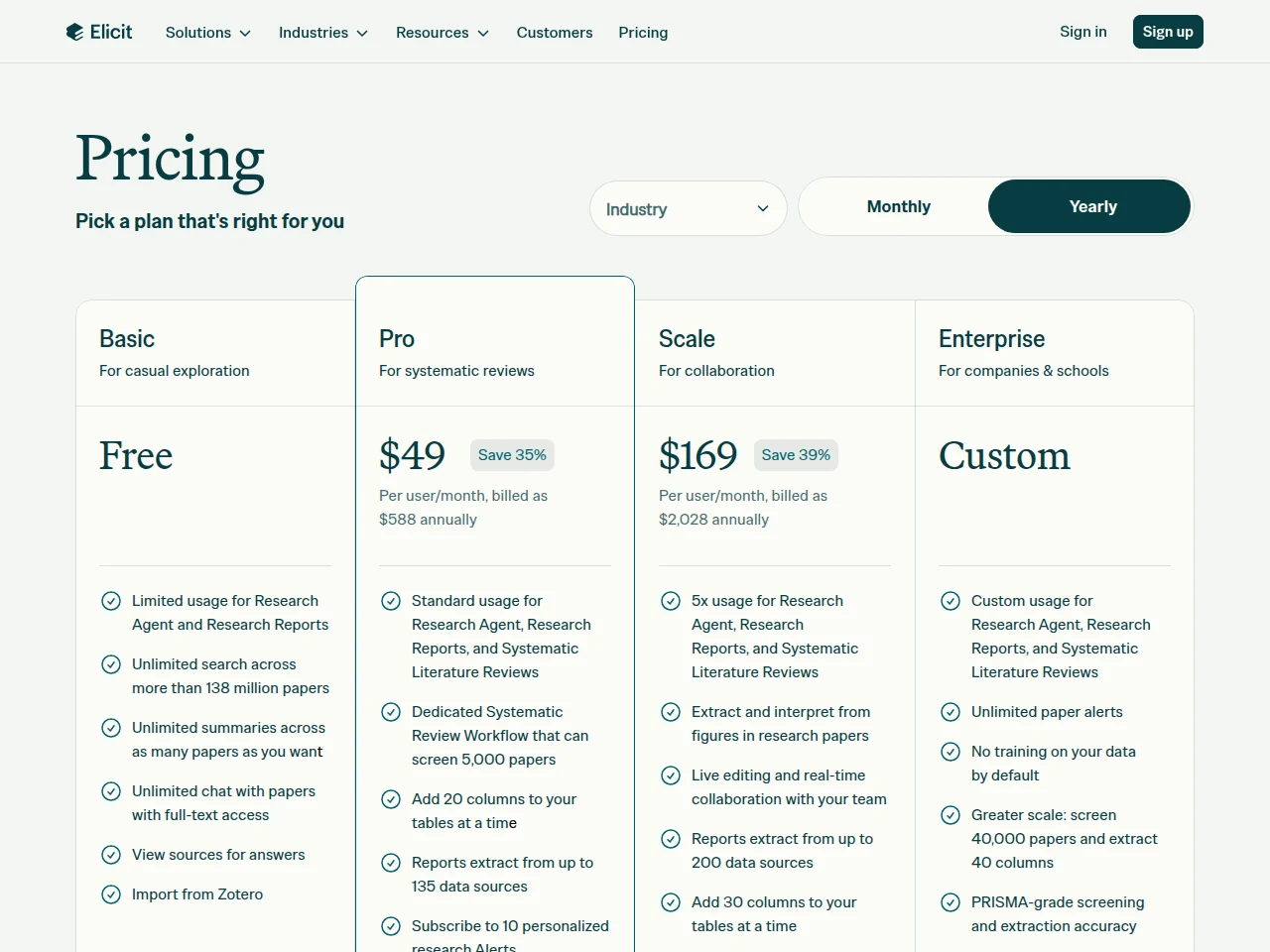
Elicit's pricing page switches between Academic and Industry prices and between monthly and yearly billing; all amounts are in US dollars per user. Plus appears only under Academic pricing. Taxes and institutional contract prices are not published.
Basic
Free
Unlimited search across more than 138 million papers, unlimited summaries, chat with papers and Zotero import; limited Research Agent and Research Reports usage.
Plus (Academic)
USD 11 per user per monthbilled annually · USD 132 per year; USD 19 billed monthly
Academic pricing only. Adds table exports and RIS, CSV and BIB citation files (Research Reports already download as PDF or Word on Basic), 5 table columns at a time, clinical-trial search and standard usage for Research Agent, Reports and systematic reviews.
Pro (Academic)
USD 39 per user per monthbilled annually · USD 468 per year; USD 69 billed monthly
5x usage for Research Agent, Reports and systematic reviews, a review workflow that can screen 5,000 papers, 20 table columns, alerts and API access.
Pro (Industry)
USD 49 per user per monthbilled annually · USD 588 per year; USD 75 billed monthly
Same features as Academic Pro with standard usage instead of 5x.
Scale (Academic)
USD 89 per user per monthbilled annually · USD 1,068 per year; USD 149 billed monthly
9x usage, figure extraction, real-time team collaboration, 30 table columns and an admin panel for seats and usage.
Scale (Industry)
USD 169 per user per monthbilled annually · USD 2,028 per year; USD 279 billed monthly
Same features as Academic Scale with 5x usage.
Enterprise
Customthrough sales
For companies and schools: custom usage, screening of up to 40,000 papers, SSO/SAML and no training on your data by default.
How far does it go?
- Yearly versus monthly on Academic ProTwelve monthly payments of USD 69 come to USD 828, while annual billing costs USD 468, so paying yearly saves about USD 360 per seat, roughly 43%.
- Three Industry Pro seats for a yearAssuming a three-person company team, annual billing costs 3 × USD 588 = USD 1,764, against 3 × USD 75 × 12 = USD 2,700 on monthly billing, about USD 936 more.
- Extra usage with a USD 250 limitIn Elicit's own example, a Pro or Scale user who sets a USD 250 monthly limit is charged USD 100, another USD 100 and then USD 50 as extra usage grows, and work that needs more usage stops at USD 250 until the next reset.
Arithmetic from the published allowances above, not a usage test.
Taxes, currency and promotions can change the price you see at checkout.
Which Elicit plan fits your research?
Editorial assessment
Choose the plan by the output you need, not by search volume, because paper search is unlimited on every plan. Company buyers should note that Plus is not offered on Industry pricing, so their first paid step is Pro.
- Basic (free) is enough for a reading list, paper summaries, chat with papers and a Research Report downloaded as PDF or Word.
- Plus (Academic only) fits when tables and citation files must leave Elicit and 5 extraction columns at a time are enough.
- Pro fits a systematic review of up to 5,000 papers, tables wider than 5 columns (up to 20), exported review tables, alerts or API access.
- Scale fits when you must extract figures, need more than 20 columns (up to 30) or want one usage pool and an admin panel for a team.
- Enterprise fits screening beyond the Pro limit, SSO/SAML sign-in or a school-wide or company-wide contract.
For the same tier, Academic plans cost less than Industry plans, and nonprofits are pointed to the academic plans instead of a separate discount. Elicit’s help center says complimentary academic access is not offered, so Basic is the no-cost option for students as well.
How does Elicit’s monthly usage work?
Every plan draws from one monthly usage pool shared by Research Agent, Reports and Systematic Literature Reviews. A quick question uses little; long Agent sessions, large PDFs, many extraction columns, full-text screening and figure extraction use more. Elicit does not publish the pool size as a number, only that higher tiers include more and that Scale has the highest self-service limit.
The pool resets on the monthly anniversary of your subscription date, even on annual billing, and unused usage does not roll over. When Basic or Plus users run out, Find Papers and Chat with Papers keep working until the reset. Pro and Scale users can switch on extra usage, charged in USD 100 steps up to a monthly spend limit they choose.
Continue reading · 5 more sectionsShow lessCan you trust the tables Elicit extracts? · Which exports come with each plan? · What does the Systematic Review workflow cover? …
Can you trust the tables Elicit extracts?
Column answers read tables inside a paper and quote them, but Elicit’s guide warns that complex table formatting can cause missed or wrong values. Premium PDF parsing handles formulae, figures and tables better; it is off by default and not available on Basic. Once switched on, it reads every PDF with a heavier model, so it draws more from the monthly pool even on simple papers.
Figure and chart extraction needs three things together: a Scale or Enterprise plan, Premium PDF parsing, and the figure option selected when you set up a Systematic Review. Turning on better parsing on Plus or Pro therefore gives no figure extraction. Compare a sample of extracted cells with the original paper before you use them.
Which exports come with each plan?
Research Reports download as PDF or Word on every plan, Basic included. Tables export as CSV or Excel and reference lists as RIS or BIB, but table exports depend on the workflow: Find Papers and Paper Chat tables need Plus or higher, while Systematic Review tables need Pro, Scale or Enterprise. On Plus, a table built inside a Systematic Review can be used in Elicit, but exporting it needs Pro.
What does the Systematic Review workflow cover?
Elicit’s systematic review page describes five steps from protocol to synthesis, with a supporting quote behind each screening decision and each extracted value. The accuracy and recall percentages on that page are Elicit’s own figures.
- Refine the protocol: research questions and search strategies.
- Gather sources: PubMed, ClinicalTrials.gov, Elicit’s corpus of 138 million papers, or imports from other databases.
- Screen papers: suggested criteria you can accept, edit or replace, with exclusion reasons for each decision.
- Extract data: AI-suggested or custom extraction templates.
- Synthesize: reports across up to 200 papers with a methods section, PRISMA flow diagram and search strategy.
Screening capacity depends on the plan: the pricing page lists a review workflow that can screen 5,000 papers on Pro and 40,000 on Enterprise. Usage per review also depends on PDF length, abstract-only versus full-text screening, the number of columns and the choice of Fast or Thorough screening.
Does Elicit work for non-English research?
Elicit says its search, summaries and extraction are optimized for English-language research; quality in other languages varies and can use up the monthly pool faster. It is not meant as a translation or document-reproduction service. A multilingual review therefore needs a separate check of coverage in each language.
How can you check Elicit’s extraction on your own papers?
Proposed evaluation · not performed yet
Select ten open papers and build a reference table by hand. Ask Elicit for study design, population, outcome and limitations using the same definitions. Count correct, missing and unsupported values separately, and settle disagreements against the original full text rather than trusting either table by default.
Elicit alternatives
Other research & sources tools profiled with the same source-checked method. Pick by the job, not by a score.
| Tool | Free access | Paid plans from | Consider it for |
|---|---|---|---|
| ElicitThis profile | Free access available | USD 49 per user per month | Extracting study data from research papers |
| Consensus | Free access available | USD 12/month | Finding and synthesizing published research |
| Gemini Notebook | Free access available | USD 4.99 per month | Cited answers from your own documents |
| Perplexity | Free access available | USD 17 per month | Web research with linked sources |


Elicit user reviews
Visitor opinions, moderated before publishing. Separate from our source checks; we do not score tools.
Frequently asked questions
Is Elicit free?
Yes. Basic has no end date and includes unlimited paper search, unlimited summaries and chat with papers, plus Zotero import. Research Agent and Research Reports are limited on Basic, and Elicit gives no numeric cap for them. Premium PDF parsing and table exports are not part of the free plan.
What does Elicit Pro cost?
On Academic pricing, Pro is USD 39 per user per month billed annually or USD 69 billed monthly. On Industry pricing it is USD 49 annually or USD 75 monthly. The feature list is the same, but Academic Pro includes 5x usage for Research Agent, Reports and systematic reviews, while Industry Pro has standard usage.
Who can use Elicit's academic pricing?
Academic users pick the Academic option in the plan dropdown on the pricing page when they subscribe. Nonprofits get no separate discount and are pointed to the academic plans, which Elicit calls its lowest price tier. Universities, research centers and nonprofit groups can also ask Elicit's sales team about an institutional subscription for many researchers.
Can I import my existing reference library?
Yes. The Library takes references from Zotero, EndNote or Mendeley, fetches abstracts and full texts from the metadata and flags duplicates using semantic matching. Zotero import is listed even on the free Basic plan. Sharing curated collections with colleagues is still marked as coming soon, while Scale lists real-time team collaboration.
Does Elicit search clinical trials?
Yes. From Plus upward the pricing page lists clinical-trial search, and the Systematic Review workflow can pull sources from ClinicalTrials.gov next to PubMed and imports from other databases. The Research Agent also works across clinical trials as well as papers. Basic users who rely on the paper corpus alone should check whether trial registries matter for their question.
Can a team share one Elicit plan?
Scale adds real-time collaboration and an admin panel for seats and usage, and a team's monthly usage is pooled: a four-member team gets four times an individual's usage. An extra Scale seat adds usage even if nobody is invited to it. Enterprise adds SSO/SAML sign-in and does not train on customer data by default.
How we checked this profile
60 details on this page were checked against Elicit's own pages and help documentation (Sep 23–24, 2026). 2 are still open and listed below.
See the checks by section51 documented7 editorial assessment2 open
Still open
- The size of each plan's monthly usage pool is not published.Not confirmed · checked · Source (opens in a new tab)
- Only a web application is documented.Not confirmed · checked · Source (opens in a new tab)
Sources for this profile
- Elicit pricingelicit.com
- Academic and nonprofit pricingsupport.elicit.com
- Usage limits in Elicitsupport.elicit.com
- Annual discount and institutional contractssupport.elicit.com
All 13 sources
Plans, prices, usage rules, exports, extraction, language limits, the library and the systematic review workflow were read from elicit.com and the Elicit Help Center. Prices are per user in US dollars and change with the Academic or Industry option.
Sources checked Sep 23–24, 2026. We read the vendor's documentation; we did not test the product or score it. Found something out of date? See how we correct profiles.


