
What is Parasail, in short?
Updated November 1, 2026 · By Elias Brandt · Documentation review, not tested hands-on
Pros
- Per-token billing with no minimum usage
- Prices are public for 41 models
- Drop-in API
- Stated data handling
Cons
- No free plan
- Billing pages disagree
- Key prices are not public
- Input restrictions
Best forDevelopers calling open models by APITeams moving off a single closed-model vendorOffline and eval workloadsNot for sensitive regulated data
Strengths, limits and who it suits, in full
Strengths
- Per-token billing with no minimum usage The pricing page says pay only for what you use with no minimums on Serverless, and Elastic Endpoints carry no GPU-hour commitment or idle-GPU bill.
- Prices are public for 41 models The serverless table lists input, output and cache-read rates per 1M tokens.
- Drop-in API The docs say any OpenAI SDK works by changing the base URL and key.
- Stated data handling The Privacy Policy says serverless and dedicated input is not stored or logged beyond producing the output and is not used for model training.
Limits
- No free plan The billing docs charge $25 starting credit when a card is added, and models and API keys do not work without a card.
- Billing pages disagree The docs describe prepaid billing for new accounts, while the Terms describe monthly billing in arrears and non-refundable fees.
- Key prices are not public Batch rates, Dedicated per-GPU-hour rates and Elastic availability need sales or a deploy screen.
- Input restrictions The Terms bar health records, ID numbers, payment card data and children's data in input without a separate agreement, and bar publicly disclosing Platform performance information.
Who it suits
- Developers calling open models by API The docs and pricing table cover Qwen, DeepSeek, GLM, Kimi, Llama, Gemma and gpt-oss models behind one API.
- Teams moving off a single closed-model vendor The homepage FAQ says teams often run Parasail alongside an existing setup first.
- Offline and eval workloads The Batch tier is described for evals and embeddings at the lowest per-token rate.
- Not for sensitive regulated data The Terms exclude health information and payment card data without a separate agreement.
How much does Parasail cost?
Some prices not published · checked
Regional prices: Prices are US dollars per 1M tokens as read on 2026-11-01 and are listed model by model; the table changes as models are added.
New accounts prepay: adding a card charges $25 of starting credit and the card is charged again when the balance reaches $5. Older accounts are billed in arrears after usage reaches $25. The Terms of Service describe monthly billing in arrears and non-refundable fees, which differs from the prepaid wording in the docs, so confirm in the dashboard which applies to your organization. Batch and Dedicated hourly rates are not published on the pages we read. Elastic Endpoints are available only for selected models.
| Plan | Price | What you get |
|---|---|---|
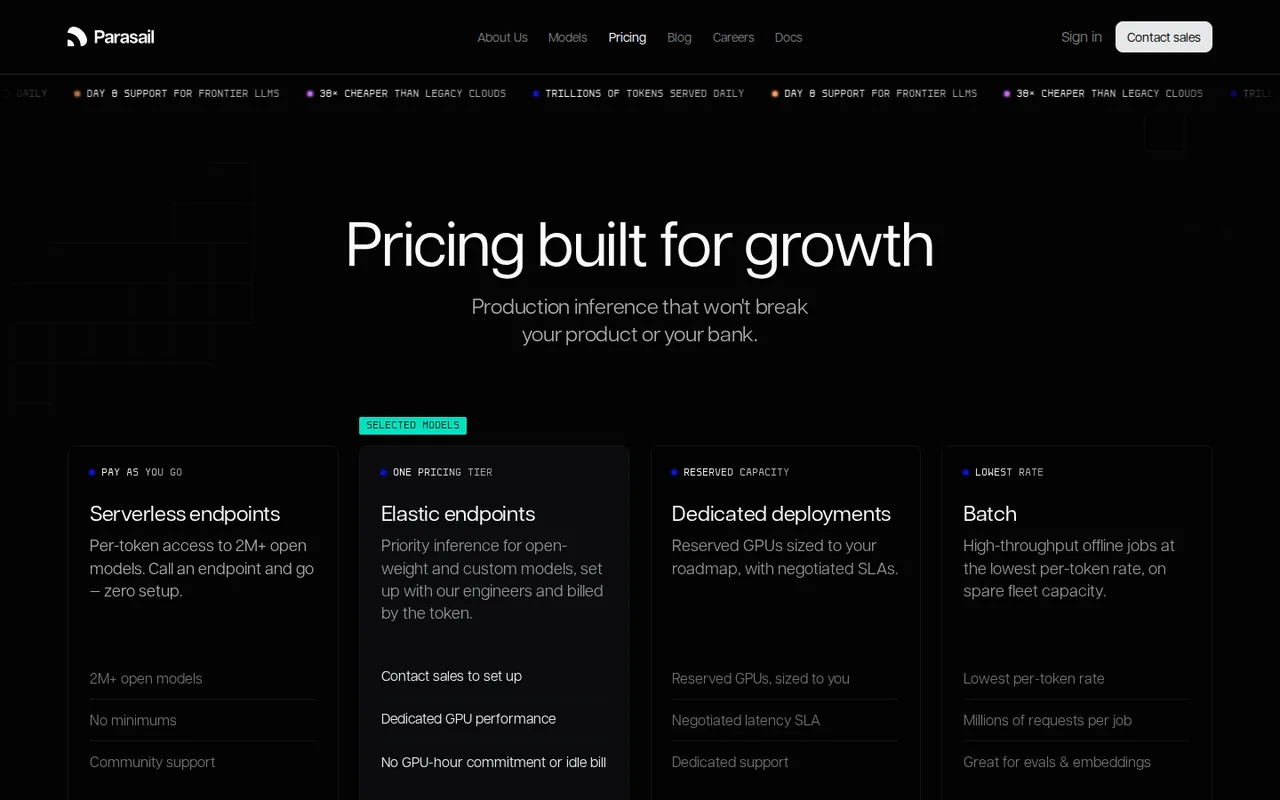
| Serverless | Pay per 1M tokens; from $0.04 input and $0.20 outputgpt-oss-20b sourceFrom parasail.io/pricing, checked Nov 1, 2026 (opens in a new tab) | Shared on-demand endpoints, no minimums. Rates vary by model, for example gpt-oss-120b $0.10 and $0.75, Kimi K3 $3.00 and $15.00. A card is required; new accounts are charged $25 starting credit. |
| Elastic Endpoints | Serverless rate + 25% sourceFrom parasail.io/pricing, checked Nov 1, 2026 (opens in a new tab) | Private capacity for selected models, billed per token with no GPU-hour commitment or idle bill. Setup through sales. |
| Dedicated Instances | Per GPU-hourshown at deploy | Private GPU endpoints with control over model, hardware and scaling. The pricing page also lists reserved deployments with negotiated SLAs through sales; no hourly rate is published on the pages we read. |
| Batch | Lowest per-token ratenot listed | Offline jobs on spare capacity; the pricing table gives no batch rate. Batch input is generally logged for 30 days. |
| Enterprise | Contract | Enterprise contracts follow their own terms, billed monthly with Net 30 by default. |
How far does it go?
- A model-mix exampleTake gpt-oss-120b at $0.10 per 1M input tokens and $0.75 per 1M output tokens. A month with 10M input and 2M output tokens costs $1.00 plus $1.50, or $2.50 on Serverless. The same tokens on an Elastic Endpoint at Serverless + 25% cost about $3.13. There is no base fee in the pricing table, but a card must be on file and new accounts hold a $25 prepaid balance. The same volume on Kimi K3 ($3.00 and $15.00) would be $30 plus $30, or $60. These are our sums from the published rates, before tax and any cache-read discount; real costs depend on prompt length and cache hits.
Arithmetic from the published allowances above, not a usage test.
Taxes, currency and promotions can change the price you see at checkout.
Visit Parasail (opens in a new tab)
Key features
| Feature | What it does | Watch out |
|---|---|---|
| One OpenAI-compatible API for open and frontier open-weight models | — | |
| Serverless per-token pricing with cache-read rates | — | |
| Elastic Endpoints: private capacity billed per token, no GPU-hour commitment | — | |
| Dedicated Instances billed per GPU-hour with autoscaling policies | — | |
| Batch tier for large offline jobs such as evals and embeddings | — | |
| Input and output not used to train Parasail's models | — | |
| Three ways to buy capacity | Serverless is shared and billed per token; Elastic Endpoints are private, billed per token at 1.25 times the Serverless rate for selected models; Dedicated Instances are billed per GPU-hour. | Start on Serverless, then ask sales about Elastic only if you need private capacity. |
| Prices are per model | The pricing table prices each model separately for input, output and cached input, so one workload can cost very different amounts depending on the model. | Price your own input and output split on two or three candidate models before choosing. |
| Optimization is described, not measured here | The homepage says an optimization agent tunes speed, quality and cost, lossless by default with no hidden quantization. | Treat it as the provider's claim; check output quality on your own prompts. |
Is Parasail free?
No free plan is listed. The billing docs say new accounts are charged $25 as starting credit when a card is added, and that models and API keys do not work without a card. After that the card tops up again when the balance falls to $5.
What serverless pricing looks like
The pricing page lists input, output and cache-read rates per 1M tokens for each model. gpt-oss-20b is $0.04 in and $0.20 out, gpt-oss-120b is $0.10 and $0.75, and Kimi K3 is $3.00 and $15.00. The rate depends on the model more than on any plan, so price your own input and output split on the models you would use.
Elastic and dedicated capacity
Elastic Endpoints are private capacity for selected models at the Serverless rate plus 25%, set up through sales, per the Elastic Endpoints docs. Dedicated Instances are billed per GPU-hour and the price appears when you configure one; no hourly rate is published on the pages we read.
Billing wording to confirm
The docs describe prepaid billing for new accounts, while the Terms of Service describe monthly billing in arrears and non-refundable fees. Check the dashboard to see which applies to your organization before adding volume.
Data and usage limits
The Privacy Policy says input and output are not used to train Parasail’s models and that serverless and dedicated input is not stored beyond producing the output; batch input is generally logged for 30 days. The Terms bar health records, ID numbers, payment card data and children’s data in input without a separate agreement.
How to try it cheaply
Proposed evaluation · not performed yet
Add a card, let the $25 starting credit fund one job, send the same 100 prompts to two models from the pricing table, and compare the billed tokens and output quality against the rates before moving real traffic.
Parasail alternatives
Other coding tools checked with the same method. Pick by the job, not by a score.

Developers who want an approval-based coding agent and choose and pay for their own models

Developers evaluating controlled repository edits with their own test suite

Developers reviewing small repository changes

Running an open model locally for code and text work

Agent-driven coding with a monthly credit budget

Builders evaluating a small operational app

Agentic coding in a desktop IDE on a metered budget

Developers who work in the terminal and want an agent there, paid per use or through their own API key
Used Parasail? Write the first review. Visitor opinions are moderated and kept separate from our source checks.
Frequently asked questions
What is Parasail?
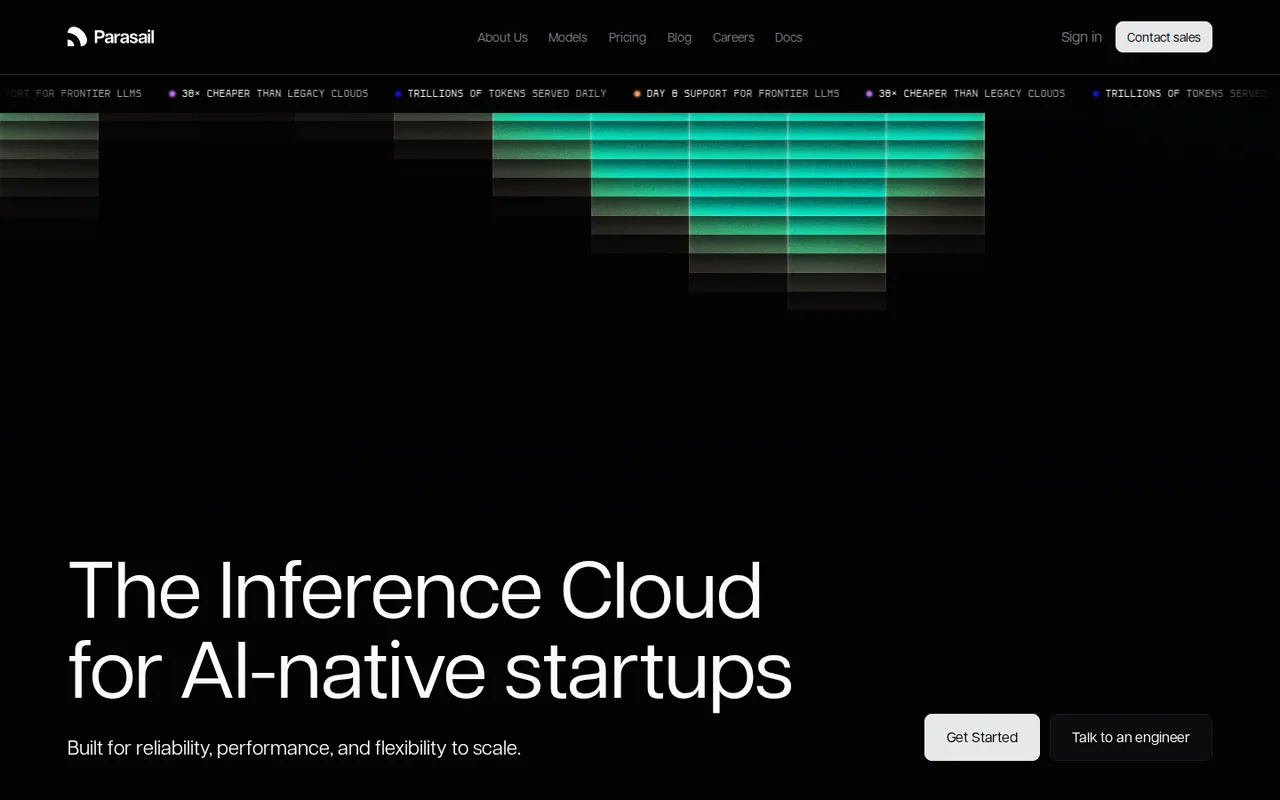
Parasail is an inference cloud run by Parasail, Inc. that serves open and fine-tuned AI models through one OpenAI-compatible API. It offers Serverless, Elastic Endpoint and Dedicated Instance products, and bills Serverless per token.
Does Parasail have a free tier?
No free plan is listed. The billing docs charge $25 of starting credit when a new account adds a card, and models and API keys do not work without a card.
How much does Parasail cost per token?
It depends on the model. On the pricing page gpt-oss-20b is $0.04 per 1M input tokens and $0.20 per 1M output tokens, and Kimi K3 is $3.00 and $15.00. Batch and Dedicated hourly rates are not published there.
Which models can I run on Parasail?
The pricing page lists 41 models with per-token rates, including gpt-oss, Qwen, DeepSeek, GLM, Kimi, Llama, Gemma and Mistral families. Custom or fine-tuned models go through sales, and a model on Serverless is not automatically eligible for an Elastic Endpoint.
Sources and method8 official sources · 15 details checked · Nov 1, 2026
How we checked this profile
15 details on this page were checked against Parasail's own pages and help documentation (Nov 1, 2026). 2 are still open and listed below.
See the checks by section12 documented1 editorial assessment2 open
| Section | Checks | Last checked | Sources |
|---|---|---|---|
| Article text | 1 documented | docs.parasail.io/parasail-docs | |
| Platforms and integrations | 1 documented | docs.parasail.io/parasail-docs | |
| Plans and prices | 6 documented 1 editorial | parasail.io/pricingdocs.parasail.io/billingdocs.parasail.io/capacity | |
| Strengths and limits | 2 documented 1 open | parasail.io/termsparasail.io/privacy | |
| Other details | 1 documented 1 open | parasail.io/termsparasail.io | |
| Features | 1 documented | parasail.io |
Still open
- The Terms of Service say fees are payable monthly in arrears, a credit card is required, payment obligations are non-cancelable and fees are non-refundable except as the Terms state.Not confirmed · checked · Source (opens in a new tab)
- The homepage says Parasail offers 41+ models through one API, which matches the 41 priced models, while the pricing page's Serverless card says 2M+ open models.Not confirmed · checked · Source (opens in a new tab)
Sources for this profile
- Pricing page, serverless per-token tableparasail.io
- Homepageparasail.io
- Docs: billing and paymentsdocs.parasail.io
- Docs: welcome and product overviewdocs.parasail.io
All 8 sources
Official pages read on 2026-11-01: homepage, pricing page, billing docs, docs welcome page, Elastic Endpoints docs, Terms of Service, Privacy Policy and About page. The provider named in the Terms is Parasail, Inc. We did not create an account, call the API or measure speed, quality or uptime, so none of the performance claims on the homepage were observed. The homepage says 41+ models, matching the 41 priced rows, while the Serverless card says 2M+ open models; we use only the priced list. The Terms and the billing docs describe billing differently, as noted above. The Terms also bar publicly disclosing Platform performance information, so this profile contains no benchmarks.
Sources checked Nov 1, 2026. Found something out of date? See how we correct profiles.