
Replit: code, AI agent and hosting in one workspace; Core is $20/month, but hosting usage bills separately
Updated October 5, 2026 · By Elias Brandt · Documentation review, not tested hands-on
Pros
- Prototype-to-hosting path
- Budget controls
- Recovery option on Pro
Cons
- Free link lifetime
- One subscription is not a fixed total bill
- Starter is limited to Lite build
Bottom line
Limited daily Agent credits up to a monthly cap, monthly credits for databases, storage and publishing; one free published app that goes down after 30 days; Lite build only.
You want to take a small prototype from code to a deployed app other people can open, without moving it to a separate host.
You need a free link that stays online, since the Starter published app goes down after 30 days.
Best forBuilders evaluating a small operational appTeams requiring an unchanging all-inclusive billSmall teams building together
Strengths, limits and who it suits, in full
Strengths
- Prototype-to-hosting path A small app can be assessed through its deployed behavior, not only a code preview.
- Budget controls Usage and shutdown limits provide concrete controls for paid consumption.
- Recovery option on Pro Database rollback reaches back up to 28 days on the Pro plan.
Limits
- Free link lifetime Starter hosting is not a permanent production promise.
- One subscription is not a fixed total bill Agent work and live services consume allowances; overage and external services need separate budgeting.
- Starter is limited to Lite build Full build and connectors require a paid plan.
Who it suits
- Builders evaluating a small operational app Useful when data persistence and running costs matter alongside generation.
- Teams requiring an unchanging all-inclusive bill Inspect the credit tier, overage controls and external services first.
- Small teams building together Core covers up to five collaborators; Pro raises that to 15 with 10 parallel agents.
How much does Replit cost?
Prices confirmed · checked
Regional prices: USD figures read on the provider's pricing page on October 5, 2026; tax and region are not stated.
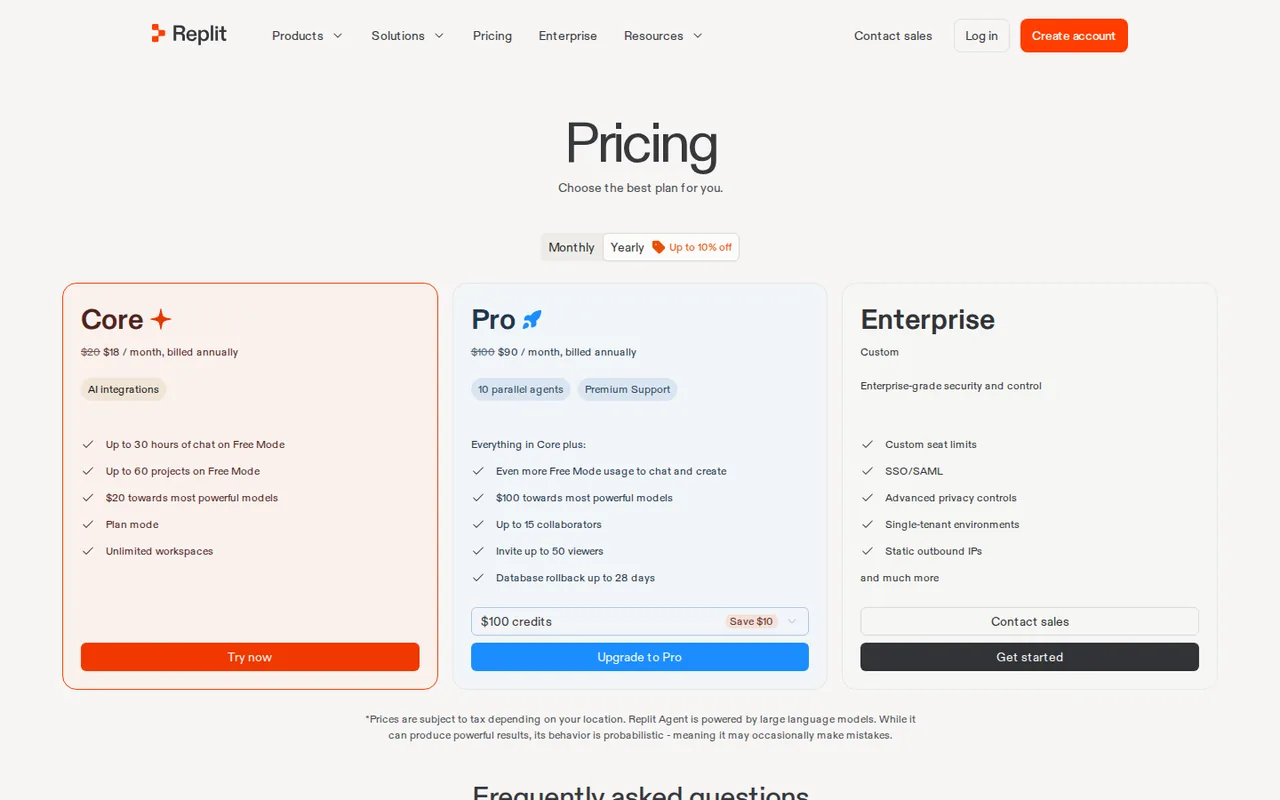
The pricing page as read lists Core, Pro and Enterprise but no Starter card, while the Starter plan guide describes a free plan; the two pages disagree, so confirm Starter in your account. Included credits are not a fixed total bill: published-app data transfer, Autoscale compute, requests and production databases are billed by usage (Core lists a 100 GiB outbound transfer allowance). Annual figures are monthly equivalents of yearly billing.
| Plan | Price | What you get |
|---|---|---|
| Starter | Free sourceFrom replit.com/pricing, checked Oct 5, 2026 (opens in a new tab) | Limited daily Agent credits up to a monthly cap, monthly credits for databases, storage and publishing; one free published app that goes down after 30 days; Lite build only. |
| Core | $20/month; $18/month billed annually sourceFrom replit.com/pricing, checked Oct 5, 2026 (opens in a new tab) | $20 of included credits; Full build; up to five collaborators; unlimited published apps per the plan guide. |
| Pro | $100/month; $90/month billed annually sourceFrom replit.com/pricing, checked Oct 5, 2026 (opens in a new tab) | $100 of included credits; up to 15 collaborators and 10 parallel agents; database rollback up to 28 days. |
| Enterprise | Custom quote | SSO/SAML, privacy controls and single-tenant options; organization-specific terms. |
How far does it go?
- Monthly versus annual CoreCore is $20/month billed monthly or $18/month billed annually: $20 x 12 = $240 versus $18 x 12 = $216, a $24 yearly difference. Included credits do not cap hosting, transfer or database charges, which the billing guide meters separately. Arithmetic on published rates, not observed usage.
Arithmetic from the published allowances above, not a usage test.
Taxes, currency and promotions can change the price you see at checkout.
Try Replit free (opens in a new tab)
Key features
| Feature | What it does | Watch out |
|---|---|---|
| Development and publishing in one workspace | — | |
| Agent assistance with plan-dependent modes | — | |
| Account usage limits and deployment choices | — | |
| Lite build on Starter, Full build on Core and Pro | — | |
| Shared workspaces for up to five collaborators on Core and 15 on Pro | — |
Check a running app, not only the preview
A working editor preview can hide problems that appear after deployment: lost records, missing environment values or an unexpected service requirement. Start with a tiny workflow whose correct behavior you can describe without asking an AI to judge itself. Keep a list of what must persist after a reload and what should be rejected.
The Starter guide separates Lite build from paid Full build and connectors. It also limits the lifetime of the free published link. An exploratory demo is therefore a different decision from a service other people will depend on.
Give usage a stopping rule
The spend-control documentation distinguishes usage limits from service shutdown limits. Reaching a limit can suspend service; a budget setting is not an uptime guarantee. Decide who reviews the usage page and what happens if a limit is reached before inviting real users.
Pro’s plan-specific guide describes two-month credit rollover. Do not apply that to every plan or to separately purchased credit packs. Subscription prices are listed on the pricing page, but included credits and live usage are separate budget lines.
Choose between Core and Pro
Core fits one builder or a small group: it allows up to five collaborators and turns on Full build. Pro is for a larger team that wants up to 15 collaborators, 10 agents working in parallel and the option to roll a database back by as much as 28 days. In both cases the monthly fee buys an equal amount of credit, so the choice is about team size and recovery options rather than a bigger hosting allowance.
Evaluate a reservation prototype
Proposed evaluation, not performed: use Starter Lite build with fictional room names and no external connectors. Stop if the required persistence or deployment exceeds the account allowance.
- Specify a room, start time and end time. Reject an end before the start and two overlapping reservations for the same room.
- Create two valid records and one deliberately overlapping record. Record the expected accept/reject decisions before running them.
- Reload the app and check persistence. Inspect both the interface response and the stored records so a hidden duplicate is not missed.
- If the available free publication fits the test, check the same cases at its published URL and note the link’s expiry date.
- Review consumed credits and any service dependencies. Do not connect real payments or customer data to this exercise.
Keep the observed behavior, missing features and running-cost questions together before deciding whether to pay for a production version.
Is Replit worth it?
Documentation review plus dated public user reports. Documentation review, not tested hands-on. Not scored.
Worth it if
- You want to take a small prototype from code to a deployed app other people can open, without moving it to a separate host.
- You will watch the usage page and set spending limits, because Agent work, data transfer, compute and databases draw on more than the plan price.
- A team of up to 15 needs parallel agents and database rollback, which Pro at $100/month adds over Core.
Probably not if
- You need a free link that stays online, since the Starter published app goes down after 30 days.
- You need a fixed monthly total, because the subscription buys included credits rather than covering every hosting and database charge.
- You plan around the free plan alone, as the pricing page we read showed no Starter card and the allowance should be confirmed in your account.
Replit alternatives
Other coding tools checked with the same method. Pick by the job, not by a score.

Developers who want an approval-based coding agent and choose and pay for their own models

Developers evaluating controlled repository edits with their own test suite

Developers reviewing small repository changes

Running an open model locally for code and text work

Agentic coding in a desktop IDE on a metered budget

Developers who work in the terminal and want an agent there, paid per use or through their own API key

Reviewing small code changes in an existing editor

Reviewing refactoring suggestions within JetBrains IDEs
Used Replit? Write the first review. Visitor opinions are moderated and kept separate from our source checks.
Frequently asked questions
Is Replit free?
The Starter plan guide describes a free plan with limited daily Agent credits, monthly credits for databases, storage and publishing, and one published app that goes down after 30 days. The pricing page we read showed no Starter card, so confirm the free plan in your account before relying on it.
Is the Replit subscription the whole bill for a hosted app?
No. Core ($20/month) and Pro ($100/month) include credits, but the billing guide says publishing is charged for outbound data transfer, Autoscale compute and requests, and production databases for compute time and storage. Estimate generation and runtime costs separately.
What is the difference between Replit Core and Pro?
Core costs $20/month ($18/month billed annually) and includes $20 of credits, Full build and up to five collaborators. Pro costs $100/month ($90/month billed annually) with $100 of credits, up to 15 collaborators, 10 parallel agents and database rollback of up to 28 days.
Can I stop Replit usage from running up a large bill?
Yes, partly. The spend-control guide offers usage limits and service shutdown limits, so you can cap paid consumption. Hitting a shutdown limit can take a published app offline, which means a cap protects the budget but not availability.
Sources and method6 official sources · Oct 5, 2026
Sources for this profile
- Core and Pro prices, credits, limitsreplit.com
- Starter access and published-link lifetimedocs.replit.com
- Core scopedocs.replit.com
- Pro collaborators and rolloverdocs.replit.com
All 6 sources
Claims come from the official pricing, plan and billing pages listed under Sources. The proposed evaluation below has not been performed. Provider demonstrations are not our test results.
Sources checked Oct 5, 2026. Found something out of date? See how we correct profiles.