
What is Warp, in short?
Updated October 24, 2026 · By Elias Brandt · Documentation review, not tested hands-on
Pros
- Free terminal
- Open source client
- Own key on Free
- Published refund windows
Cons
- No bundled agent usage on Free
- Billing unit in transition
- Included usage expires monthly
- Larger companies cannot use BYOK
- AI interactions collected by default
Best forTerminal-first developersDevelopers with their own API keysTeams up to 25 seatsTeams delegating to cloud agentsNot for a predictable flat price
Strengths, limits and who it suits, in full
Strengths
- Free terminal The terminal and Agent CLI need no subscription; ordinary shell commands never use agent usage.
- Open source client Warp's client source is public under AGPL v3, and the docs publish the full list of telemetry events.
- Own key on Free Individuals and companies of 10 or fewer employees can bring an OpenAI, Anthropic or Google key on every plan, including Free.
- Published refund windows Monthly plans are refundable within 24 hours and annual plans within 15 days if no usage was consumed.
Limits
- No bundled agent usage on Free Free-plan purchases carry a premium: $12 buys $10 of usage.
- Billing unit in transition Self-serve accounts moved from credits to dollars, and the pricing page still mixes both.
- Included usage expires monthly Unused included usage does not roll over, even on annual plans.
- Larger companies cannot use BYOK Organizations with more than 10 employees need Business or Enterprise to bring their own keys.
- AI interactions collected by default With "Help improve Warp" on, Warp may collect AI interactions and console inputs on Free, Build and Max.
Who it suits
- Terminal-first developers The agent works where commands run, and the CLI brings it to terminals other than Warp.
- Developers with their own API keys BYOK sends local agent runs to your provider's bill on any plan, Free included.
- Teams up to 25 seats Business adds SAML SSO, admin data controls and zero data retention.
- Teams delegating to cloud agents Cloud runs, Slack and Linear mentions and GitHub pull requests run without a local session.
- Not for a predictable flat price dollar usage at API rates follows task size, and auto-reload can keep buying more.
How much does Warp cost?
Prices confirmed · checked
Regional prices: Prices are in USD.
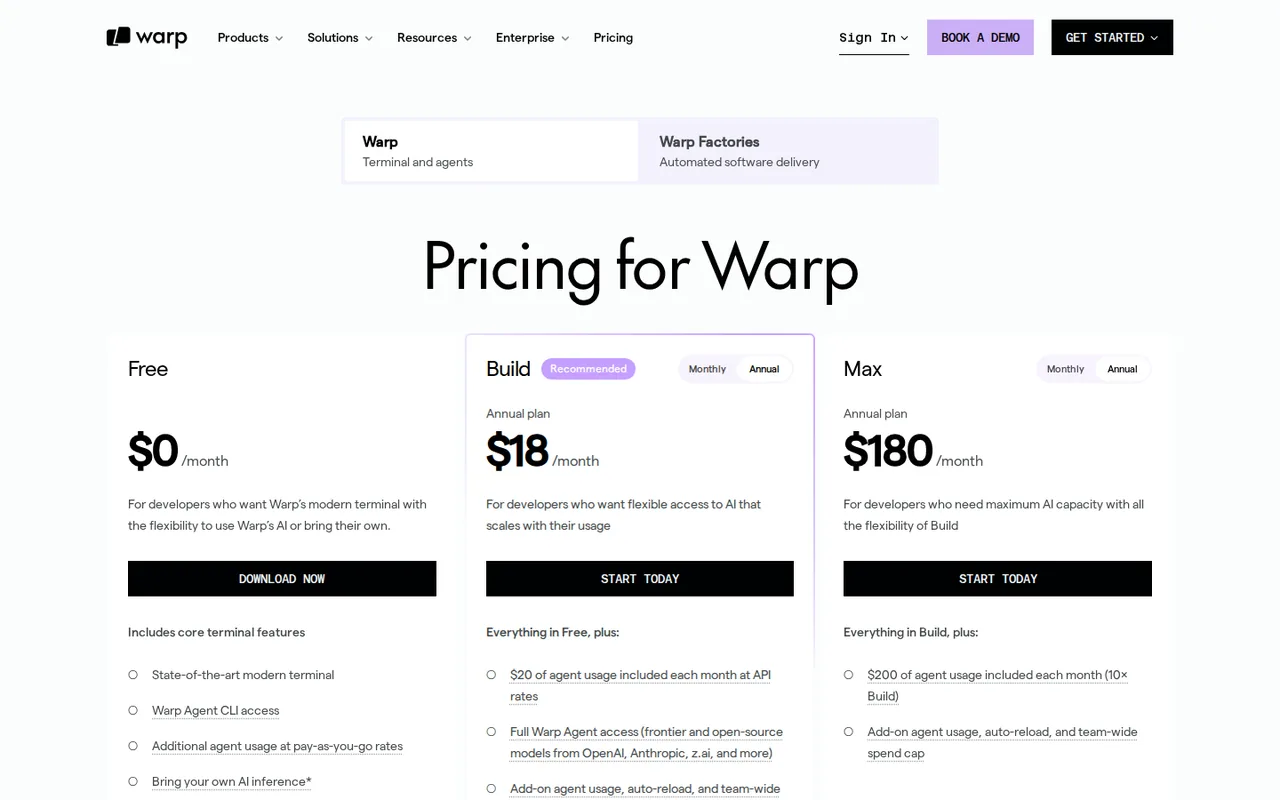
Included usage is per seat, resets monthly even on annual billing and does not roll over; purchased usage is shared across a team and lasts 12 months, including after moving to Free. Warp says Warp-provided inference on paid self-serve plans is priced at public API rates, while Free-plan purchases carry a premium. A team-wide monthly spend limit, $200 by default, covers purchases and auto-reloads but is not a guaranteed ceiling. Existing seats can keep a different allowance from the one advertised, and converted credit packs keep their face value. Cloud runs also bill agent hours; the rate was not shown on the pricing page.
| Plan | Price | What you get |
|---|---|---|
| Free | $0 sourceFrom warp.dev/pricing, checked Oct 24, 2026 (opens in a new tab) | Terminal and Warp Agent CLI; no bundled agent usage, so buy usage at a premium ($12 for $10, up to $120 for $100) or bring your own key; limited cloud agents; 3 indexed codebases of 3,000 files; 30 stored cloud conversations. |
| Build | $20/monthor $18/month billed annually sourceFrom warp.dev/pricing, checked Oct 24, 2026 (opens in a new tab) | $20 of agent usage at API rates each month; add-on usage at face value ($10, $20, $50 or $100); 40 indexed codebases of 100,000 files; 20 concurrent cloud agents; private email support. |
| Max | $200/monthor $180/month billed annually sourceFrom warp.dev/pricing, checked Oct 24, 2026 (opens in a new tab) | $200 of agent usage each month on the plan card (the comparison table shows $240, or 18,000 credits); 20 concurrent cloud agents with larger compute. |
| Business | $50 per user per monthor $45 billed annually sourceFrom warp.dev/pricing, checked Oct 24, 2026 (opens in a new tab) | Up to 25 seats; $20 of agent usage per seat each month; SAML-based SSO; admin data controls; team-managed keys and endpoints; zero data retention. |
| Enterprise | Custom pricing | Unlimited seats, custom shared usage pools, inference through your own cloud (BYOLLM), self-hosted cloud agents and a dedicated account manager. |
How far does it go?
- One month of agent tasks in dollarsAssume 200 agent tasks a month, each sending 200,000 uncached input tokens and receiving 10,000 output tokens on Claude Sonnet 5.5, whose list API price is $2 and $10 per million tokens: $0.50 a task, $100 of usage a month. On Build, $20 is included and $80 more is bought at face value, so the month costs $100. Max ($200) covers it but leaves $100 unused, which does not roll over. On Free, $100 of usage costs $120 at the $12-for-$10 rate. With your own Anthropic key on Free, Anthropic bills the $100 and local runs carry no Warp charge. Editorial arithmetic on published rates and an assumed workload, not a Warp figure.
Arithmetic from the published allowances above, not a usage test.
Taxes, currency and promotions can change the price you see at checkout.
Try Warp free (opens in a new tab)
Key features
| Feature | What it does | Watch out |
|---|---|---|
| Warp Agent inside the terminal: prompt in natural language, review diffs and approve actions in the same input where you run shell commands (pricing page, Agent CLI docs) | — | |
| Warp Agent CLI: the same agent as a standalone `warp` command that runs in any terminal emulator, including over SSH, with its own pseudoterminal for interactive programs (Agent CLI docs) | — | |
| Model choice across frontier and open models from OpenAI, Anthropic, Google, z.ai and others, with your own key for OpenAI, Anthropic or Google, or a connected ChatGPT or SuperGrok subscription (BYOK docs) | Warp's Auto models always use Warp-provided inference and draw on your usage balance, even after you add your own API keys. | To bill your provider instead, pick a specific model marked with a key icon in the model picker. |
| Cloud agents on Warp-hosted sandboxes, with concurrent limits from 20 on Build to 80 on Business, plus Claude Code and Codex as alternative harnesses (pricing table, platform usage docs) | — | |
| Codebase indexing for agent context: 3 codebases of 3,000 files on Free, 40 of 100,000 files on Build and Max, 80 on Business (pricing table) | — | |
| Slack, Linear and GitHub integrations: mention @Warp to investigate a bug, suggest a fix or open a pull request (pricing page) | — | |
| Three cost components | A run can incur inference (model calls Warp provides), compute (a Warp-hosted sandbox) and platform charges (billable agent hours on cloud runs). | Local runs on Free, Build and Max carry no platform charge, whether Warp or you pay for the model. |
| Secret Redaction | An optional setting masks content matching your patterns before AI requests are sent; it is off by default. | Telemetry payloads are redacted with built-in patterns regardless of this setting. |
What is free in Warp, and what costs money?
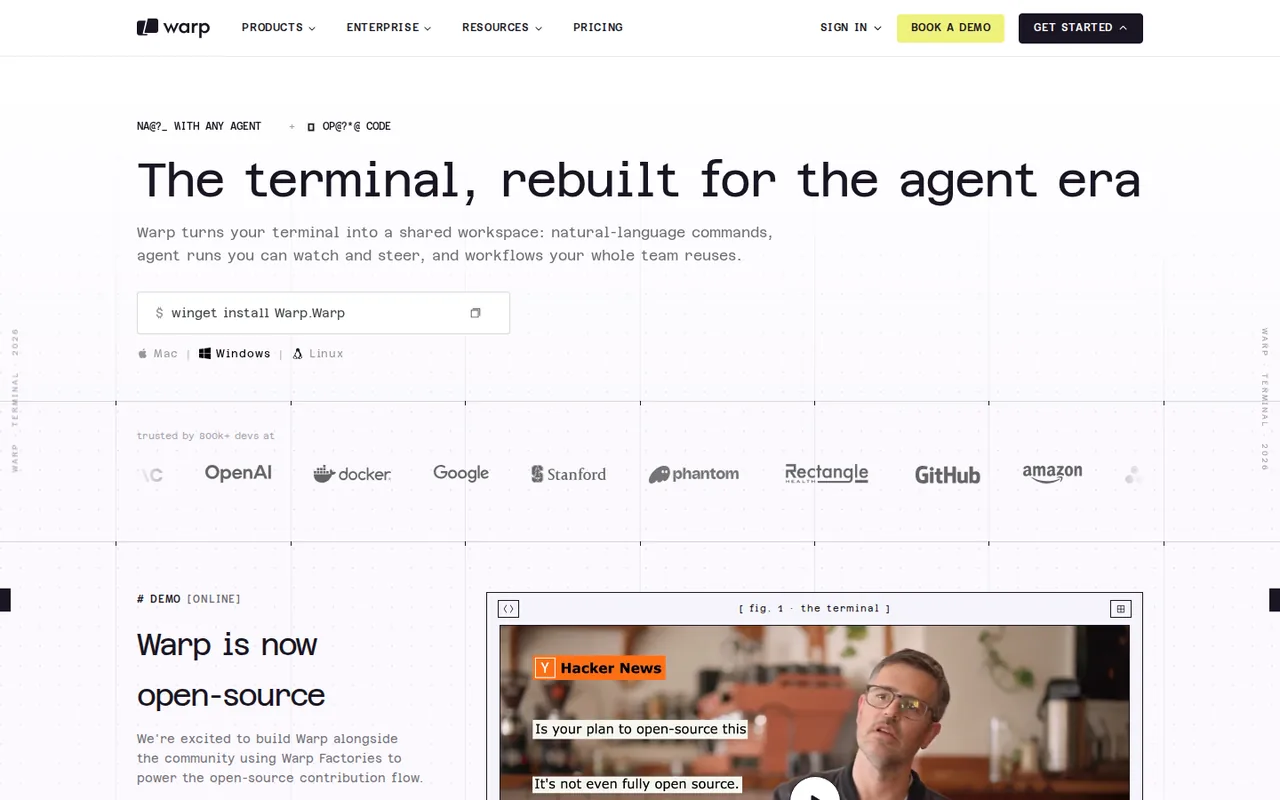
The terminal is free; the agent’s model calls are not. The plans page says the Free plan includes no bundled usage for the Warp Agent, so you either buy usage, upgrade or bring your own inference. Ordinary shell commands and non-AI terminal features never draw on agent usage, according to the usage docs. Other AI features, such as Generate and AI Autofill in Workflows, do.
Buying usage on Free costs more than on a paid plan. The pricing page sells Free-plan usage at $12 for $10, $24 for $20, $60 for $50 and $120 for $100, while paid plans buy the same amounts at face value. Purchased usage rolls over for 12 months and stays available after moving back to Free.
How is agent usage counted?
In dollars for most self-serve accounts, after a change from credits. The usage docs say a plan bills either a US dollar balance or credits, and Enterprise contracts that use credits keep their terms. The pricing page still mixes both: the Build card promises $20 of usage while the comparison table lists $20 as 1,500 credits, and the Max card says $200 while the table says $240, or 18,000 credits. Your own Settings, Billing and usage screen shows the allowance that applies to your seat.
A run can draw on three parts. Inference is the model call, priced for paid self-serve plans at public API rates. Compute is the Warp-hosted sandbox for cloud runs. Platform usage bills agent hours on cloud runs, excluding queued and idle time; for the Warp Agent it counts time spent generating responses, while Claude Code and Codex runs count their whole active runtime. Below each response Warp shows the turn’s cost, with input, output and cache tokens where available.
When does bringing your own key help?
The BYOK docs allow your own OpenAI, Anthropic or Google key on Free and every eligible paid plan, but only for individuals and organizations with 10 or fewer employees; larger companies need Business or Enterprise. Keys are stored on your device, and your prompt, context and key pass through Warp’s servers to the provider; Warp says it does not retain the key. Personal keys work for local runs, not cloud runs.
Two details decide whether the key actually saves money. The Auto models always use Warp-provided inference, so only a specific model marked with a key icon bills your provider. And on Business and Enterprise, local runs with your own inference add a platform charge. A ChatGPT or SuperGrok subscription can be connected, but a Claude consumer subscription cannot; if you pay for Claude and want its own terminal agent, the Claude profile covers that route.
What data leaves your machine?
With “Help improve Warp” switched on, the privacy docs say Warp may collect high-level usage events and the AI interactions and console inputs behind its AI features. Business and Enterprise are covered by a zero data retention agreement, so no AI interaction or console data is collected there. For model traffic Warp routes to OpenAI, Anthropic, Google or xAI, every plan is covered by zero data retention agreements with those providers; traffic through your own key follows your provider’s policy.
You can switch off telemetry and crash reports under Settings, Privacy, and the docs publish every telemetry event. The client source is public under AGPL v3. The license agreement itself is broader: it lets Warp use licensee data to improve the product, including training its algorithms and models, which sits alongside the narrower privacy-docs wording.
What are the refund rules?
The refund policy covers mistaken sign-ups. A monthly plan is refunded in full if you cancel within 24 hours of the charge and used nothing; otherwise the plan runs to the end of the cycle. An annual plan is refunded in full within 15 days with no usage, and after that for the remaining full months, excluding the first. A usage purchase is refundable only if none of it was used. Refunds for a product defect need the conversation ID, logs and “Help improve Warp” enabled.
The Terms of Service, from Denver Technologies, Inc. doing business as Warp.dev, describe payments as non-cancelable and non-refundable except for a material breach by Warp. Warp also offers no guaranteed uptime agreement; incidents appear on its status page.
How could you check Warp before paying?
Proposed evaluation · not performed yet
Price one small agent task on the Free plan with your own key before choosing a plan.
- Install Warp, leave Settings, Privacy at your preferred telemetry choice, and add your Anthropic, OpenAI or Google key under API keys.
- Open a small repository and pick a specific model with the key icon, not Auto.
- Ask the agent to fix one failing test, approve each command, and read the diff before accepting it.
- Expand the usage under the response and note input, output and cache tokens and the cost.
- Repeat the task on Auto and compare what was drawn from Warp usage rather than your provider.
Accept if the test passes, no command ran without approval, and the per-task cost fits your monthly volume. Reject if the agent changes unrelated files or the cost on Auto is not visible before you top up. No result is recorded here.
Warp alternatives
Other coding tools checked with the same method. Pick by the job, not by a score.

Developers who want an approval-based coding agent and choose and pay for their own models

Developers evaluating controlled repository edits with their own test suite

Developers reviewing small repository changes

Running an open model locally for code and text work

Agentic coding in a desktop IDE on a metered budget

Reviewing small code changes in an existing editor

Reviewing refactoring suggestions within JetBrains IDEs

Developers who want spec-driven agent work in a VS Code-style IDE with a fixed monthly credit cap
Used Warp? Write the first review. Visitor opinions are moderated and kept separate from our source checks.
Frequently asked questions
Is Warp free?
The Warp terminal and the Warp Agent CLI are free to use, and regular shell commands never cost anything. The Free plan includes no agent usage, though: you pay for model calls by buying usage at the Free-plan premium or route them through your own API key. Free also limits indexing to 3 codebases of 3,000 files and keeps 30 cloud conversations.
Is Warp open source?
The client is. Warp's privacy documentation links the source code in the warpdotdev/warp GitHub repository and says it is open source under the GNU Affero General Public License v3. Hosted services such as cloud agents, Warp Drive and Warp-provided inference remain governed by Warp's license agreement and plan terms.
Why does the Max plan show two different allowances?
In October the pricing page showed $200 of agent usage a month on the Max plan card and $240, or 18,000 credits, in the comparison table below it. Warp moved self-serve billing from credits to dollars, and the docs say existing seats can keep a different allowance, so check Billing and usage in the app.
Can I use the Warp agent outside the Warp app?
Yes. The Warp Agent CLI is a standalone program started with the warp command, and it runs the same agent as the app in any terminal emulator, including over SSH. It keeps its own pseudoterminal, so you and the agent can run commands and interact with full-screen programs in the same session.
Who runs Warp?
Denver Technologies, Inc., doing business as Warp.dev, is the company named in Warp's software and services license agreement. That agreement covers every Warp product you download or access, charges fees on a monthly recurring basis by default, and lets Warp charge the saved card for subscriptions and overages.
Sources and method13 official sources · 20 details checked · Oct 24, 2026
How we checked this profile
20 details on this page were checked against Warp's own pages and help documentation (Oct 24, 2026).
See the checks by section19 documented1 editorial assessment
| Section | Checks | Last checked | Sources |
|---|---|---|---|
| Plans and prices | 7 documented 1 editorial | warp.dev/pricingdocs.warp.dev/plans-pricing-refundsdocs.warp.dev/add-on-creditsplatform.claude.com/pricing | |
| Features | 3 documented | warp.dev/pricingdocs.warp.dev/platform-credits | |
| Article text | 6 documented | docs.warp.dev/plans-pricing-refundsdocs.warp.dev/creditsdocs.warp.dev/bring-your-own-api-keydocs.warp.dev/privacydocs.warp.dev/pricing-faqswarp.dev/terms-of-service | |
| Strengths and limits | 1 documented | docs.warp.dev/privacy | |
| Questions | 1 documented | docs.warp.dev/cli | |
| Official channels and media | 1 documented | warp.dev |
Sources for this profile
- Pricing page (monthly and annual views, comparison table)warp.dev
- Warp homepagewarp.dev
- Docs: plans, pricing and refundsdocs.warp.dev
- Docs: usage and billingdocs.warp.dev
All 13 sources
- Docs: purchasing additional usagedocs.warp.dev
- Docs: platform usagedocs.warp.dev
- Docs: pricing and billing FAQsdocs.warp.dev
- Docs: privacy and data controldocs.warp.dev
- Docs: bring your own API keydocs.warp.dev
- Docs: Warp Agent CLI overviewdocs.warp.dev
- Software and Services License Agreement (Terms of Service)warp.dev
- GitHub repository warpdotdev/warp (AGPL-3.0 licence)github.com
- Anthropic API pricing (for the editorial cost example)platform.claude.com
Official pages read on 24 Oct 2026: the pricing page with a local browser in its annual and monthly views, the docs on plans and refunds, usage and billing, purchasing usage, platform usage, pricing FAQs, privacy, BYOK and the Agent CLI, the Terms of Service and the GitHub repository. We did not install Warp or run an agent. Sources disagree in places: the Max card shows $200 of usage and the comparison table $240 or 18,000 credits; the docs publish refund windows while the terms call payments non-refundable; and the terms grant Warp the right to train models on licensee data, while the privacy docs say Business and Enterprise collect no AI interaction data. The agent-hour rate for cloud runs was not visible. Anthropic's API price page was read for the cost example. Third-party prices and reviews were not used.
Sources checked Oct 24, 2026. Found something out of date? See how we correct profiles.