
What is Semantic Scholar, in short?
Updated October 24, 2026 · By Elias Brandt · Documentation review, not tested hands-on
Pros
- Free without an account
- Published API limits
- Institutional full text
- Non-profit operator
Cons
- TLDRs in two fields only
- Simple query language
- Thin book and patent coverage
- English first
- No notes, no app
Best forResearchers following a fast-moving fieldDevelopers building literature toolsReaders in computer science and biomedicineNot for complex Boolean search stringsNot for non-English literature
Strengths, limits and who it suits, in full
Strengths
- Free without an account Search, paper pages and citation data open without signing in.
- Published API limits The API page states the shared rate for calls without a key and the starting rate for a key.
- Institutional full text Signing in through OpenAthens, eduGAIN or InCommon links to subscribed PDFs through GetFTR and LibKey.
- Non-profit operator Ai2 is a Seattle-based non-profit AI research institute.
Limits
- TLDRs in two fields only One-sentence AI summaries cover computer science and biomedical papers.
- Simple query language Search has no Boolean operators or wildcards and does not expand abbreviations; quoted phrases work.
- Thin book and patent coverage Book coverage is very limited and patents are excluded, so counts differ from other indexes.
- English first The corpus focuses on English-language publications.
- No notes, no app Semantic Reader has no built-in note-taking since its Hypothesis integration ended, and there is no smartphone app.
Who it suits
- Researchers following a fast-moving field Research Feeds and alerts bring new papers to a daily list and the inbox.
- Developers building literature tools The free API and monthly dataset downloads expose the same corpus.
- Readers in computer science and biomedicine TLDRs and the arXiv-based Semantic Reader help most in those fields.
- Not for complex Boolean search strings a systematic-review search string needs a database that supports Boolean operators.
- Not for non-English literature The corpus focuses on English-language papers.
How much does Semantic Scholar cost?
Prices confirmed · checked
Regional prices: Semantic Scholar has no paid tier and no pricing page; the FAQ describes it as free, and an account is optional.
API keys are requested through a form and arrive by email; some users are granted a slightly higher rate after a review. API use falls under a separate license that requires attribution to Semantic Scholar, keeps the data under its own licences such as ODC-BY, and lets Ai2 end access at any time. Paywalled full texts can still cost money at the publisher.
| Plan | Price | What you get |
|---|---|---|
| Without an account | $0 sourceFrom semanticscholar.org/faq, checked Oct 24, 2026 (opens in a new tab) | Search, paper pages, TLDRs where available, citation data, Semantic Reader on arXiv papers and full-text links; no sign-in needed. |
| Free account | $0 sourceFrom semanticscholar.org/faq, checked Oct 24, 2026 (opens in a new tab) | Library folders with bulk export and shareable links, email alerts for authors, papers, topics and feeds, Research Feeds, author page claims, and institutional sign-in for subscribed PDFs. |
| API key | $0 sourceFrom semanticscholar.org/faq, checked Oct 24, 2026 (opens in a new tab) | Academic Graph, Recommendations and Datasets APIs; a key starts at 1 request per second on all endpoints, while calls without a key share 1,000 requests per second among all such users; attribution required. |
How far does it go?
- A monthly library refresh through the APIUpdating details for a 2,000-paper library takes 4 paper batch calls (500 IDs each), and pulling 25,000 records for a topic sweep takes 25 bulk search calls (1,000 each). At the starting rate of 1 request per second that is under a minute of request time; the 10 MB response cap is the limit more likely to bind. Arithmetic on published API limits, not a statement by Semantic Scholar.
- Requests a key allows in a dayAt 1 request per second a key allows at most 86,400 requests in 24 hours (60 x 60 x 24). Calls without a key have no per-user figure, because 1,000 requests per second are shared among everyone without one and may be throttled. Arithmetic on published API limits, not a statement by Semantic Scholar.
- Setting up Research Feeds for four projectsThe FAQ suggests 5 saved papers and 3 not-relevant ratings per feed, so four project folders need 20 saves and 12 ratings before tuning; each feed then draws only on papers from the last 3 months. Arithmetic on the FAQ guidance, not a statement by Semantic Scholar.
Arithmetic from the published allowances above, not a usage test.
Taxes, currency and promotions can change the price you see at checkout.
Try Semantic Scholar free (opens in a new tab)
Key features
| Feature | What it does | Watch out |
|---|---|---|
| Search across all fields of science, sortable by relevance, citation count, influence or recency, with quoted phrases (FAQ) | — | |
| TLDRs: one-sentence AI summaries next to search results, currently for computer science and biomedical papers (FAQ) | — | |
| Highly Influential Citations, citation intent (background, method, result) and citation velocity on paper pages (FAQ) | A weighted average of a paper's citations over the last 3 years, with citation acceleration showing whether that rate is rising or falling. | Both depend on the citing papers the corpus holds. |
| Research Feeds that recommend new papers each day from what you save in a library folder (FAQ) | — | |
| Semantic Reader (beta) for arXiv papers, with in-line citation cards, Ask This Paper and skimming highlights (FAQ) | — | |
| Academic Graph, Recommendations and Datasets APIs with free keys, plus monthly dataset downloads (API page) | — | |
| Influence signals need the full text | Highly influential citations and citation intent come from machine-learning models that read the citing paper. | Where Semantic Scholar has no full text for the citing paper, an influential citation can go unflagged. |
| Field of Study tags | A classifier assigns up to three fields from the title and abstract. | It works only on English-language papers and may leave a paper with an ambiguous title untagged. |
What is free, and what needs an account?
Everything is free. The FAQ calls Semantic Scholar a free, AI-powered search and discovery tool and says no account is needed to reach the papers. A free account adds a library with folders, bulk citation export and shareable folder links, email alerts for authors, papers, topics and Research Feeds, the feeds themselves, and the option to claim an author page.
Signing in with an institution through OpenAthens, eduGAIN or InCommon adds an Access PDF via Institution button where the publisher takes part in GetFTR, or a LibKey route where it does not. Without that, a paywalled paper links out to the publisher, where reading it may need a subscription or a purchase.
Where does the AI appear, and how far can you trust it?
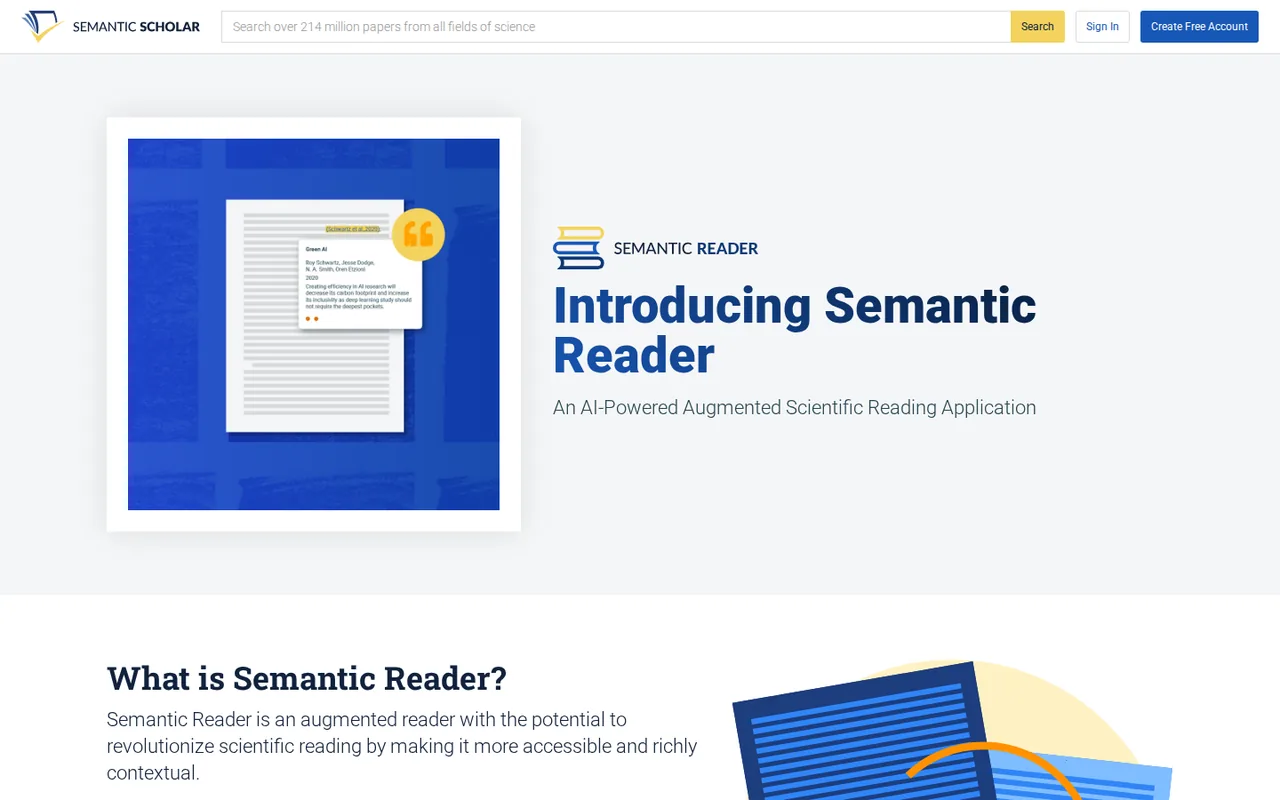
Machine learning ranks results, assigns fields of study, flags highly influential citations and classifies why one paper cites another. TLDRs, the one-sentence AI summaries shown beside results, are limited to computer science and biomedical papers. The generative features sit mostly in Semantic Reader, which opens only arXiv papers, 250k+ of them so far:
- Ask This Paper sends the paper and your question to OpenAI’s gpt3.5-turbo-16k and shows supporting snippets from the paper; it has been tested only on English-language papers.
- Clicking an underlined term asks ChatGPT for a definition in context.
- Skimming highlights mark Goal, Method and Result passages on a limited set of English papers, on desktop.
- Topic pages use large language models to extract topics and write their definitions.
The FAQ warns that generated text can contain factual errors that are hard to spot, from subtle to serious, so check each answer against the snippet it cites.
How complete is the corpus?
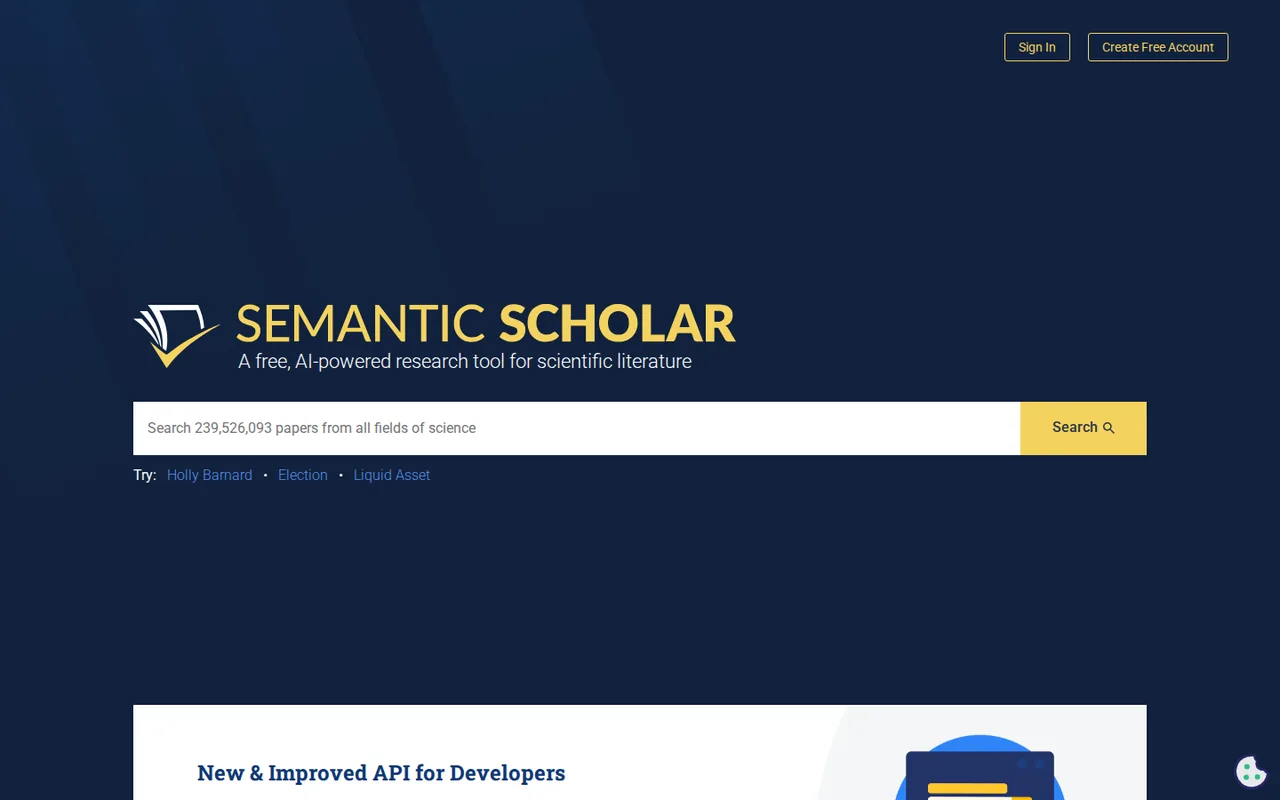
The API page counts 214 million papers, 2.49 billion citations and 79 million authors, while the homepage search bar showed 239,525,222 papers; the FAQ says the corpus keeps growing and points to the search bar for the current number. Content comes from web indexing and from partnerships with publishers and indexes such as PubMed, arXiv and Springer Nature.
The gaps are documented: book coverage is very limited, patents are not included and the focus is on English-language work, so citation counts and h-index values will differ from other sites. The FAQ itself advises against using its h-index for comparative research assessment. Other research tools build on this corpus; the Undermind profile covers a deep-search service that runs on the Semantic Scholar database.
How do search and Research Feeds behave?
Search does not support Boolean operators or wildcards, though quoted text works, and abbreviations such as KDD are not expanded, so search with full terms. Results can be sorted by relevance, citation count, most influential papers or recency, and the reranker model is published on GitHub.
A Research Feed is tied to a library folder and uses a paper embedding model. Papers saved in the folder count as positive signals and papers marked not relevant in the feed as negative ones. The feed refreshes daily and recommends only papers published in the last 3 months, so it is a monitoring tool rather than a way to find older literature.
What do the API limits and license require?
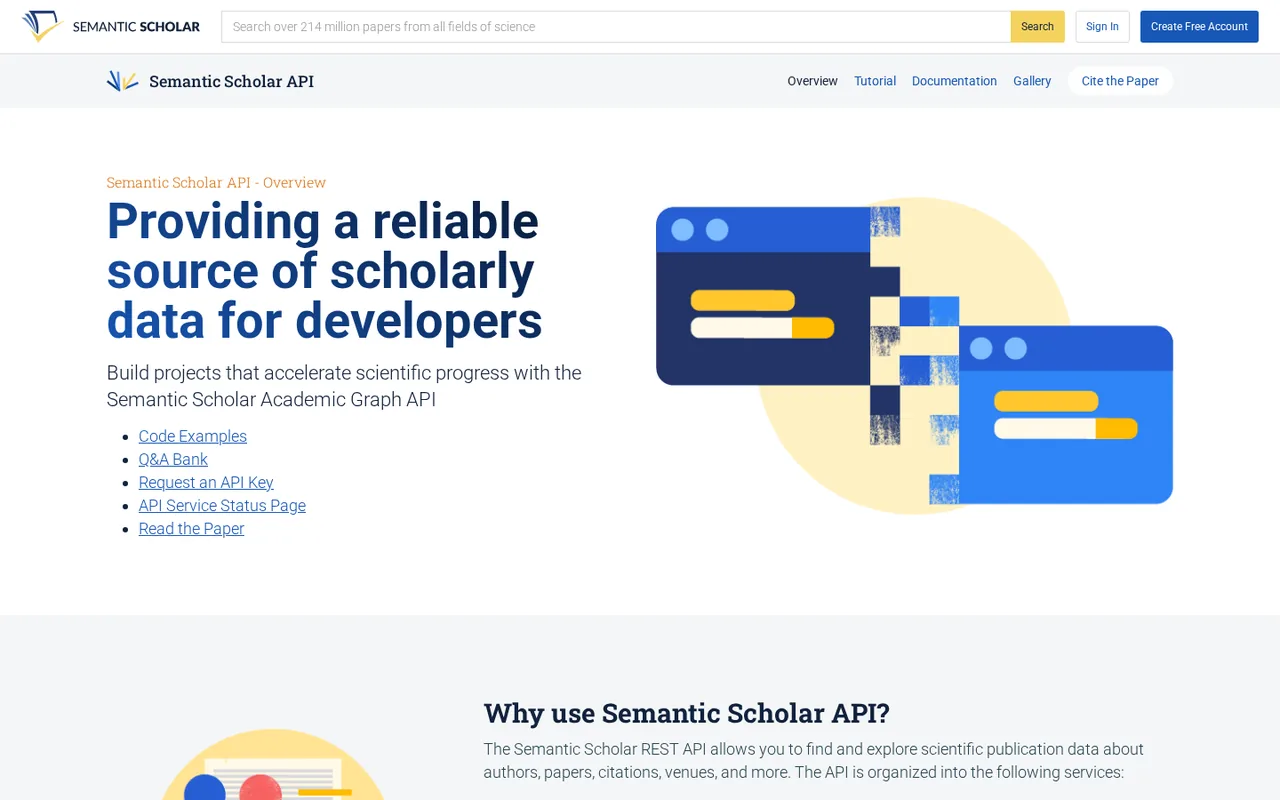
Most endpoints work without a key, but those calls share 1,000 requests per second among all unauthenticated users and can be throttled at busy times. The API tutorial says an individual key gets 1 request per second across all endpoints and recommends batch and bulk endpoints for large jobs. The API documentation sets the working limits:
- Paper batch: 500 paper IDs per call, up to 10 MB per response.
- Relevance search: up to 1,000 ranked results for a query.
- Bulk search: 1,000 papers per call, up to 10,000,000 papers in total.
- Author batch: 1,000 author IDs per call.
The API license requires an attribution to Semantic Scholar wherever results are published and a citation in scientific papers that use the API, and says exceeding or trying to get around the rate limits can lead Ai2 to suspend or disable access.
How could you check Semantic Scholar on your own topic?
Proposed evaluation · not performed yet
Check coverage and AI answers in one field you know before relying on it.
- List ten papers from your field, including two books or chapters and, if your field has them, two non-English papers.
- Search each title in quotes and record which appear, with their citation counts next to the counts in another index you use.
- Save five to a library folder, switch on a Research Feed and mark three recommendations as not relevant.
- Over the next week, count how many daily recommendations you would actually read.
- On one arXiv paper, ask Ask This Paper a question you can answer yourself and compare the answer with its supporting snippet.
Accept if your core papers appear and the generated answer matches its snippet. Reject if key papers or whole publication types are missing, or the answer states something the snippet does not. No result is recorded here.
Semantic Scholar alternatives
Other research & sources tools checked with the same method. Pick by the job, not by a score.

Comparing AI model answers by voting, without a paid plan

Finding and synthesizing published research

Extracting study data from research papers

K-12 schools piloting an AI tutor that teachers can monitor

Students and researchers reading a small set of papers who will check every cited passage

Researchers and students checking how a paper has been cited

Quick summaries of articles, papers and videos

Finding hard-to-locate papers on a specific research question
Used Semantic Scholar? Write the first review. Visitor opinions are moderated and kept separate from our source checks.
Frequently asked questions
Is Semantic Scholar free?
Yes. There is no paid tier or pricing page: search, paper pages, the library, alerts, Research Feeds and API keys all cost nothing, and paper pages open without an account. Full texts are a separate question, because paywalled papers link to the publisher, where access may need a subscription or a one-off purchase.
Who runs Semantic Scholar?
Ai2, the Allen Institute for Artificial Intelligence, a non-profit AI research institute in Seattle founded in 2014 by the late Paul Allen. Ai2's terms and privacy notice cover the site, with a Semantic Scholar section explaining that author pages are generated automatically from publicly available paper metadata.
How do I get a Semantic Scholar API key?
Request one through the form on the API page; the key is sent by email and should not be shared. It is free, and Ai2 may raise the starting rate a little after reviewing your use. Keep the key in every request, which the tutorial recommends, and use batch or bulk endpoints for large jobs.
Can I save Semantic Scholar papers to Zotero?
Yes. With the Zotero browser extension you can save from a paper page, from Semantic Reader, or several papers at once from a search results page; the paper details, URL, PDF where available and TLDR go into your Zotero library. Inside Semantic Scholar, the library can also export selected citations in bulk.
Is there a Semantic Scholar app?
There is no smartphone app; the site is designed to work in mobile browsers. Chrome and Firefox extensions let you highlight a paper title, keyword or author name on any web page and search Semantic Scholar from it, or jump straight to a matching paper page.
How do I claim my author page on Semantic Scholar?
Use the Claim Author Page button on the page. Ai2 stores the first and last name, email address and justification you submit in order to moderate the claim. Once it is approved you can add or remove papers, add an affiliation, a homepage link and an ORCID iD, and you can unclaim the page later.
Sources and method8 official sources · 23 details checked · Oct 24, 2026
How we checked this profile
23 details on this page were checked against Semantic Scholar's own pages and help documentation (Oct 24, 2026). 1 is still open and listed below.
See the checks by section21 documented1 editorial assessment1 open
| Section | Checks | Last checked | Sources |
|---|---|---|---|
| Article text | 9 documented | semanticscholar.org/faqsemanticscholar.org/tutorialapi.semanticscholar.org/graph | |
| Plans and prices | 3 documented 1 editorial | semanticscholar.org/faqsemanticscholar.org/apisemanticscholar.org/licenseapi.semanticscholar.org/graph | |
| Strengths and limits | 2 documented | semanticscholar.org/faq | |
| Features | 3 documented | semanticscholar.org/faq | |
| Questions | 4 documented | semanticscholar.org/faqallenai.org/terms.htmlallenai.org/privacy-policy.html | |
| Official channels and media | 1 open | semanticscholar.org |
Still open
- No social media accounts are linked from the Semantic Scholar pages read.Not confirmed · checked · Source (opens in a new tab)
Sources for this profile
- Semantic Scholar FAQsemanticscholar.org
- Semantic Scholar homepagesemanticscholar.org
- Semantic Scholar API overviewsemanticscholar.org
- API tutorial (rate limits and batch endpoints)semanticscholar.org
All 8 sources
Official pages read on 24 Oct 2026 with plain HTTP requests, plus a local browser for the homepage and the API documentation: homepage, FAQ, API overview, API tutorial, Academic Graph API documentation, API License Agreement, Ai2 Terms of Use and Ai2 Privacy Notice with its Semantic Scholar section. We did not create an account or request an API key. Paper counts differ by page: the API page lists 214 million papers, while the homepage search bar showed 239,525,222; the FAQ points to the search bar for the current number. Partner quotes on the API page were not used. Third-party reviews were not used.
Sources checked Oct 24, 2026. Found something out of date? See how we correct profiles.