
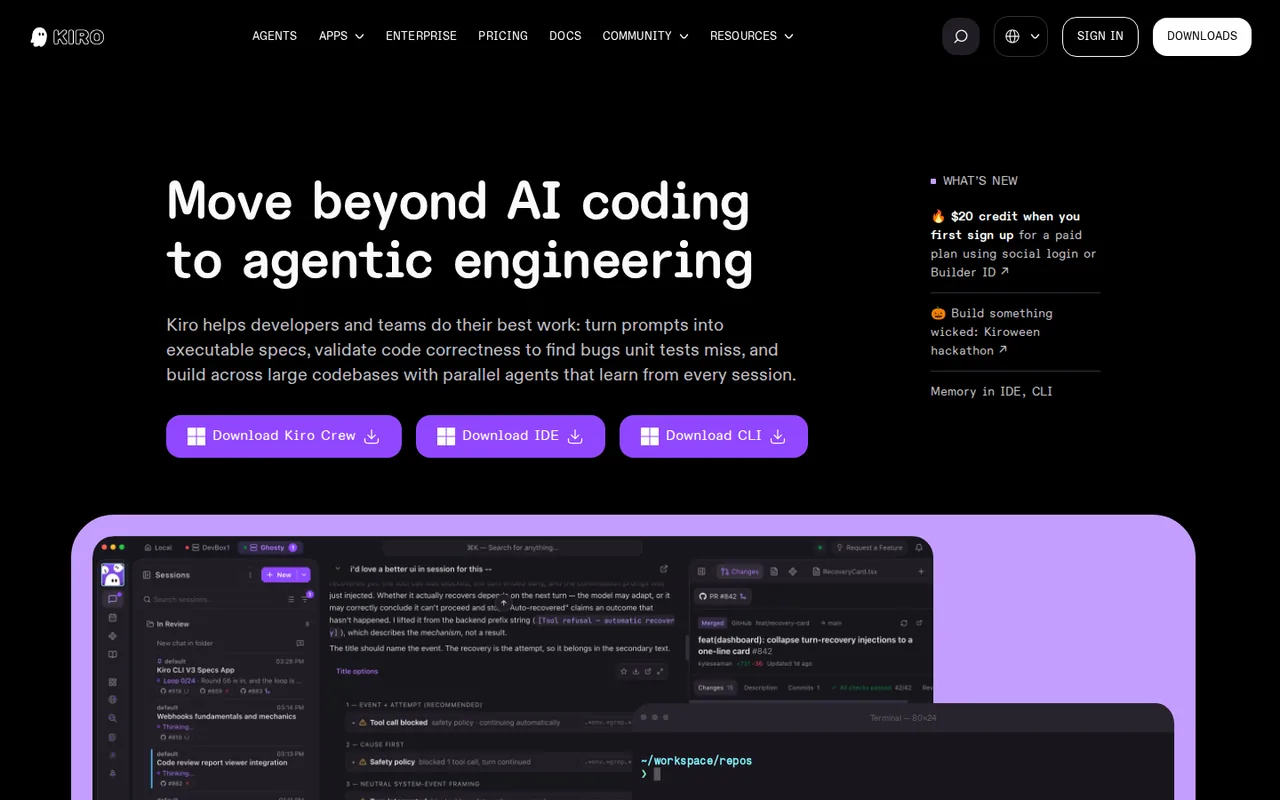
What is Kiro, in short?
Updated October 24, 2026 · By Elias Brandt · Documentation review, not tested hands-on
Pros
- Published credit sizes
- Hard cap by default
- Structured planning files
- Opt-out for content use
Cons
- Content used by default
- Free has no top-up
- Credits do not roll over
- Downgrades cost a full month
- No tokens-per-credit figure
Best forDevelopers who want a plan before codeAmazon Q Developer usersVS Code users willing to switch editorAnyone who needs a fixed monthly billNot for keeping prompts out of training by default
Strengths, limits and who it suits, in full
Strengths
- Published credit sizes Each plan states its monthly credits, and the docs list a multiplier for every model, so a month can be sized before paying.
- Hard cap by default If you buy no add-on credits, usage pauses at the plan limit instead of running up an overage bill.
- Structured planning files Specs leave requirements, design and tasks as files in the repository that you can review and keep.
- Opt-out for content use Free and individual users can switch off telemetry and content collection in the IDE and CLI settings.
Limits
- Content used by default Free and individual paid users' prompts, code and responses may be used for service improvement unless they opt out.
- Free has no top-up Free cannot buy add-on credits; when its 50 credits run out, you wait for next month or upgrade.
- Credits do not roll over Unused plan credits reset at the start of each calendar month; only purchased add-ons last 12 months.
- Downgrades cost a full month Moving to a cheaper plan mid-month still charges the current plan in full for that month.
- No tokens-per-credit figure The cost of a given task in credits is only known after it runs.
Who it suits
- Developers who want a plan before code Specs write requirements, design and tasks first, which suits features that need review before implementation.
- Amazon Q Developer users AWS names Kiro as the replacement, with Q Developer IDE plugins ending support on 30 April 2027.
- VS Code users willing to switch editor The Code OSS base imports settings, themes and Open VSX extensions.
- Anyone who needs a fixed monthly bill Without add-on credits, paid plans stop at their cap.
- Not for keeping prompts out of training by default content use is on until you opt out on Free and individual plans; only Enterprise users are opted out automatically.
How much does Kiro cost?
Prices confirmed · checked
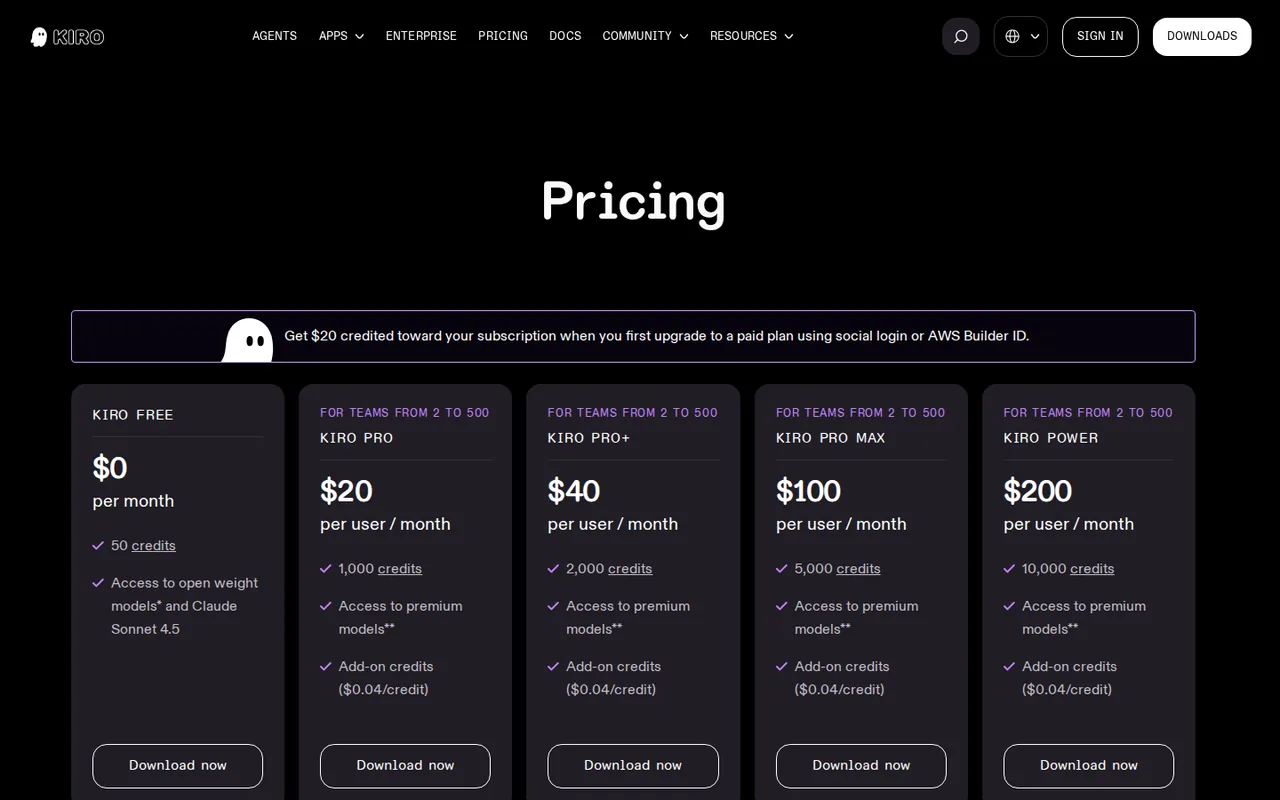
Regional prices: Prices exclude taxes and are charged on the calendar month (UTC) by credit card.
The first upgrade from Free is prorated to the days left and comes with a $20 credit for social login or AWS Builder ID accounts. Add-on credits cost $0.04 each, from $5 (125 credits) up to $100 per pack and up to five packs at a time; they expire 12 months after purchase and are used after plan credits. Plan credits do not roll over. Each developer needs a separate subscription, and paid plans are sold only to listed billing countries. No refund policy was found on Kiro's pages.
| Plan | Price | What you get |
|---|---|---|
| Free | $0 sourceFrom kiro.dev/pricing, checked Oct 24, 2026 (opens in a new tab) | 50 credits per month; open-weight models plus Claude Sonnet 4.5 (with Sonnet 4.0 and Auto); no add-on credits; credits reset monthly. |
| Pro | $20 per user per month sourceFrom kiro.dev/pricing, checked Oct 24, 2026 (opens in a new tab) | 1,000 credits per month; premium models; add-on credits at $0.04 each; Kiro Web and cloud sessions included. |
| Pro+ | $40 per user per month sourceFrom kiro.dev/pricing, checked Oct 24, 2026 (opens in a new tab) | 2,000 credits per month; premium models; add-on credits at $0.04 each. |
| Pro Max | $100 per user per month sourceFrom kiro.dev/pricing, checked Oct 24, 2026 (opens in a new tab) | 5,000 credits per month; premium models; add-on credits at $0.04 each. |
| Power | $200 per user per month sourceFrom kiro.dev/pricing, checked Oct 24, 2026 (opens in a new tab) | 10,000 credits per month; premium models; add-on credits at $0.04 each. |
| Enterprise | Contact sales | Centralized billing through AWS, SSO, usage analytics and enterprise security controls; content not used for service improvement. |
Which plan fits?
Smallest plan whose monthly credits cover your number with 15% spare for regenerations. Arithmetic from the plan table above, not a usage test.
How far does it go?
- One month of agent tasks in creditsAssume 200 agent tasks a month at 2 credits each on Auto, since Kiro publishes no tokens-per-credit figure: 400 credits. On Free, 50 credits cover 25 such tasks on Auto, or 19 on Claude Sonnet 4.5 at 1.3x (2.6 credits each). Pro ($20, 1,000 credits) covers the month on Sonnet 5.5 at 1.3x (520 credits) or Opus 5.5 at 2.0x (800 credits). On GPT-5.6 Sol at 4.4x the month needs 1,760 credits: Pro plus 760 add-on credits at $0.04 is $20 + $30.40 = $50.40, while Pro+ ($40, 2,000 credits) covers it for less. Editorial arithmetic on published prices and multipliers with an assumed credit count, not a Kiro figure.
Arithmetic from the published allowances above, not a usage test.
Taxes, currency and promotions can change the price you see at checkout.
Try Kiro free (opens in a new tab)
Key features
| Feature | What it does | Watch out |
|---|---|---|
| Specs: a feature or bug becomes requirements.md (or bugfix.md), design.md and tasks.md in .kiro/specs/, built requirements-first or design-first, with a one-pass Quick Spec option (Specs docs) | — | |
| Steering: Markdown files in .kiro/steering/ for one workspace or ~/.kiro/steering/ for all of them give the agent your standards, architecture and conventions (Steering docs) | — | |
| Hooks: JSON files in .kiro/hooks/ run a shell command or an agent prompt on events such as the agent saving a file, for example a lint-on-save check (Hooks docs) | — | |
| Model picker with credit multipliers, from Qwen3 Coder Next at 0.05x and Auto at 1.0x to Claude Opus 5.5 at 2.0x and GPT-5.6 Sol at 4.4x (Models docs) | — | |
| Cloud sessions on paid plans: the agent runs in a managed sandbox that clones attached repositories server-side, up to 10 at once, with no separate compute charge (Cloud sessions docs) | — | |
| Code OSS base: import VS Code settings, themes and Open VSX-compatible extensions during onboarding; sign in with GitHub, Google, AWS Builder ID or IAM Identity Center (FAQ, Authentication docs) | — | |
| What a credit is | A credit is a unit of work per prompt, metered to the second decimal place: a simple prompt can cost less than one credit, while a spec task typically costs more. | Kiro does not publish how many tokens a credit covers; a request with very large context or output can be counted as more than one credit. |
| Long-context surcharges | GPT-5.6 requests over 272,000 tokens are billed at double the listed multiplier (Sol 8.8x, Terra 4.4x, Luna 1.2x). | Claude Haiku 5.5 is 0.06x up to 100,000 tokens and 0.3x above that. |
| Free tier model set | Free users can pick Auto, Claude Sonnet 4.5 and 4.0, DeepSeek 3.2, MiniMax M2.5 and M2.1, GLM-5 and Qwen3 Coder Next. | Newer Claude Opus and Sonnet models, GPT-5.6 and Kimi K3 need a paid plan. |
What does a Kiro credit buy?
A credit is Kiro’s unit of work per prompt, not a token count. The billing questions page says a simple prompt can use less than one credit, a spec task typically uses more, and usage is metered to the second decimal place. The model you pick multiplies the cost. The models page sets Auto at 1.0x and gives the example that a task costing 10 credits on Auto costs 20 on Claude Opus 5.5 and 0.5 on Qwen3 Coder Next.
Two things make a task cost more than expected. Equal multipliers do not mean equal spend, because models generate different amounts of output and reasoning. And a request with very large context or output can count as more than one credit. Kiro shows the count right after each interaction and updates the account total at least every five minutes.
How do specs, steering and hooks change the work?
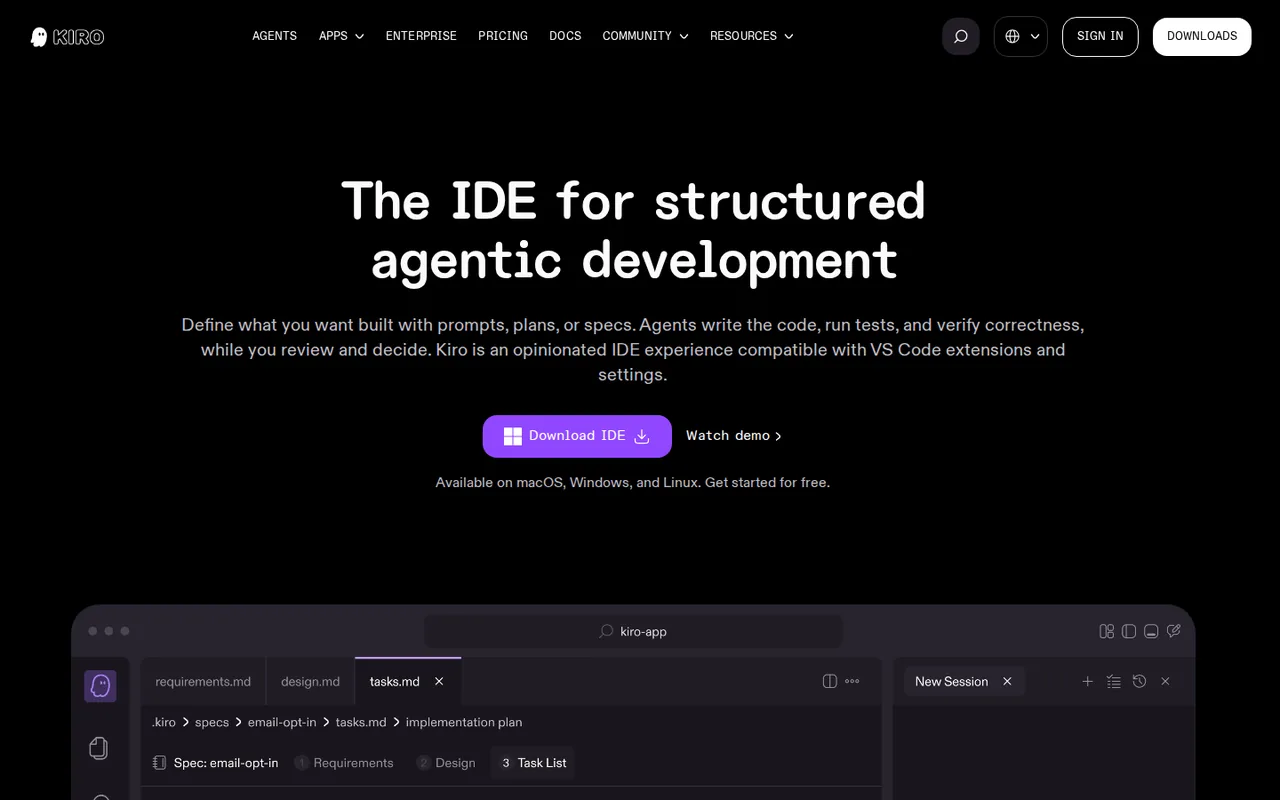
A spec turns a feature request into three files in .kiro/specs/: requirements.md with user stories and acceptance criteria, design.md with the architecture, and tasks.md with a trackable implementation plan. You can start from requirements or from the technical design; bugs get a bugfix.md instead. Each spec task the agent executes uses credits like any other prompt.
Steering files are Markdown documents that give the agent your standards; workspace files sit in the project, global ones in your home folder, and teams can push global files to machines through device management. Hooks are JSON files that run a shell command or an agent prompt when an event fires, such as the agent saving a TypeScript file. A hook that runs an agent prompt also uses credits each time it fires.
Which billing rules change what you pay?
The billing page separates the first upgrade from later ones. Your first move from Free to a paid plan is prorated to the days left in the month but gives the full credit allowance at once. After that first month, an upgrade charges the whole price difference and re-rates the month under the bigger allowance, while a downgrade charges the current plan in full and takes effect next month.
Cancelling means switching to Free: the cancellation guide keeps the paid plan to the end of the month and leaves unused add-on credits valid until they expire. The FAQ adds that a Kiro subscription works in the IDE, CLI, Web, Kiro Crew, ACP-compatible editors and CI automation, but not through third-party harnesses that route requests outside Kiro’s own interfaces.
What happens to your prompts and code?
It depends on how you sign in. The data protection page says content from Free and individual subscribers, meaning paid users who sign in with GitHub, Google or AWS Builder ID, may be used for service improvement unless they opt out. That content includes questions, other inputs, and the responses and code Kiro generates. Free inputs may also be kept up to 60 days for abuse detection. For both groups content is stored in the US East (N. Virginia) Region, while models may process requests elsewhere.
Enterprise users signing in through IAM Identity Center or their own identity provider are opted out automatically. Everyone else can turn off usage analytics and content collection separately in the IDE under Settings, Application, Telemetry and Content, or in the CLI settings.
Should Amazon Q Developer users move now?
AWS has set the dates. Its end-of-support post of 30 April 2026 says Q Developer IDE plugins and paid subscriptions reach end of support on 30 April 2027, new Q Developer sign-ups stopped on 15 May 2026, and the latest coding models are available only on Kiro. Existing Pro subscriptions can still add users, and Java upgrades and .NET porting through the plugins end on the same date. Q Developer inside the AWS console and chat apps is not affected.
Kiro is a separate subscription, priced per user in credits rather than the Q Developer Pro seat. If you would rather stay in a VS Code-style editor with a different usage model, the Devin Desktop profile covers the former Windsurf IDE.
How could you check Kiro on the free tier?
Proposed evaluation · not performed yet
Measure what one small spec costs in credits before choosing a paid plan.
- Install the IDE, sign in with GitHub or Google, and turn off content collection under Telemetry and Content if you want to keep prompts out of service improvement.
- Open a small repository and add one steering file with your test command and code style.
- Ask for a spec for one small feature on Auto, and check requirements.md and design.md before letting tasks run.
- Run the tasks one by one and note the credit count Kiro shows after each, plus the total on the usage dashboard.
- Multiply the credits per task by your expected monthly tasks and by the multiplier of the model you would use.
Accept if the tasks pass your tests and the projected month fits a plan’s allowance. Reject if the spec adds requirements you did not ask for, or one feature uses a large share of the 50 free credits. No result is recorded here.
Kiro alternatives
Other coding tools checked with the same method. Pick by the job, not by a score.

Developers who want an approval-based coding agent and choose and pay for their own models

Developers evaluating controlled repository edits with their own test suite

Developers reviewing small repository changes

Running an open model locally for code and text work

Agentic coding in a desktop IDE on a metered budget

Developers who work in the terminal and want an agent there, paid per use or through their own API key

Reviewing small code changes in an existing editor

Reviewing refactoring suggestions within JetBrains IDEs
Used Kiro? Write the first review. Visitor opinions are moderated and kept separate from our source checks.
Frequently asked questions
Is Kiro free?
Yes, within limits. New users start on the perpetual Free tier with 50 credits a month, which reset at the start of each month and cannot be topped up. Free covers Auto, Claude Sonnet 4.5 and several open-weight models but not the newest Claude, GPT or Kimi models. Kiro Web and cloud sessions need a paid plan.
How does the $20 sign-up credit work?
The first time you upgrade from Free with a social login or AWS Builder ID, Kiro credits $20 toward the subscription. Because the first month is prorated, the FAQ example of a Pro upgrade on 15 June credits $10 in June and charges $10 on 1 July. IAM Identity Center sign-ins do not get the credit, and paying requires a valid credit card.
Who owns Kiro?
Kiro comes from Amazon. Its license page says the Kiro IDE and CLI are licensed as AWS Content under the AWS Customer Agreement and the AWS Intellectual Property License, and the site's legal and privacy links go to aws.amazon.com. The IDE and CLI are not open source, although Kiro Crew is described as an open source workspace.
What systems does Kiro run on?
The IDE runs on macOS (Intel and Apple Silicon), Windows 10 or 11 on x64 or ARM64, and Linux distributions such as Ubuntu 24 or later and Fedora 40 or later. The CLI needs macOS, Windows 11 with PowerShell, or Linux with glibc 2.34 or later. The iPhone app is in early access through Apple TestFlight.
Can a team share one Kiro subscription?
No. The FAQ says each developer needs their own subscription, and team billing and management run through Kiro's Enterprise setup on AWS. Enterprise plans are billed by AWS rather than by billing address, so where you can buy follows the AWS Regions where the Kiro profile is set up.
Sources and method17 official sources · 24 details checked · Oct 24, 2026
How we checked this profile
24 details on this page were checked against Kiro's own pages and help documentation (Oct 24, 2026).
See the checks by section23 documented1 editorial assessment
| Section | Checks | Last checked | Sources |
|---|---|---|---|
| Plans and prices | 3 documented 1 editorial | kiro.dev/billingkiro.dev/pricingkiro.dev/add-on-creditskiro.dev/models | |
| Article text | 7 documented | kiro.dev/billingkiro.dev/cancellingkiro.dev/related-questionskiro.dev/data-protectionkiro.dev/steeringaws.amazon.com/amazon-q-developer-end-of-… | |
| Features | 8 documented | kiro.dev/related-questionskiro.dev/modelskiro.dev/faqkiro.dev/specskiro.dev/hookskiro.dev/cloud-sessionskiro.dev/authentication | |
| Questions | 3 documented | kiro.dev/licensekiro.dev/faqkiro.dev/installation | |
| Strengths and limits | 1 documented | kiro.dev/faq | |
| Official channels and media | 1 documented | kiro.dev |
Sources for this profile
All 17 sources
- Docs: billing and tier comparisonkiro.dev
- Docs: add-on creditskiro.dev
- Docs: cancelling a subscriptionkiro.dev
- Docs: billing related questionskiro.dev
- Docs: models and credit multiplierskiro.dev
- Docs: data protectionkiro.dev
- Docs: installation and system requirementskiro.dev
- Docs: authenticationkiro.dev
- Docs: specskiro.dev
- Docs: steeringkiro.dev
- Docs: hookskiro.dev
- Docs: cloud sessionskiro.dev
- AWS DevOps Blog: Amazon Q Developer end of support announcement, 30 April 2026aws.amazon.com
Official pages read on 24 Oct 2026 with plain HTTP requests (the docs serve Markdown copies) and a local browser for the pricing and license pages: homepage, pricing, FAQ, license, and docs on billing, add-on credits, cancelling, billing questions, models, data protection, installation, authentication, specs, steering, hooks and cloud sessions, plus the AWS DevOps Blog post of 30 April 2026 on Amazon Q Developer. We did not install Kiro or run a task. Kiro does not say how many tokens a credit covers, so task costs in credits are assumptions. The pricing page names Claude Sonnet 4.5 for Free while the models table also marks Sonnet 4.0, Auto and five open-weight models as Free. No refund policy was found. Third-party prices and reviews were not used.
Sources checked Oct 24, 2026. Found something out of date? See how we correct profiles.