
GitHub Copilot: free includes 2,000 completions, but the cloud agent starts on paid Pro at USD 10 per month
Updated October 2, 2026 · By Elias Brandt · Documentation review, not tested hands-on
Pros
- Keep the current editor
- Separate local and delegated work
- Visible billing units
- Concrete refactoring documentation
Cons
- Free is not unlimited agent work
- Variable interaction cost
- Exclusion gaps
- Cloud repository restriction
- Cloud agent excludes repositories owned by managed user accounts, and repository or organization policy can disable access.
Bottom line
Limited chat and agent usage; 2,000 inline completions per month; no cloud agent or paid code review.
You already work in a supported editor and want assistance added to it, because the free plan lets you try local chat and completions before paying.
You expect a fixed number of refactors for your money, because credit use depends on the model and the amount of context you supply.
Best forExisting IDE usersMaintainers with regression testsGitHub repository teamsBudget-conscious individuals
Strengths, limits and who it suits, in full
Strengths
- Keep the current editor Supported IDE integrations let a developer evaluate assistance without replacing the entire coding environment.
- Separate local and delegated work Chat, local agent mode and the cloud agent address different levels of repository work.
- Visible billing units The individual billing documentation explains credit conversion, base allowance and variable flex allotment.
- Concrete refactoring documentation Official examples cover maintainability changes rather than only new-code generation.
Limits
- Free is not unlimited agent work Free has limited chat and agent usage; cloud agent and code review require paid access.
- Variable interaction cost Long context, model choice and repeated edits change credit consumption.
- Exclusion gaps Content exclusion is not supported in Edit or Agent modes; do not treat a file policy as a universal boundary.
- Cloud repository restriction The cloud agent operates on GitHub-hosted repositories and can be disabled by repository policy.
- Cloud agent excludes repositories owned by managed user accounts, and repository or organization policy can disable access.
Who it suits
- Existing IDE users consider it when a plugin fits better than moving an established project to a different editor.
- Maintainers with regression tests use narrow refactors where expected behavior can be checked before merging.
- GitHub repository teams evaluate the cloud agent separately when a branch and pull request are the desired handoff.
- Budget-conscious individuals start with a small local task and inspect credit consumption before paying for a larger allowance.
How much does GitHub Copilot cost?
Prices confirmed · checked
Regional prices: These are individual USD monthly plans.
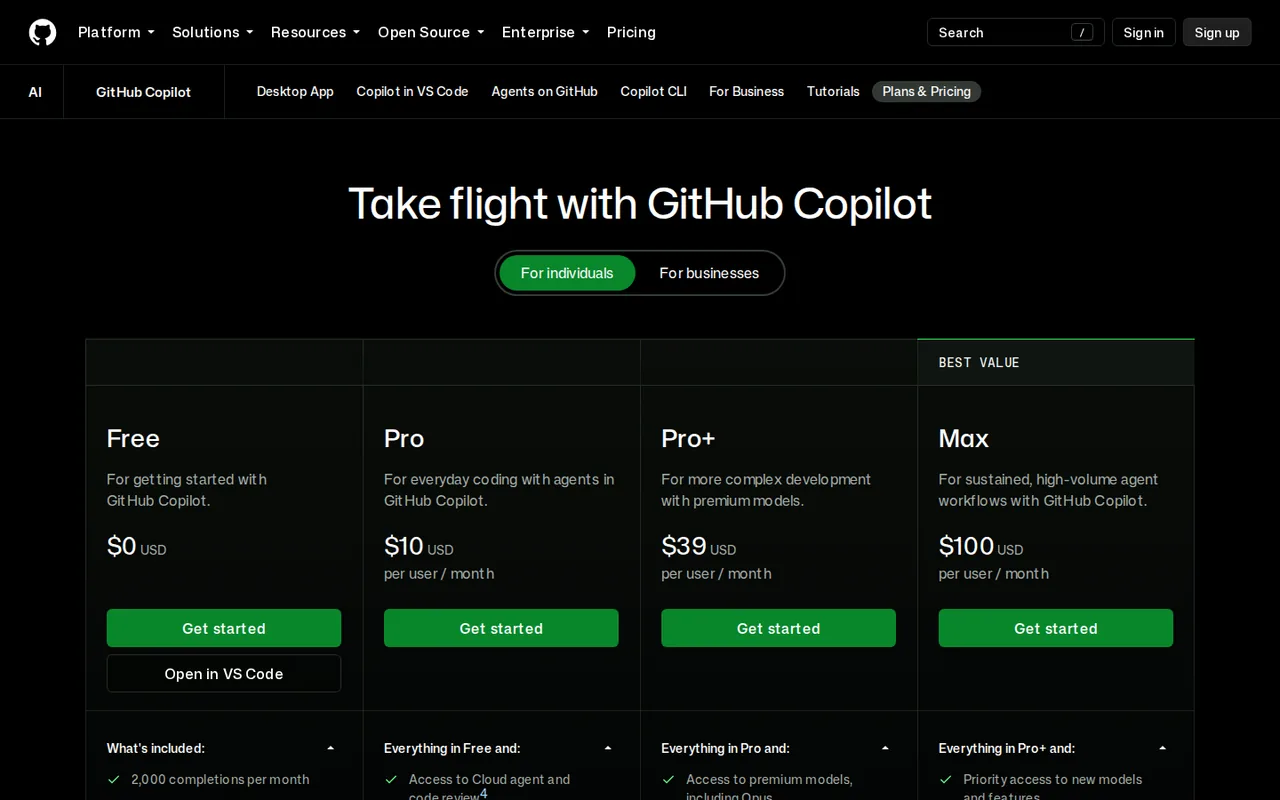
Organization licenses use separate terms and pooling. Taxes and checkout-localized totals were not established. The plans page states included usage in dollars: $15, $70 and $200 of total monthly credits for Pro, Pro+ and Max, each made of base credits equal to the price plus a flex allotment of $5, $31 and $100; at $0.01 per AI Credit these are the credit counts listed above. Flex allotments may change; included credits do not roll over and reset on the first day of the calendar month in UTC, independently of the subscription billing date. Extra usage requires its own budget. Cloud-agent work consumes both AI Credits and GitHub Actions minutes; code review also uses Actions minutes on private repositories. Check both included balances and overage settings.
| Plan | Price | What you get |
|---|---|---|
| Free | USD 0 sourceFrom github.com/features/copilot/plans, checked Oct 2, 2026 (opens in a new tab) | Limited chat and agent usage; 2,000 inline completions per month; no cloud agent or paid code review. |
| Pro | USD 10 per person per monthmonthly subscription sourceFrom github.com/features/copilot/plans, checked Oct 2, 2026 (opens in a new tab) | 1,000 base AI Credits plus a variable 500-credit flex allotment currently shown; unlimited inline completions; paid agent and review features. |
| Pro+ | USD 39 per person per monthmonthly subscription sourceFrom github.com/features/copilot/plans, checked Oct 2, 2026 (opens in a new tab) | 3,900 base AI Credits plus a variable 3,100-credit flex allotment currently shown; additional model/agent access varies by feature. |
| Max | USD 100 per person per monthmonthly subscription sourceFrom github.com/features/copilot/plans, checked Oct 2, 2026 (opens in a new tab) | 10,000 base AI Credits plus a variable 10,000-credit flex allotment currently shown; larger included usage. |
How far does it go?
- Base credit conversionUSD 10 / USD 0.01 per AI Credit = 1,000 base credits on Pro. The currently listed 500-credit flex allotment is additional and variable; neither amount implies a fixed number of prompts or refactors.
Arithmetic from the published allowances above, not a usage test.
Taxes, currency and promotions can change the price you see at checkout.
Try GitHub Copilot free (opens in a new tab)
Key features
| Feature | What it does | Watch out |
|---|---|---|
| Editor assistance | Inline completions and chat work in supported development environments. | — |
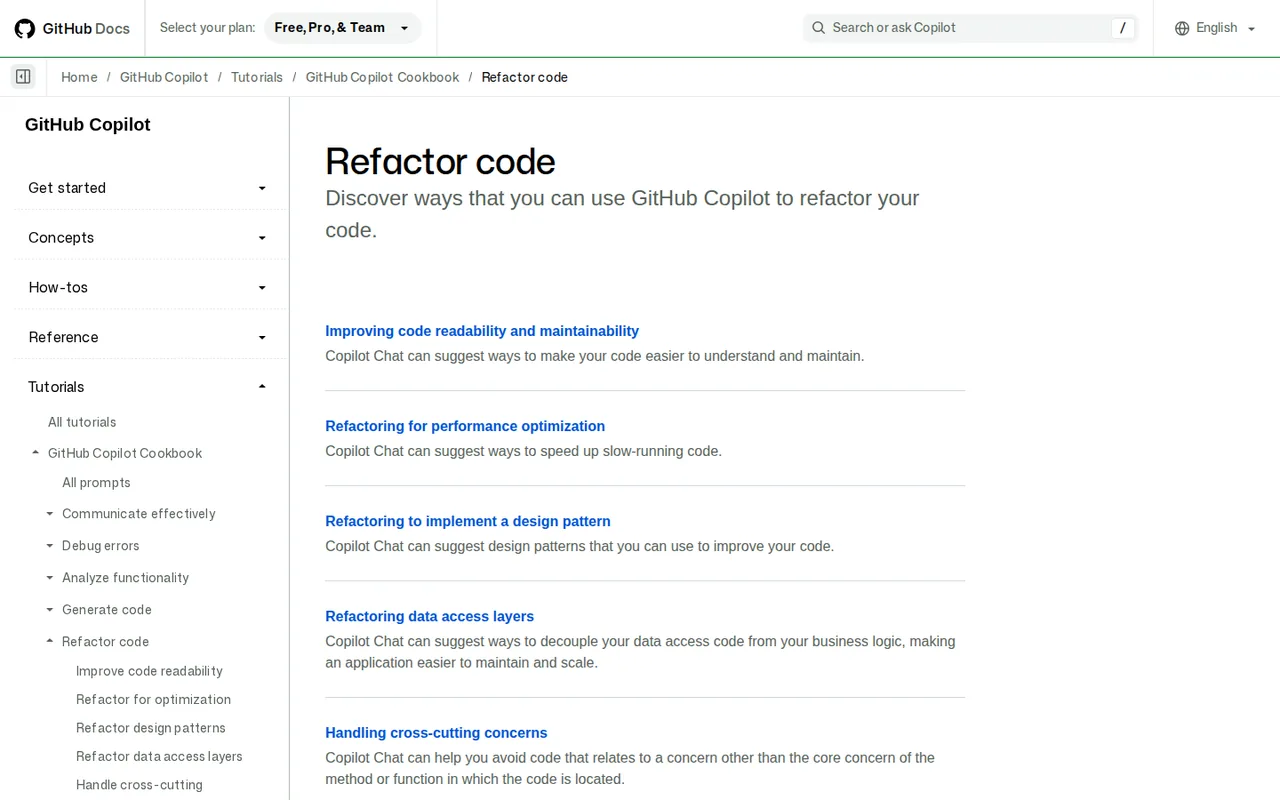
| Refactoring suggestions | Chat can suggest clearer naming, simpler conditionals and smaller methods. | — |
| Local agent mode | Agent mode can edit code in the local development environment. | — |
| Cloud agent | Paid plans can delegate repository research and code changes to an isolated GitHub environment.Research a GitHub repository and prepare changes on a branch before opening a pull request. | Requires a paid plan and enabled repository policies; it is distinct from local agent mode. |
| Code review | Paid plans include pull request reviews and file diff reviews in supported editors. | — |
| Custom instructions | Provide project rules and conventions to guide supported chat and agent workflows. | — |
| Refactoring chat | Select a function and request an explanation or a narrowly scoped structural change. | Generated suggestions still need regression tests; equivalent behavior is not guaranteed. |
| AI Credits | Model and token consumption determine how much allowance each interaction uses. | A dollar allowance cannot be converted into a fixed number of successful refactors. |
| Content exclusion | Business and Enterprise administrators can exclude files from supported Copilot features. | Edit and Agent modes do not support these exclusions; symlinks and remote filesystems have further limits. |
Should the change stay in your editor or run in the cloud?
Choose the execution location before you write the prompt. Local agent mode modifies the development environment you are using, while the cloud agent works in a separate GitHub environment and prepares a branch. For a small function cleanup, reviewing a local suggestion may be easier than configuring a delegated task; for a repository issue, a branch-based handoff may be useful.
What should a refactoring request preserve?
State the behavior that must survive: public names, return types, exception messages and ordering rules. Ask for the smallest structural change that improves one named problem. GitHub documents naming, conditional simplification and method extraction, but the useful output for a maintainer is a reviewable change with preserved behavior, not a shorter file at any cost.
- Keep the public function signature unchanged.
- List the observable behavior before suggesting a replacement.
- Reject new dependencies or unrelated formatting unless requested.
- Run the existing checks against the original and changed code.
Which personal plan is the first meaningful step up?
Editorial assessment
Free is a reasonable starting point for a small local suggestion when an allowance is available. Pro is the first paid individual tier with cloud-agent and code-review access; higher tiers primarily need justification from your actual workload and feature access. Do not buy a large allowance merely because the repository is large: a narrow change can use little context, while repeated whole-repository conversations can consume much more.
Why is there no reliable refactors-per-month figure?
Credit cost depends on the selected model and input, output and cached tokens. Repeating a prompt after adding logs or more files changes the work being billed. Keep the first experiment small, record the dashboard balance before and after it, and budget for review iterations; that observation is useful for your repository but should not become a universal claim about everyone else’s allowance.
Cloud-agent budgeting also needs GitHub Actions minutes, alongside AI Credits. Code review consumes Actions minutes on private repositories too. Check the two allowances separately before delegating a long-running task; a credit balance alone can hide the Actions cost of the workflow.
Do excluded files stay outside every agent workflow?
Do not infer that from an organization content-exclusion setting. GitHub identifies unsupported modes and indirect context limitations, including information supplied through IDE features. For a confidential project, confirm the exact mode and policy with its owner before providing context; use a sanitized fixture if the policy does not clearly permit the proposed workflow.
A task to evaluate before choosing
Proposed evaluation · not performed yet
Use an eligible account with remaining local chat allowance and a supported editor. Create a disposable JavaScript shipping-quote fixture with three nested conditions: express costs 12, standard costs 5, and unknown methods return the literal string unsupported. Add a free-shipping exception for standard orders of at least 100; express must still cost 12 above that threshold. No production repository or cloud-agent subscription is needed for this local exercise.
- Write assertions for standard totals 99 and 100, express total 100, and an unknown shipping method.
- Ask Copilot to replace nested branching while preserving all four results and the function signature.
- Inspect the diff before accepting it; reject changed error text, broad file edits or a new dependency.
- Run the assertions, inspect usage and save the final diff with the original fixture.
Pass only when the results remain 5, 0, 12 and unsupported, and you can explain the new branch order. Fail if the express case becomes free or the unknown method silently receives a standard price. If access or quota is unavailable, stop the task rather than treating an incomplete response as a successful refactor. For a separate code explanation, the ChatGPT and Claude profiles describe general assistants; the editorial policy explains the evidence standard.
Is GitHub Copilot worth it?
Documentation review plus dated public user reports. Documentation review, not tested hands-on. Not scored.
Worth it if
- You already work in a supported editor and want assistance added to it, because the free plan lets you try local chat and completions before paying.
- Your code lives in GitHub repositories and you want branch-based delegated changes, since the cloud agent is available only on paid plans.
- You can check generated changes against existing tests, which makes narrow structural edits easier to accept or reject.
Probably not if
- You expect a fixed number of refactors for your money, because credit use depends on the model and the amount of context you supply.
- Your repositories are owned by managed user accounts or hosted outside GitHub, since the cloud agent cannot work on them.
- You need file exclusions to hold in every mode, because Edit and Agent modes do not support content exclusion.
GitHub Copilot alternatives
Other coding tools checked with the same method. Pick by the job, not by a score.

Developers evaluating controlled repository edits with their own test suite

Reviewing refactoring suggestions within JetBrains IDEs

Developers who want an approval-based coding agent and choose and pay for their own models

Developers reviewing small repository changes

Agent-driven coding with a monthly credit budget

Builders evaluating a small operational app

Agentic coding in a desktop IDE on a metered budget

Developers who work in the terminal and want an agent there, paid per use or through their own API key
Used GitHub Copilot? Write the first review. Visitor opinions are moderated and kept separate from our source checks.
Frequently asked questions
Will unused AI Credits carry into next month?
Included credits expire rather than rolling forward. GitHub resets the monthly allowance at the start of each calendar month in UTC, even when the subscription bill arrives on another date. Check the usage dashboard before scheduling a large cleanup near that reset; previously unused allowance will not extend the next cycle.
Does unlimited completion mean unlimited chat?
No. Inline completion and interactions that consume AI Credits are separate parts of the offer. Paid individual plans list unlimited inline suggestions, while chat, agent work and code review use the relevant allowance. When comparing plans, record both entitlements instead of applying the word unlimited to every Copilot feature.
Can a team disable the cloud agent?
Yes. Repository owners can opt repositories out, and Business or Enterprise administrators control the relevant policy. A paid seat therefore gives the agent no access to a company repository whose owner has opted it out. Ask the repository owner which workflow is enabled before choosing a cloud-agent evaluation task.
Can I delegate a repository hosted outside GitHub?
The cloud agent is limited to repositories hosted on GitHub. Local editor assistance is a separate workflow, so this restriction should not be read as a blanket statement about all Copilot features. For a repository on another host, assess the supported local integration and its data rules instead of assuming cloud delegation will work.
How should I compare Copilot with a general assistant?
Give each candidate an authorized, small code sample and the same observable behavior requirements. Compare the effort needed to supply context, review changes and run your existing checks. Copilot adds editor and GitHub workflows; ChatGPT or Claude may fit a question-and-answer review. Product context should guide the choice before model preference.
Sources and method5 official sources · 10 details checked · Sep 27 – Oct 2, 2026
How we checked this profile
10 details on this page were checked against GitHub Copilot's own pages and help documentation (Sep 27 – Oct 2, 2026).
See the checks by section9 documented1 editorial assessment
| Section | Checks | Last checked | Sources |
|---|---|---|---|
| Features | 2 documented | docs.github.com/improve-code-readabilitydocs.github.com/about-cloud-agent | |
| Plans and prices | 5 documented | github.com/plansdocs.github.com/billingdocs.github.com/about-cloud-agent | |
| Strengths and limits | 2 documented | docs.github.com/content-exclusiondocs.github.com/about-cloud-agent | |
| Article text | 1 editorial | docs.github.com/improve-code-readability |
Sources for this profile
- Copilot plansgithub.com
- Individual AI Creditsdocs.github.com
- Readable code refactoringdocs.github.com
- Cloud agent scopedocs.github.com
All 5 sources
Official plan, billing, refactoring, cloud-agent and content-exclusion documentation supports the stated distinctions. Individual monthly prices are separated from organization licensing. Flex allowance and model availability can change; the sample task below is an evaluation proposal.
Sources checked Sep 27 – Oct 2, 2026. Found something out of date? Our editorial policy explains how we correct profiles.