Play.ht Alternatives After the Shutdown: Where to Move Your AI Voiceovers
Play.ht no longer sells plans, so the real question is where your scripts, pronunciation rules, cloned voices and API calls go next. This guide matches five live text-to-speech tools to the job your old account did, counts the same narration in each tool’s own unit, and lists what moves and what has to be rebuilt.
By Elias Brandt · Updated 8 Oct 2026 · About 17 min read · Plan terms taken from each tool profile
The short answer
Need commercial narration, cloning or an API on one plan? ElevenLabs adds a commercial license and instant voice cloning from Starter. Voicemaker’s Starter, at $5 billed monthly, also carries commercial rights and five clones.
Editing course or slide narration line by line? Murf Studio works block by block; downloads and commercial rights start at Creator.
No budget yet? TTSMaker’s free web route documents downloads and commercial use under its terms. Developers can start on Speechify’s API Free, which lists commercial use.
What happened to Play.ht, and what can you still recover?
What the record shows
In shortMeta bought the company in July 2025, and the service has since closed. There is no plan left to buy.
Meta acquired PlayAI, the company behind Play.ht. Bloomberg reported the deal on 2025-07-11, and TechCrunch wrote that a Meta spokesperson confirmed it and that the whole PlayAI team would join Meta. The product closed afterwards: an Internet Archive copy of play.ht from 2026-03-10 carries the banner “We have shut down the service. Thank you for being part of our journey.” The archived copy from 2025-12-31 still shows the normal homepage.
Some vendor blogs and search summaries give an exact shutdown day and a data-deletion date. We found no first-party Play.ht statement with those dates, so this guide does not repeat them. What can be checked today is that play.ht and play.ai have no web server behind them and their domain records point to Meta’s name servers.
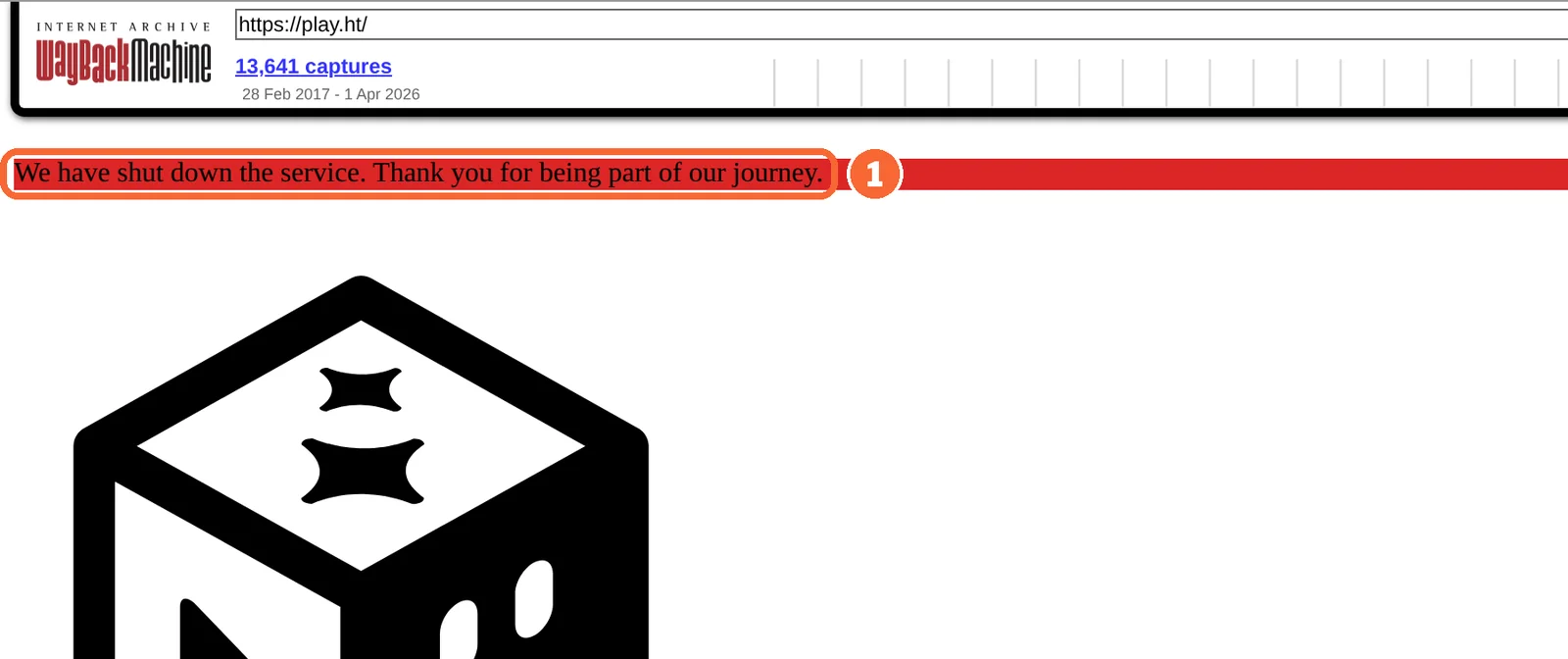
Sources: Bloomberg on the PlayAI acquisition, TechCrunch on the PlayAI acquisition, Archived play.ht homepage.
What you can still recover
In shortOnly what you already downloaded or kept elsewhere. Start from your own files.
- Nothing new from the service. There is no official login page, so audio, projects or settings you did not download earlier cannot be fetched now.
- Your own copies. Downloaded masters, the approved script text and any pronunciation notes you kept outside Play.ht are what a migration actually moves.
- Lookalike domains. playht.com is a parked domain, not a Play.ht property. Do not enter old passwords, API keys or card details on sites that offer to restore accounts or sell Play.ht plans.
Which Play.ht alternative fits the job your account did?
The five alternatives at a glance
In shortRead across a row. Commercial rights and cloning differ more between these tools than the entry prices do.
| Tool | Free access | Entry paid plan, as listed | Commercial use | Voice cloning | API |
|---|---|---|---|---|---|
 ElevenLabs | Creative Free: 10,000 credits a month | Starter: USD 5 per month billed yearly, USD 6 billed monthly | From Starter | Instant from Starter, professional from Creator | Yes, on every plan |
 Murf | Free: 10 minutes once, no downloads | Creator: USD 19 per month billed yearly, USD 29 billed monthly | From Creator | Enterprise add-on only | Separate, pay as you go |
 Speechify | API Free: 500K characters a month | API Starter: $10 per month | API Free lists it; the Reader app is personal use | From API Starter | Separate API plans |
 Voicemaker | Free: 25k credits a month, 250 characters per conversion | Starter: $5 per month billed monthly, or $50 billed yearly | Any paid plan | 5 clones on Starter | Separate developer platform |
 TTSMaker | Free: 20,000 characters a week, downloads | Lite and PRO Mini: confirm the total at checkout | Documented on Free, under its terms | Not covered in the sources checked | From PRO Mini |
From each tool’s profile on this site; prices in the format each vendor lists, never converted. Each profile shows its own check date.
What makes a good Play.ht replacement
In shortFive checks, in the order a migration usually fails them.
- The output rights match your useFree audio is noncommercial on ElevenLabs and Voicemaker and cannot be downloaded on Murf. A free plan that suits an audition can fail a client brief.
- Your pronunciation fixes have somewhere to goDictionaries, per-word IPA, SSML or plain respelling: each tool takes a different format.
- Cloning is on a plan you will pay forSelf-serve cloning starts at ElevenLabs Starter, Voicemaker Starter and Speechify API Starter; Murf sells it through Enterprise.
- The API sits on the right planTTSMaker starts API access at PRO Mini; Murf and Voicemaker bill their APIs apart from the studio.
- The unit fits your volume and your correctionsCredits, minutes or characters, and whether a fix to one line charges the whole script again. See the cost tables.
Pick by the job your old account did
| If Play.ht was used for… | Start with | Why |
|---|---|---|
| Commercial narration for videos and ads | ElevenLabs or Voicemaker | Both put commercial rights on the entry paid plan; Voicemaker’s terms keep output made while subscribed usable after the plan ends. |
| Course, training or slide narration edited line by line | Murf | Voice, style, pitch, speed and pronunciation changes on unchanged text use no generation minutes; PowerPoint and Google Slides add-ins come with Business. |
| Speech generated inside an app | Speechify API, ElevenLabs or Murf API | Speechify API Free lists commercial use; Murf’s API is billed per 1,000 characters; ElevenLabs offers REST with Python and TypeScript SDKs. |
| A cloned brand or presenter voice | ElevenLabs, Voicemaker or Speechify API Starter | Each sells self-serve cloning, and each requires consent from the speaker. |
| Short clips with no budget | TTSMaker | Downloads and commercial use are documented on Free; the per-conversion limit depends on the voice. |
The alternatives, tool by tool
In shortSame layout for each: what it does, what it takes over from Play.ht, what changes and what you can bring.
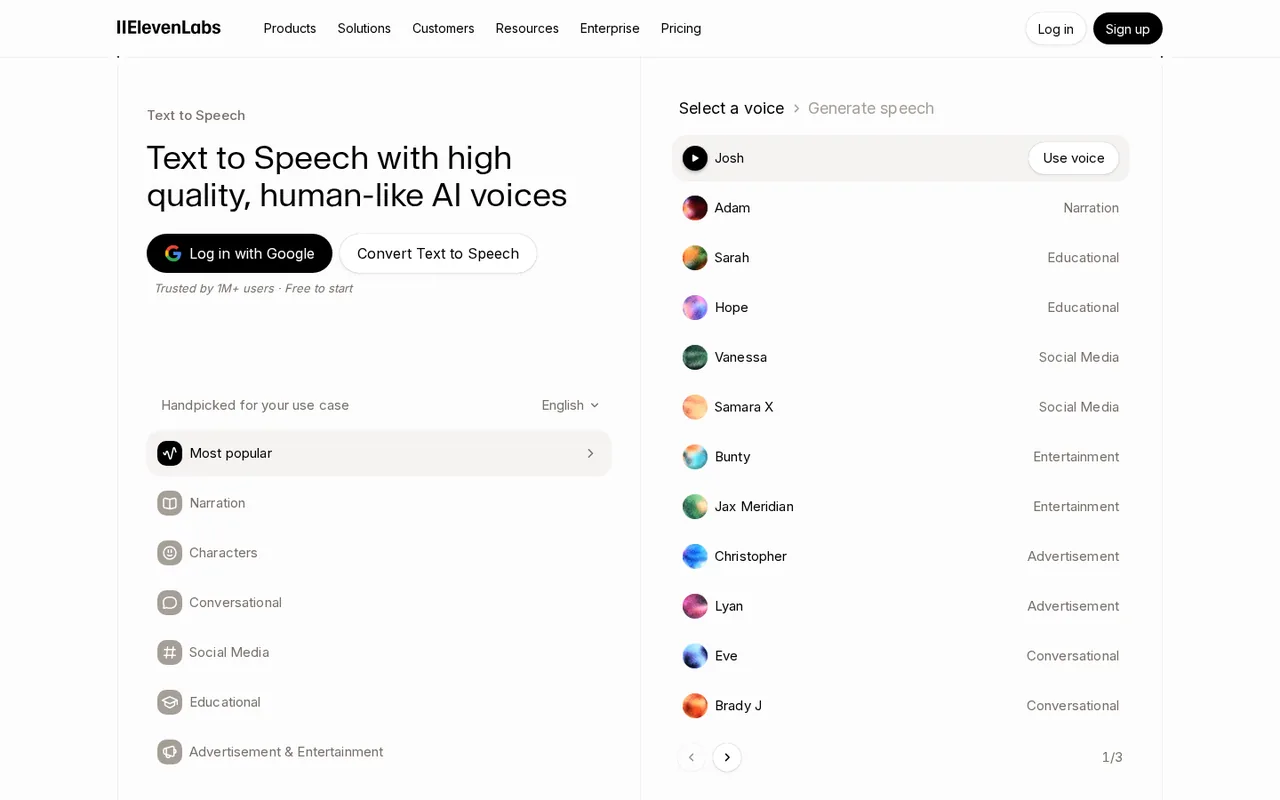
ElevenLabs
Best for API work, cloned voices and commercial narration on one plan
- Free 10,000 credits a month, noncommercial
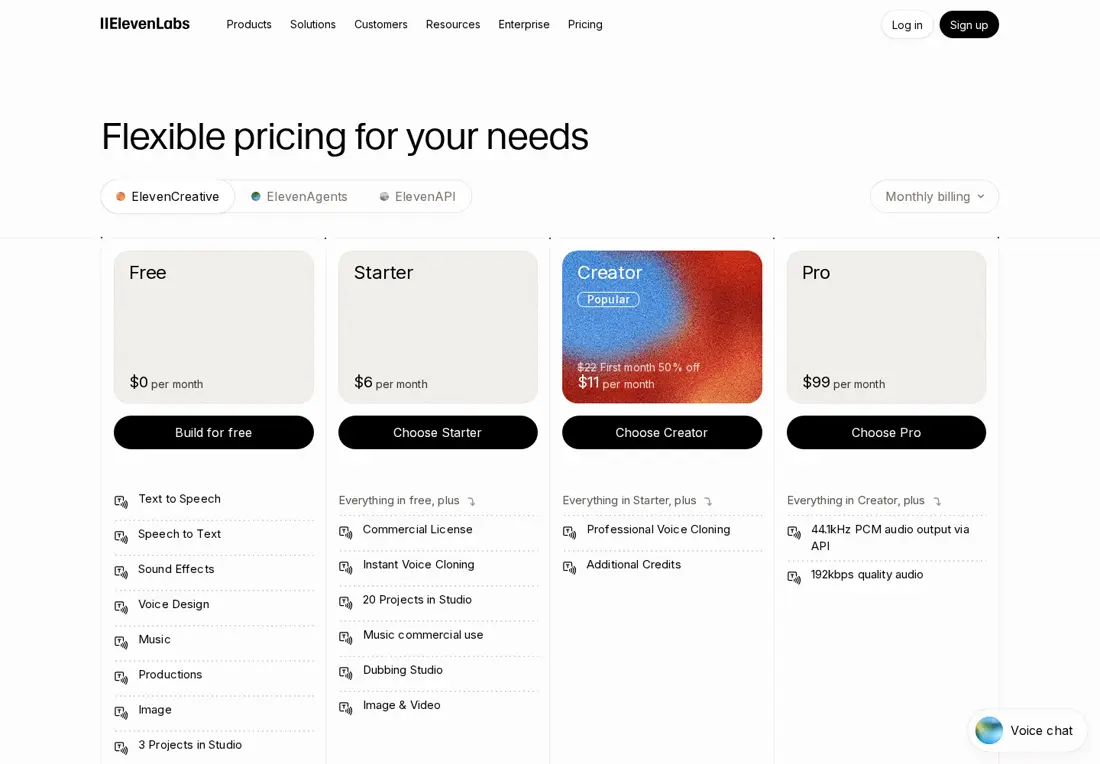
- Entry from USD 5 per month Starter, billed yearly; USD 6 billed monthly
Credits, not minutes, are the unit, and narration, transcription, dubbing and sound effects all draw on one monthly pool. Audio made on Free stays noncommercial after a later upgrade, so re-render anything you will publish once you subscribe.
What it does
- Text to speech
- 74 languages, with library voices, Voice Design or your own clone on paid plans.
- Voice cloning
- Instant cloning from Starter after a right-and-consent confirmation; one professional clone on Creator.
- API
- Every capability as a REST interface with official Python and TypeScript SDKs.
- Pronunciation dictionaries
- PLS files with phoneme or alias rules.
- Transcription and dubbing
- From the same credits: about 330 per minute to transcribe, about 10,000 per minute in Dubbing Studio.
Takes over from Play.ht
Narration, cloned voices rebuilt from original recordings, and API calls behind a new key.
What changes for you
Downgrades and cancellations take effect at the end of the billing cycle, and unused subscription credits are lost then. Paid plans roll unused credits forward for up to two months.
What carries over
Scripts as text, and your pronunciation list rewritten as a PLS dictionary.
See the ElevenLabs profile for plans, limits and sources.
Visit ElevenLabs (opens in a new tab)
Sources: ElevenLabs pricing, ElevenLabs credit changes on downgrade.
Murf
Best for narration edited block by block for training, slides and marketing
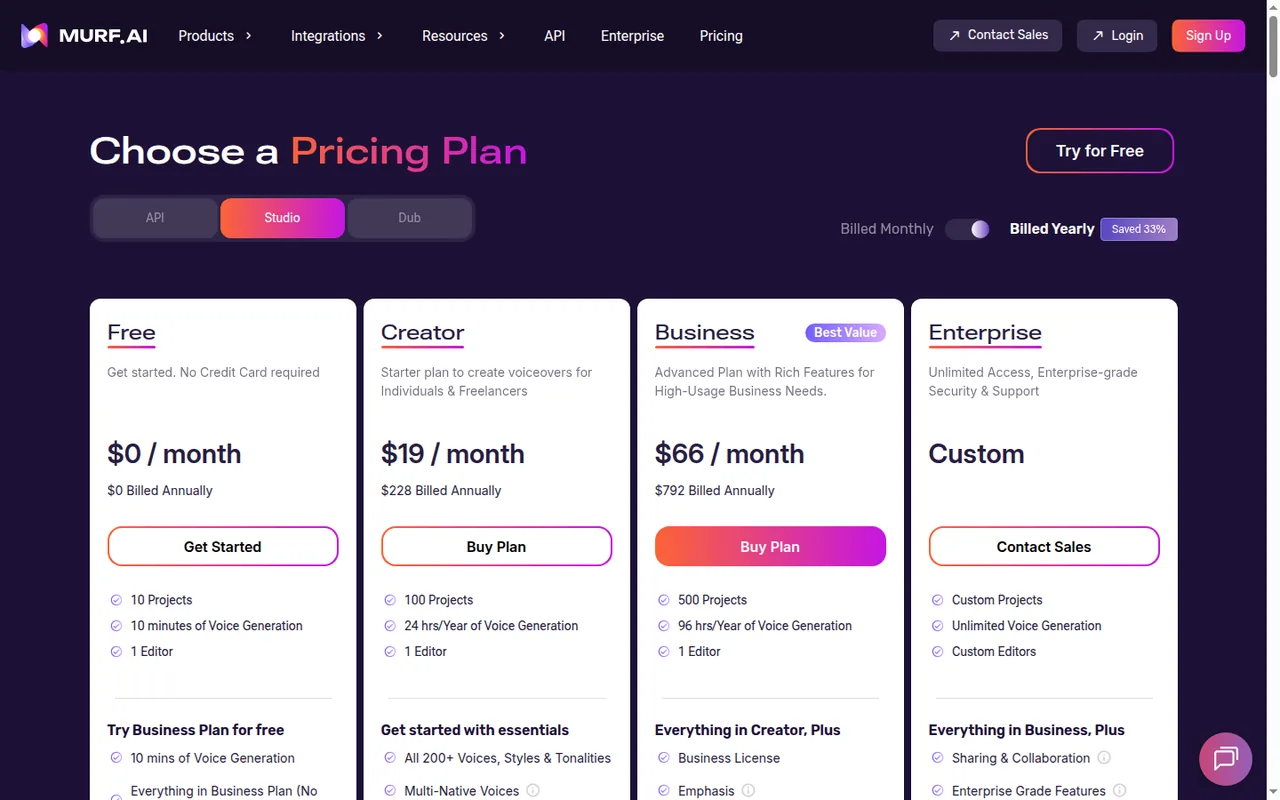
- Free 10 minutes once, no downloads
- Entry from USD 19 per month Creator, billed yearly; USD 29 billed monthly
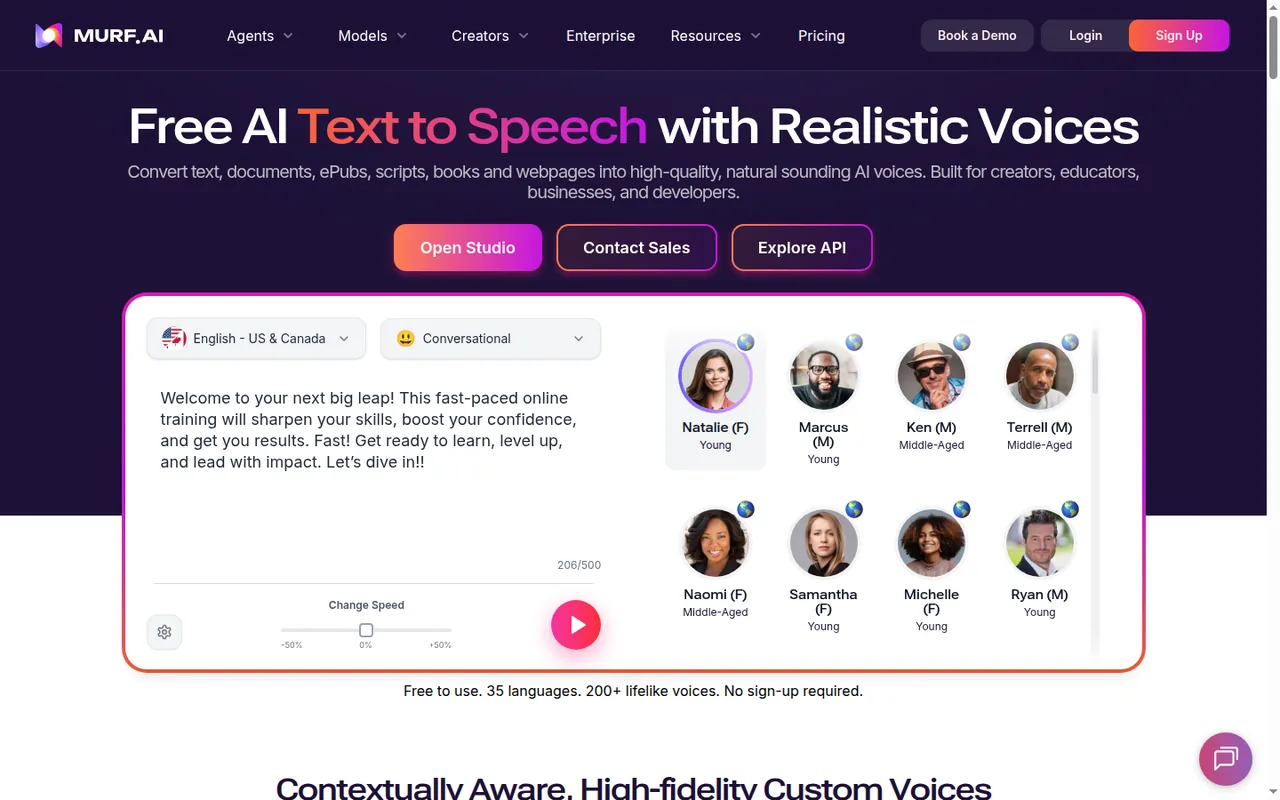
Murf Studio meters minutes of generated speech. Changing voice, style, pitch, speed or pronunciation on unchanged text costs nothing, while editing the text regenerates that sub-block. Downloads and commercial rights start at Creator; the API and Murf Dub are billed separately from Studio.
What it does
- Studio
- Write or import a script and adjust pitch, speed, pauses and pronunciation block by block.
- Timeline
- Add images, video and music, then export audio or video.
- Exports
- MP3, WAV, FLAC and telephony formats up to 48 kHz; MP4 or MOV with optional subtitles.
- API
- Pay as you go: USD 0.01 per 1,000 characters on Falcon, USD 0.03 on Gen2.
- Add-ins
- Canva on Creator; PowerPoint, Google Slides and Windows apps on Business and above.
Takes over from Play.ht
Studio narration, including timing against slides and video.
What changes for you
No self-serve cloning: custom voice clones are an Enterprise add-on. The shared Pronunciation Library is Enterprise only, each script upload is capped at 15,000 words, and subscription payments are not refundable.
What carries over
Scripts, split into parts above 15,000 words; pronunciation fixes re-entered per word, with IPA pasted without the slashes.
See the Murf profile for plans, limits and sources.
Visit Murf (opens in a new tab)
Sources: Murf pricing, Murf voice cloning, Murf import limits.
Speechify
Best for developers who need a speech API with a free commercial allowance
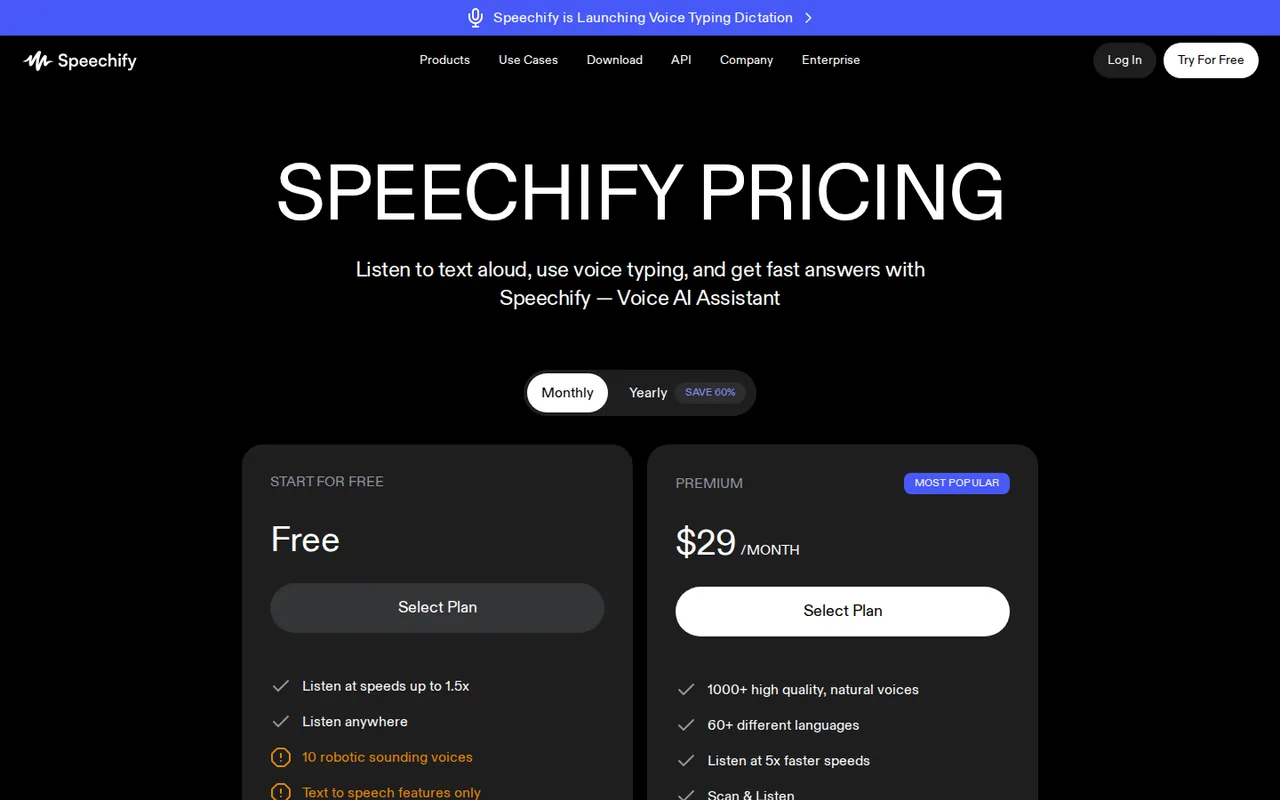
- Free API Free: 500K characters a month
- Entry API Starter $10 per month 1.9M characters
Speechify is three products with different rights. The Reader app, Free or Premium at $29 per month, is for personal listening, and a Reader subscription is not a license for published narration. The developer API is separate: API Free lists catalog voices, streaming, SSML and commercial use, and Starter adds voice cloning with $10 per 1M characters above its allowance.
What it does
- Speech API
- Catalog voices, streaming and SSML from API Free.
- Voice cloning
- From API Starter; API Pro lists 13.5M characters a month.
- Studio
- A separate voice-over and dubbing product; its price was not readable on the official site at the last check.
- Reader apps
- iOS, Android, Chrome and web, for listening rather than publishing.
Takes over from Play.ht
API calls from an app, and cloned voices on API Starter.
What changes for you
The API supplemental terms require permission for uploaded voice material and explicit written consent from the speaker. If you need a studio editor rather than an API, confirm the Studio price and terms first.
What carries over
Scripts and SSML-based pronunciation fixes, rechecked against the new voices.
See the Speechify profile for plans, limits and sources.
Visit Speechify (opens in a new tab)
Sources: Speechify API plans, Speechify AI voice API terms.
Voicemaker
Best for low-cost commercial voiceovers with clones on the entry plan
- Free 25k credits a month, non-commercial
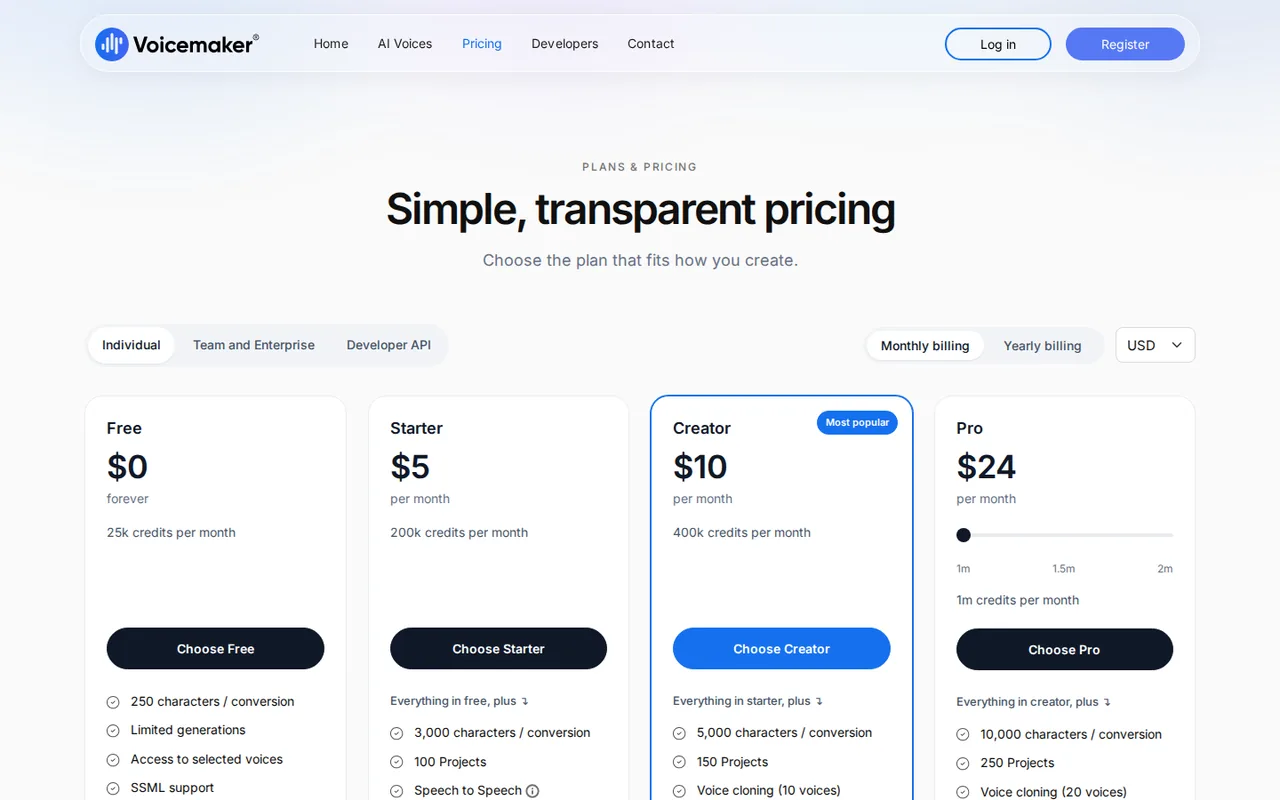
- Entry from $5 per month Starter, billed monthly; $50 billed yearly
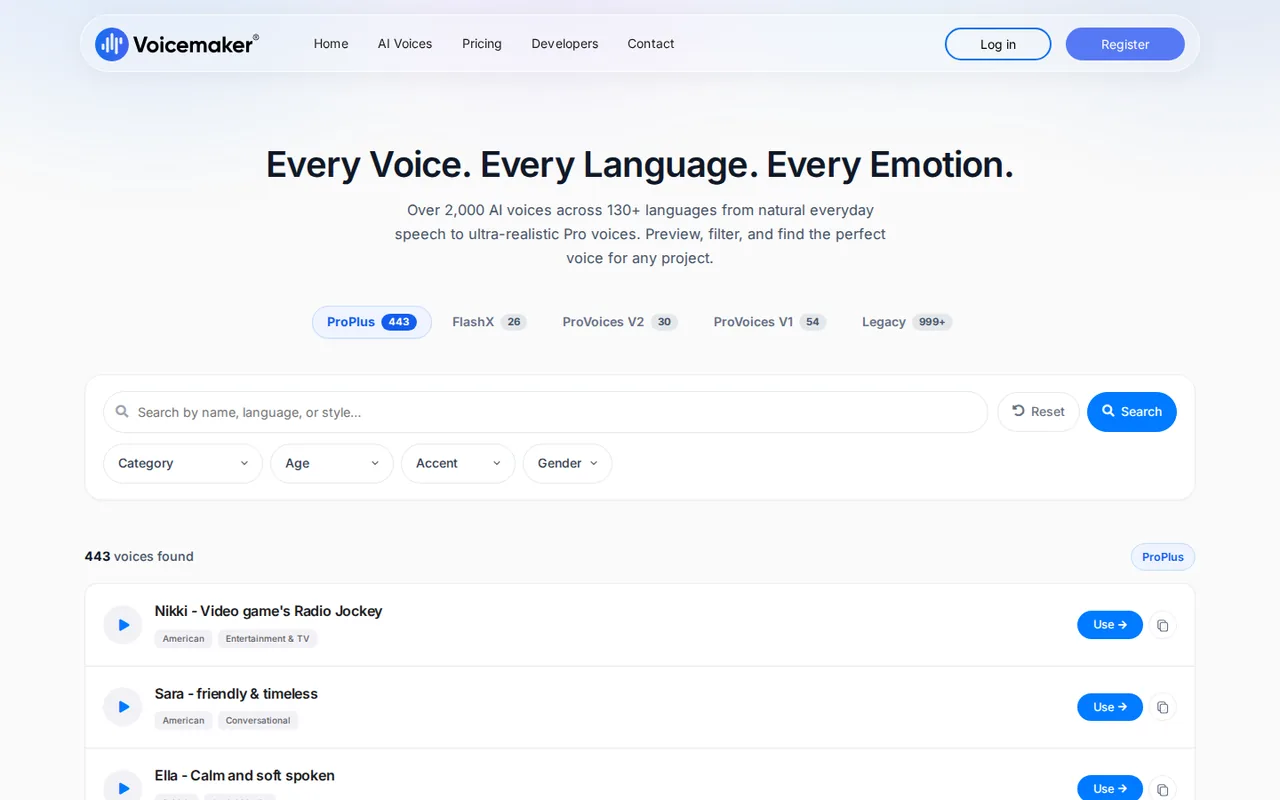
Voicemaker charges credits per character, and the rate depends on the voice model: 1 credit for Default, ProV1 and FlashX voices, 2 for ProV2 and ProPlus Turbo, and 4 for ProPlus Expressive. Every Convert charges all the text in the box again. Starter brings 200k credits a month and 3,000 characters per conversion.
What it does
- Text to speech
- 140+ languages across several voice models.
- Voice cloning
- From recordings of a consenting speaker: 5 clones on Starter, up to 50 on Business.
- Pronunciation
- SSML from Free; a pronunciation editor from Creator.
- Speech to text and speech to speech
- SRT export at 10 credits a second; voice conversion at 100 credits a second.
- Downloads and API
- MP3, OGG, WAV, OPUS, AAC and telephony formats; a pay-as-you-go REST API on a separate developer platform.
Takes over from Play.ht
Commercial narration and cloned voices at a low entry price.
What changes for you
Free output is limited to personal, internal evaluation or non-commercial use, at 250 characters per conversion. Unused credits are cleared when a plan ends without renewal.
What carries over
Output made while subscribed stays usable after the plan ends, so renders made now remain usable if you cancel later.
See the Voicemaker profile for plans, limits and sources.
Visit Voicemaker (opens in a new tab)
Sources: Voicemaker plans and credits, Voicemaker terms.
TTSMaker
Best for short commercial clips made by hand at no cost
- Free 20,000 characters a week
- Entry Lite paid; confirm the total at checkout
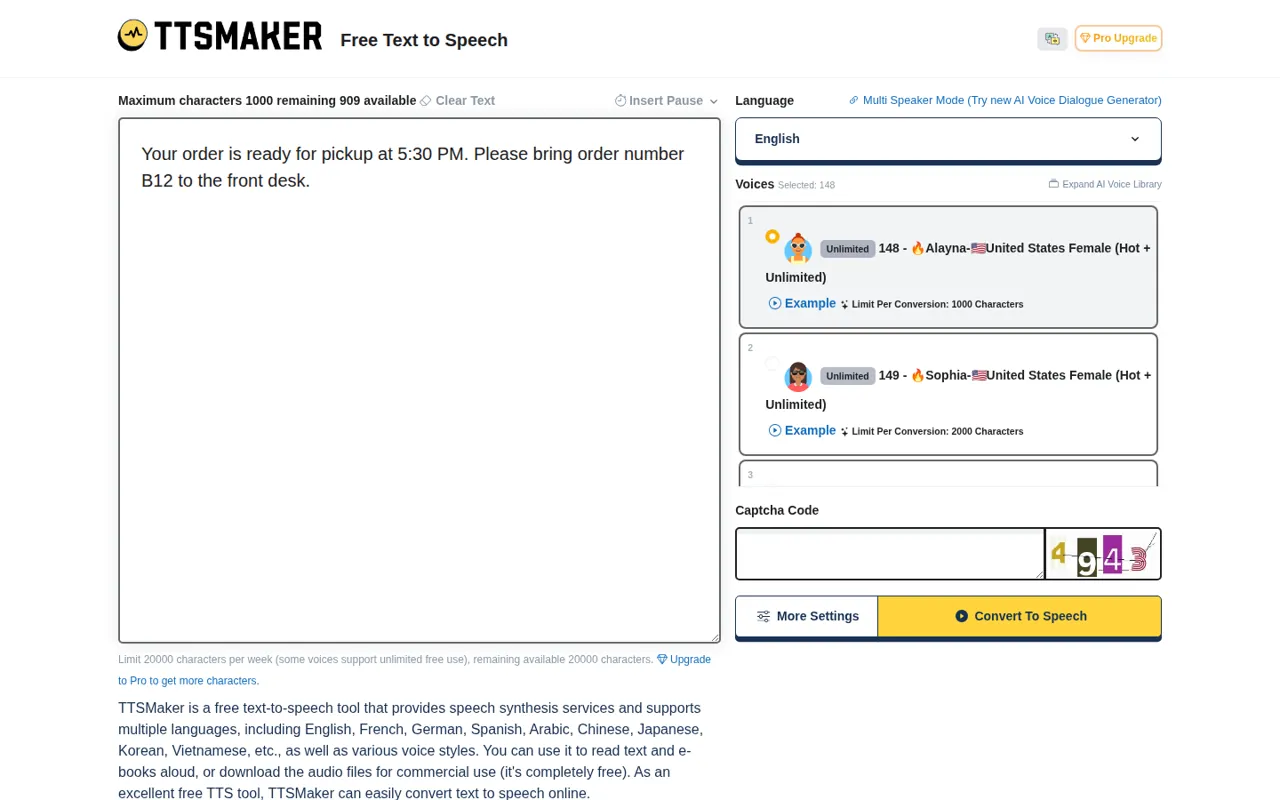
The free web route documents MP3 downloads and commercial use under the provider’s terms. Each voice sets its own per-conversion limit, and Free history is short-lived, so download each file as soon as it is made. API access starts at PRO Mini, with 600,000 characters a month and up to 20,000 per conversion.
What it does
- Browser converter
- Pick a language and a stock voice, type, convert and download.
- Script controls
- Speed, volume, pitch and inserted pauses.
- Paid capacity
- Lite: 300,000 characters a month, up to 10,000 per conversion, no API.
- API
- Documented API with a temporary file URL, from PRO Mini.
Takes over from Play.ht
Short scripted clips produced by hand.
What changes for you
No pronunciation dictionary is documented, so fixes become respellings in the spoken copy of the script. Long scripts are split to fit the chosen voice.
What carries over
Scripts, and the respelling column of your pronunciation list.
See the TTSMaker profile for plans, limits and sources.
Visit TTSMaker (opens in a new tab)
Sources: TTSMaker converter, TTSMaker plan comparison.
Two names from other lists, and why they are not in the table
Resemble AI appears on some Play.ht lists, as does its open-source Chatterbox model. The company began as a voice cloning tool and now says it focuses entirely on deepfake detection. Its pricing page lists no text-to-speech or cloning rate, the docs say the Voice Cloning API needs a Business plan or higher, and the hosted API lists Chatterbox as end of life while the open-source release stays MIT licensed. See the Resemble AI profile for plans, limits and sources.
NaturalReader reads documents aloud. Its personal plans are for private listening: the subscription agreement bars sharing or publishing the audio, including in videos and podcasts. Its commercial product, AI Voice Generator, is sold and licensed separately. See the NaturalReader profile for plans, limits and sources.
Feature matrix and output rights
What each tool offers
In shortEach cell comes from the tool’s profile. A dash means the profile does not cover it, not that the tool lacks it.
| Capability | ElevenLabs | Murf | Speechify | Voicemaker | TTSMaker |
|---|---|---|---|---|---|
| Making speech | |||||
| Browser studio or converter | OfferedStudio projects | OfferedMurf Studio | PartlyStudio sold separately, price unread | Offeredweb converter | Offeredweb converter |
| Downloadable audio | Offered192kbps on Pro | Partlypaid plans only | Not listednot covered in the sources checked | OfferedMP3, WAV, OGG and more | OfferedMP3, short-lived history |
| Pronunciation control | OfferedPLS dictionaries | Offeredper-word IPA and respelling | PartlySSML on the API | OfferedSSML; editor from Creator | Partlyspeed, pitch, pauses only |
| Voices | |||||
| Self-serve voice cloning | Offeredfrom Starter | PartlyEnterprise add-on | Offeredfrom API Starter | Offered5 clones on Starter | Not listednot covered in the sources checked |
| Languages listed | Offered74 | Offered35+ on the API | Partly60+ on Reader Premium | Offered140+ | Partlyselectable; count not listed |
| Developers and teams | |||||
| API | OfferedREST, Python and TypeScript SDKs | Offeredpay as you go | OfferedAPI Free to Scale | Offeredseparate platform | Partlyfrom PRO Mini |
| Transcription or dubbing | Offeredboth, same credits | OfferedAudio to Text on Business; Murf Dub | Partlydubbing in Studio | Offeredspeech to text with SRT | Not listednot covered in the sources checked |
| Workspace seats | Partly3 on Scale, 10 on Business | Partly1 editor; 5+ on Enterprise | Not listednot covered in the sources checked | Offered3 on Teams, 10 on Business | Not listednot covered in the sources checked |
offered partly or with limits not listed on the profile.
Who may publish the audio
In shortRights are set by the plan you render on. Check them before you re-render a library.
| Tool | Audio made on the free plan | Audio made on a paid plan | Cloning someone’s voice |
|---|---|---|---|
| ElevenLabs | Noncommercial, with attribution; upgrading later does not change it | Commercial license from Starter, excluding beta features | Confirm you have the right and consent before saving a clone |
| Murf | No downloads and no commercial rights | Commercial rights from Creator; Business License on Business | Through the Enterprise team only |
| Speechify | Reader Free: personal, non-commercial. API Free: commercial use listed | Reader Premium does not license published narration; API and Studio have their own terms | Permission for the material and explicit written consent from the speaker |
| Voicemaker | Personal, internal evaluation or non-commercial only | Commercial on any paid plan; output stays usable after the plan ends | Only recordings of a consenting speaker; imitating a real person without consent is forbidden |
| TTSMaker | Downloads and commercial use documented under its terms | Commercial use permitted under its terms; paid plans add capacity and the API | Not covered in the sources checked |
Sources: ElevenLabs publishing rights, Speechify terms, TTSMaker terms of service.
What the same narration costs in each tool’s unit
In shortEach tool counts something different. Count your script once, then read it in each unit.
One 10,000-character script
| Tool | Unit | What the script uses | Limit per conversion | Fixing one line afterwards |
|---|---|---|---|---|
| ElevenLabs | Credits: 1 per character on Multilingual v2; 0.5 to 1 on Flash and Turbo through the API | 10,000 credits: a third of Starter’s 30,000 | Not covered in the sources checked | Each regeneration spends credits again |
| Murf | Minutes of generated speech | Counted in minutes, not characters; see the hour table | 15,000 words per script import | Voice, style, pitch, speed or pronunciation changes are free; a text edit regenerates the sub-block |
| Speechify API | Characters | 10,000 of API Free’s 500K a month | Not covered in the sources checked | Not covered in the sources checked |
| Voicemaker | Credits per character, by voice model | 10,000, 20,000 or 40,000 credits for 1-, 2- or 4-credit voices | Free 250, Starter 3,000, Creator 5,000, Pro 10,000 characters | Each Convert charges all the text in the box |
| TTSMaker | Characters | Half of Free’s 20,000 a week | Set by the voice; 1,000 or 2,000 in the capture above | A second full pass doubles the count if the voice charges the whole script each time |
Arithmetic on the units in each profile. On Voicemaker Free, 10,000 characters at 250 per conversion means at least 40 separate conversions.
About an hour of narration, by each vendor’s own estimate
| Tool | Vendor’s estimate | One hour uses | Plan that covers it |
|---|---|---|---|
| ElevenLabs | The pricing table puts 121,000 credits at about 121 minutes | About 60,000 credits | Creator (121,000 credits): USD 22 billed monthly. Starter’s 30,000 covers about 30 minutes |
| Murf | About 6 minutes per 1,000-word English script | 60 minutes, or about ten 1,000-word scripts | Creator: 2 hours a month on monthly billing, USD 29 billed monthly |
| Voicemaker | The FAQ puts 500,000 credits at about 10 hours | About 50,000 credits with 1-credit voices; about 200,000 with Expressive voices | Starter’s 200k credits: about 4 hours, or about 1 hour with Expressive voices |
| Speechify API, TTSMaker | No minutes-per-character figure in the sources checked | Count characters instead | See the script table above |
The estimates are each vendor’s, on different bases, not measured output. Prices as each profile lists them.
Plan steps
In shortEntry plans only; bars compare plans within one tool, and currencies and billing periods follow each vendor.

Price per month on yearly billing, from the ElevenLabs profile. Bars compare plans of this tool only.

Price per month on yearly billing, from the Murf profile. Bars compare plans of this tool only.

Price per month on monthly billing, from the Voicemaker profile. Bars compare plans of this tool only.

Price per month, as each plan is first listed, from the Speechify profile. Bars compare plans of this tool only.
TTSMaker’s paid totals are left to checkout on its profile, so it has no chart.
Sources: ElevenLabs pricing, Murf pricing, Voicemaker FAQ.
How to move from Play.ht without losing work
What moves, and what has to be rebuilt
In shortA migration moves files you still hold. Everything else is rebuilt in the new tool.
| What you had | Does it move? | What to do |
|---|---|---|
| Scripts and source text | Yes, if you kept them outside Play.ht | Collect the final approved text, including edits made only in the old editor. |
| Downloaded audio masters | Yes, as files | Keep them as the reference and as your fallback if a re-render sounds worse. |
| Pronunciation fixes, SSML tags, lexicons | Only as text | Copy them into one neutral list; each new tool needs its own format. |
| Cloned voices | No | Rebuild from the speaker’s original recordings with fresh consent, or choose a stock voice. |
| API integration | No | Replace the endpoint, keys, voice IDs and error handling; requests to play.ht hosts now fail. |
| Videos and captions built on old audio | Partly | New audio can change timing, so recheck cuts and caption timing. |
Tag each script with its use: a public commercial video, an internal training clip, or an app prompt made on demand. That tag decides which plan and which rights you need.
Rebuild pronunciation rules from one master list
In shortKeep one neutral list and produce each tool’s version from it.
Pronunciation fixes record decisions about names, brands and jargon, and tags written for one engine can be read aloud, ignored or rejected by another. Keep four columns: the word as written, the approved spelling, a respelling that sounds right, and an IPA transcription if you have one.
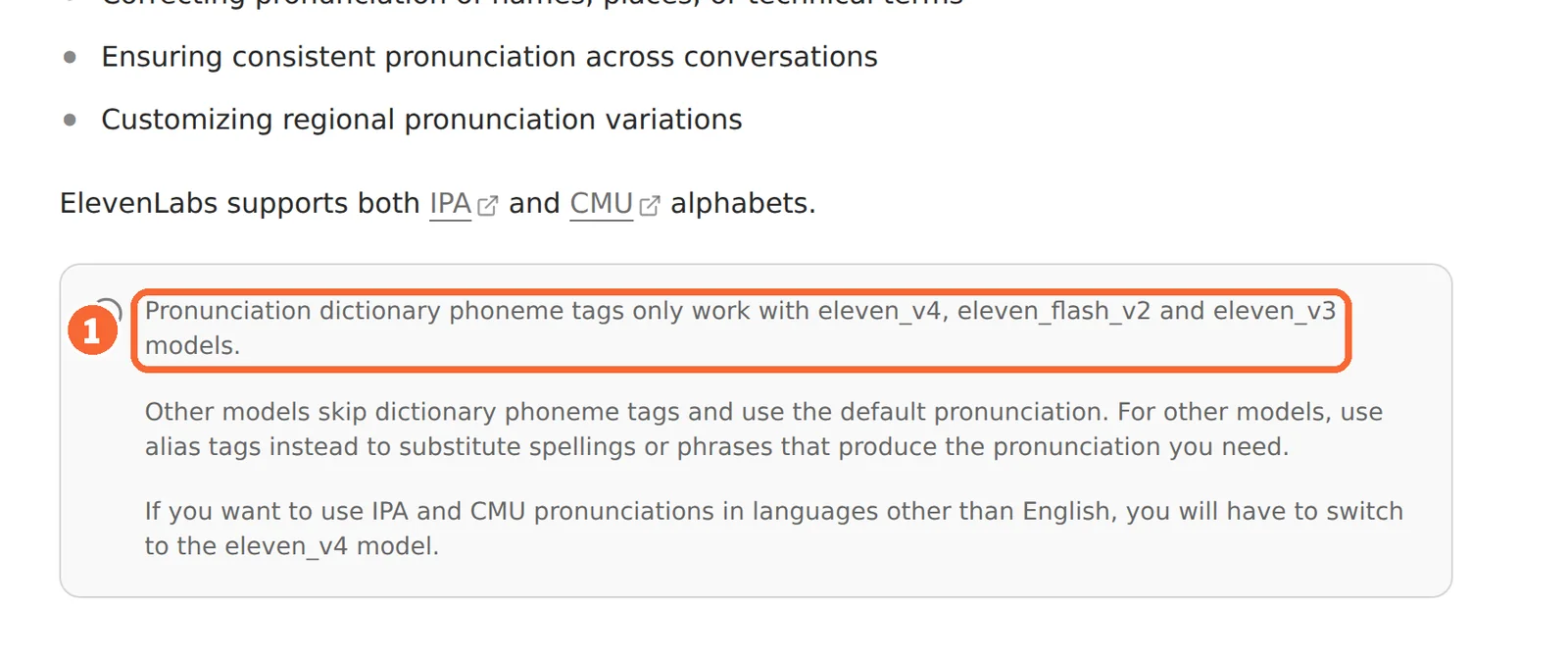
- ElevenLabs takes PLS dictionaries with phoneme or alias rules. Phoneme rules work only with the eleven_v4, eleven_flash_v2 and eleven_v3 models; other models skip them, so use alias rules there. Matching is case sensitive.
- Murf fixes words inside Studio with suggestions, custom IPA, alternative spelling or a locale change, for one block or the whole project. Paste IPA without the surrounding slashes.
- Voicemaker accepts SSML from Free and adds a pronunciation editor from Creator; Speechify lists SSML on its API plans.
- TTSMaker documents speed, volume, pitch and pauses but no dictionary: use the respelling column in the spoken copy of the script.
Sources: ElevenLabs pronunciation dictionaries, Murf pronunciation help.
Cloned voices need fresh consent, not a transfer
In shortNo live tool can import a Play.ht clone. Treat it as a new clone with a new consent record.
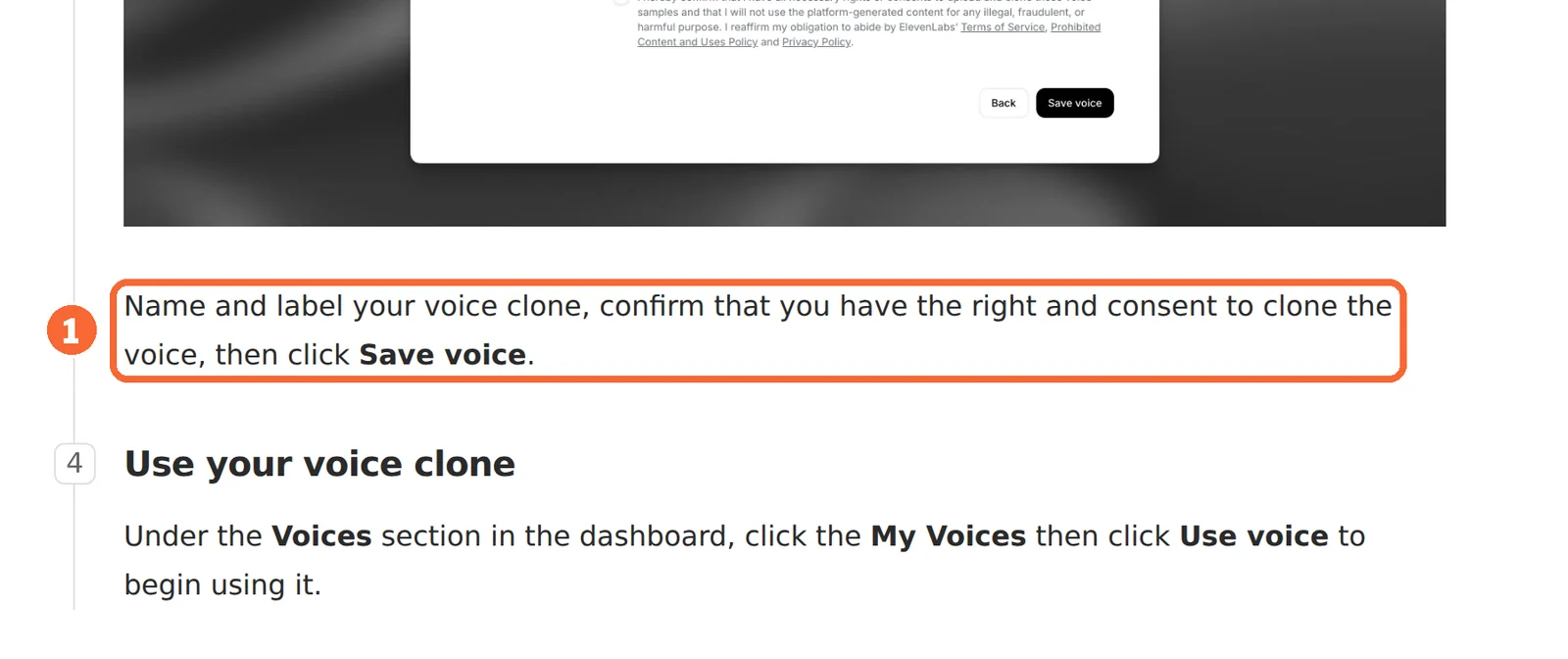
Ask the speaker again, in writing, naming the new provider and the intended uses. Clone from the speaker’s original recordings, not from audio Play.ht generated: generated speech is not a recording of the person, and it gives no new permission. Every self-serve route above asks for consent: ElevenLabs before you save a clone, Voicemaker in its terms, and Speechify in its API terms, which require it in writing. If consent cannot be renewed, move those scripts to a stock voice and tell the people who rely on the old sound.
Sources: ElevenLabs instant voice cloning.
Swap API calls behind one switch you can reverse
Search code, environment variables and logs for play.ht and play.ai hosts. Those requests now fail at name resolution, so check whether an app failed silently or served stale audio. Then put speech generation behind one internal function that takes text, a voice key and an output format and returns a stored file, and map each old voice to a new one in a small table. Serving generated files from your own storage makes a later provider change a configuration change, and the audio you already stored is your fallback.
Questions, limits and how this guide was made
Common questions
Is Play.ht still available?
No. Meta acquired PlayAI, the company behind Play.ht, in July 2025, and an archived copy of the homepage from March 2026 carries the message that the service has shut down. No plan can be bought and no account can be opened, so pricing tables still shown on review sites describe a service you cannot subscribe to.
Can I get my Play.ht audio files or cloned voices back?
Only if you saved them yourself. With the service closed, nothing can be downloaded from an account now, so the audio masters and script text you kept are what you can move. A cloned voice cannot be exported; recreate it in a new tool from the speaker's original recordings, with fresh written consent that names the new provider.
Is there a free Play.ht alternative I can use for commercial work?
Two free routes list commercial use. TTSMaker's free web converter documents downloads and commercial use under its terms, with 20,000 characters a week. Speechify's API Free lists commercial use with 500K characters a month, but it is a developer API. ElevenLabs Free and Voicemaker Free are noncommercial, and Murf Free gives previews without downloads.
Which Play.ht alternative lets me clone a voice without an enterprise contract?
ElevenLabs offers instant cloning from Starter, Voicemaker includes five clones on Starter, and Speechify adds cloning on API Starter. Murf handles cloning through its Enterprise team. All three self-serve routes ask for the speaker's consent, so get written permission naming the new provider and clone from original recordings rather than Play.ht output.
Is playht.com the official Play.ht website?
No. Play.ht ran on play.ht, a domain that now has no web server and points to Meta. playht.com is a parked domain with nothing to do with the former company. Treat any site that asks for an old Play.ht login, API key or payment to recover an account as untrusted, and change any password you reused elsewhere.
Will my Play.ht API keys or voice IDs work with another provider?
No. Keys and voice IDs belong to each provider, and calls to the old Play.ht hosts now fail. Each replacement issues its own keys and voice names. Keep a small table that maps every old voice to a new one, and check logs for apps that still call the old endpoint and fail without showing an error.
What this guide does not judge
Many Play.ht lists rank tools on how natural or expressive the voices sound and how fast they respond. None of the profiles documents those in a way we can check, and we have not rendered your scripts, so this guide compares rights, cloning, API access and units. The trial below answers the quality question on your own material.
Take three real scripts from your old library, each with a downloaded master: a short plain paragraph, one with at least five entries from your pronunciation list, and the longest one you expect to re-render. Render them on the free route of each tool you are considering, with a stock voice, and note the plan, voice, model and remaining allowance before each render.
- Did you get a local file? Murf Free stops at a preview, which is a documented result.
- Did every pronunciation entry come out as approved, in that tool’s own format?
- How much allowance did the renders and corrections use?
- Do the rights fit the use: personal, noncommercial with attribution, or commercial?
- Does the new file fit the timing of any video or captions built on the old master?
Accept a tool only when all three scripts pass on the plan you will pay for, and keep publishing the stored masters until then. For the correction and delivery loop, use the AI voiceover workflow; for rights on free output, see the free AI tools guide.
How this guide was made
Shutdown facts come from Bloomberg, TechCrunch and an Internet Archive copy of play.ht. Plans, units, rights and limits come from the ElevenLabs, Murf, Speechify, Voicemaker and TTSMaker profiles on this site, which cite each vendor’s pricing, help and terms pages and carry their own check dates; plan charts are read from those profiles when the page loads. Sections follow the topics the top-ranking Play.ht alternative pages cover, limited to what the vendors document. No rating is given. See our editorial policy.