
What is Julius AI, in short?
Updated October 24, 2026 · By Elias Brandt · Documentation review, not tested hands-on
Pros
- Credit allowances are published
- Live database queries
- Daily credits on paid plans
- No training on personal information
Cons
- Cost per message unknown
- Free files expire after an hour
- No credit top-ups
- Refunds are rarely given
- Public link needed for Google Sheets
Best forAnalysts working from CSV and Excel exportsTeams on Snowflake, BigQuery or PostgresPeople testing before payingNot for confidential Google SheetsNot for buyers who need a refund window
Strengths, limits and who it suits, in full
Strengths
- Credit allowances are published The credits documentation lists welcome, daily and monthly credits for every plan, including legacy ones.
- Live database queries Connectors for Postgres, MySQL, SQL Server, Snowflake, BigQuery and Supabase avoid exporting a file before each analysis.
- Daily credits on paid plans Paid accounts get 100 daily credits, used before the purchased balance.
- No training on personal information The privacy policy says Julius does not use your personal information to train its own AI models.
Limits
- Cost per message unknown Credit use varies by action, model and data size, and no per-task figure is published.
- Free files expire after an hour Free-tier uploads and generated files are deleted after 1 hour of inactivity.
- No credit top-ups Buying extra credits is not supported; more usage means a higher plan.
- Refunds are rarely given The refund policy calls purchases generally final and normally declines requests based on forgetting to cancel.
- Public link needed for Google Sheets Linking a sheet by URL requires sharing it with anyone who has the link.
Who it suits
- Analysts working from CSV and Excel exports Julius reads the common data formats and returns charts and downloadable tables.
- Teams on Snowflake, BigQuery or Postgres Paid plans query the warehouse directly, and Business pools 60,000 credits a month for up to 50 members.
- People testing before paying the daily free credits allow a small trial, but each file has to be analyzed in one sitting because of the 1-hour retention.
- Not for confidential Google Sheets The URL connection needs a sheet shared with anyone who has the link.
- Not for buyers who need a refund window Julius states no general refund window and treats subscriptions as final.
How much does Julius AI cost?
Prices confirmed · checked
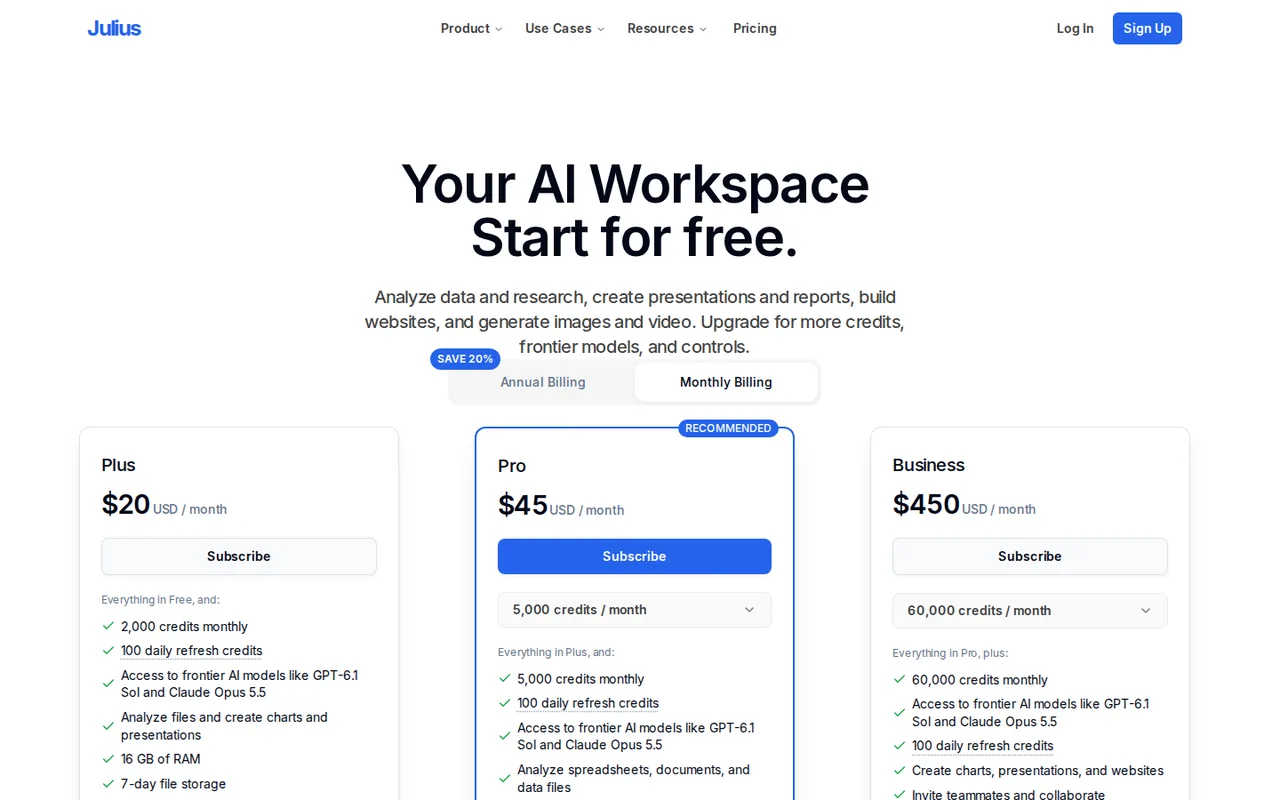
- $20Plus
- $45Pro
- $450Business
Regional prices: Prices are in US dollars and exclude taxes, according to the Terms of Service.
Monthly purchased credits expire at the end of each billing period; annual credits are 12 times the monthly allowance, granted upfront and forfeited at the end of the year. Daily credits reset at 00:00 UTC and do not accumulate. Extra credits cannot be bought. Julius offers no new student discounts and no paid-plan trials; new accounts get free usage instead. Cancellation normally takes effect at the end of the billing period.
| Plan | Price | What you get |
|---|---|---|
| Free | $0 sourceFrom julius.ai/pricing, checked Oct 24, 2026 (opens in a new tab) | 75 one-time welcome credits for eligible new web accounts plus 25 daily credits that reset at 00:00 UTC; Julius Lite models; Google Drive, OneDrive and SharePoint connectors; limited presentation, image, video and website creation; files deleted after 1 hour of inactivity. |
| Plus | $20 per month billed monthlyor $16 per month billed annually sourceFrom julius.ai/pricing, checked Oct 24, 2026 (opens in a new tab) | 2,000 credits a month (24,000 upfront on annual billing) plus 100 daily credits; GPT-6.1 Sol and Claude Opus 5.5; 16 GB of RAM; Snowflake, BigQuery and Postgres connectors; 7-day file storage; websites on a custom Julius domain. |
| Pro | $45 per month billed monthlyor $37 per month billed annually sourceFrom julius.ai/pricing, checked Oct 24, 2026 (opens in a new tab) | 5,000 credits a month (60,000 upfront on annual billing) plus 100 daily credits; 32 GB of RAM; unlimited parallel agents; priority email support. |
| Business | $450 per month billed monthlyor $375 per month billed annually sourceFrom julius.ai/pricing, checked Oct 24, 2026 (opens in a new tab) | 60,000 credits a month (720,000 upfront on annual billing) in one team pool; up to 50 team members; shared workspace, files and threads; usage dashboard and centralized billing; no table limit in data connections. |
| Enterprise | Contact sales | Unlimited credits and all models according to the comparison table; permanent file storage; single sign-on, audit logs, user roles and tailored onboarding. |
Which plan fits?
Smallest plan whose monthly credits cover your number with 15% spare for regenerations. Arithmetic from the plan table above, not a usage test.
How far does it go?
- Five analysts: separate Plus accounts or one Business poolFive Plus accounts cost 5 x $20 = $100 a month for 5 x 2,000 = 10,000 purchased credits, plus 100 daily credits each. Business costs $450 for one shared pool of 60,000. Per dollar, Plus gives 2,000 / 20 = 100 credits, Pro 5,000 / 45 = about 111 and Business 60,000 / 450 = about 133. Reaching 60,000 with Pro takes 12 accounts, 12 x $45 = $540 a month. Editorial arithmetic on published allowances; credits per analysis are not published.
Arithmetic from the published allowances above, not a usage test.
Taxes, currency and promotions can change the price you see at checkout.
Try Julius AI free (opens in a new tab)
Key features
| Feature | What it does | Watch out |
|---|---|---|
| Chat analysis of uploaded CSV, Excel (.xlsx, .xls), JSON, Parquet, SQLite and SPSS files, plus PDFs and images (Files documentation) | — | |
| Live queries against PostgreSQL, MySQL, SQL Server, Snowflake, BigQuery and Supabase through data connectors, with filtered schemas (connectors documentation) | You add database credentials once, and Julius can query live tables in every message of that chat; for large warehouses it builds a semantic layer of the schema. | The comparison table lists Snowflake, BigQuery and Postgres from Plus; Free covers Google Drive, OneDrive and SharePoint only. |
| Google Sheets and Drive files linked by URL, provided the sheet is shared as viewable by anyone with the link (Files documentation) | — | |
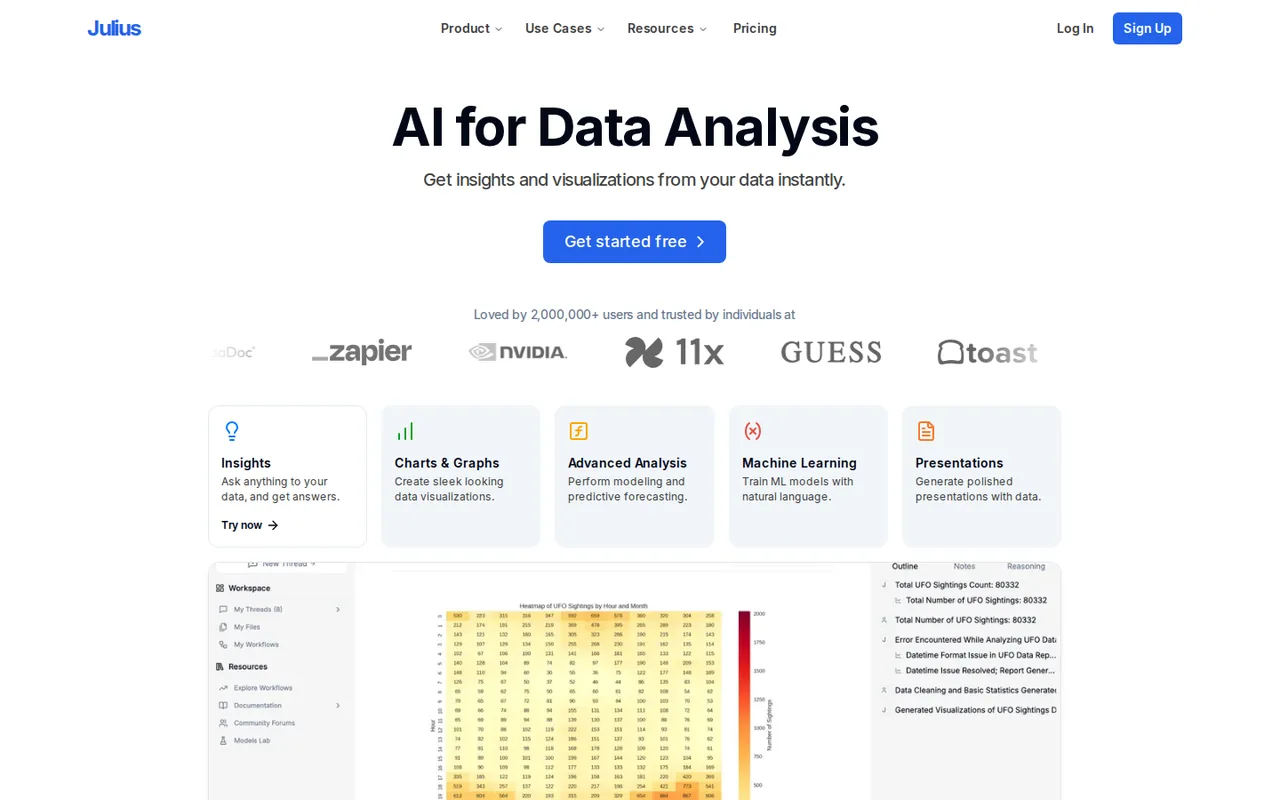
| Charts and tables from the analysis, downloadable as CSV or Excel (AI for Excel page) | — | |
| Presentations that follow uploaded brand guidelines, exported as PPTX, PDF, PNG or Google Slides, and websites on a Julius domain (pricing FAQ) | — | |
| Built-in web search with citations and US equity data such as filings, earnings and insider trades, billed in credits (connectors documentation) | — | |
| Credits instead of messages | Every action draws credits; the cost depends on the action, the model chosen and how much data or code is involved, and a Usage page shows the balance and history. | No per-message or per-analysis price is published, so how many analyses a plan covers can only be measured in your own account. |
| From analysis to slides | A finished analysis can become a slide deck that keeps uploaded brand colours and fonts, or an interactive web page. | On Free, presentations, websites and video are marked "Limited" and draw on the same daily credits. |
How far do the free credits go?
Julius meters usage in credits rather than messages. The credits documentation says a short question costs less than an analysis that runs code or builds a deliverable, and that frontier models use credits faster than lighter ones such as Julius 1.2 Lite or Claude Sonnet 5.5. Eligible new web accounts start with 75 one-time welcome credits plus 25 daily credits, so 100 are available on the first day. Daily credits reset at 00:00 UTC, expire at the next midnight and are spent before any other balance.
Editorial arithmetic: a free account that uses its whole daily allowance for 30 days gets 75 + 30 x 25 = 825 credits, and a Plus account doing the same gets 2,000 + 30 x 100 = 5,000. Because no cost per message is published, those totals do not convert into a number of analyses; the Usage page shows what each chat actually consumed. Credits cannot be topped up, and the documentation points to a higher plan as the only way to more usage.
What happens to files you upload on the free plan?
The Files documentation lists the data formats Julius accepts: CSV, Excel (.xlsx and .xls), JSON, Parquet, Feather, SQLite and SPSS, alongside text, PDF, image and code files such as Jupyter notebooks. Retention is where the plans differ most. Free-tier files, including AI-generated outputs, are deleted after 1 hour of inactivity; paid users keep files for up to 7 days of inactivity, and the comparison table lists permanent storage only for Enterprise.
In practice, a free analysis has to be finished and downloaded in one sitting. The same page explains how to link a Google Sheet or Drive file by URL, which requires sharing the sheet so that anyone with the link can view it. For a sheet that should stay private, uploading an export or using a paid database connector avoids that step.
Which databases can Julius query without uploading files?
The data connectors documentation lists PostgreSQL, MySQL, SQL Server, Snowflake, BigQuery and Supabase, plus Google Ads and Meta Ads. Once enabled, a connector stays available for the whole chat session. For warehouses with thousands of tables, the pricing FAQ says Julius builds a semantic layer of the schema, and you can filter schemas or add a data dictionary. In the comparison table, Free covers Google Drive, OneDrive and SharePoint, the warehouse connectors start at Plus, and Business adds no table limit in data connections.
Julius also has built-in web search with citations and US equity data: fundamentals, 10-K, 10-Q and 8-K filings, earnings, insider trades and historical prices. Both run on the same credits as everything else, so a question that triggers a search costs more than one answered from your file alone.
Is annual billing worth it?
The pricing page labels annual billing “save 20%”. Editorial arithmetic: that holds for Plus ($20 – $16 = $4, or 20%), while Pro saves $8 (8 / 45, about 17.8%) and Business $75 (75 / 450, about 16.7%). The annual total is not printed on the page, so check it at checkout rather than multiplying the monthly rate by twelve.
Annual billing also changes how credits arrive. A Pro annual subscriber receives all 60,000 purchased credits upfront, usable in any month of the term and forfeited at its end, while monthly credits lapse every month. An annual pool therefore allows a heavy month, provided the rest lasts until renewal; it does not allow carrying credits into the next year.
Where does your data go?
The Privacy Policy names Anthropic, Google and OpenAI among its service providers and says Julius does not use your personal information to train its own AI models. The security page lists SOC 2 Type II and TX-RAMP, isolation between customer accounts, encryption in transit and at rest, and short-term storage of processed data. Database credentials are encrypted, according to the connectors documentation.
The Terms of Service are an agreement with Caesar Labs Inc., require users to be 18 or older, and send disputes to binding individual arbitration with the American Arbitration Association, seated in Los Angeles under California law. Cancelling a subscription keeps the account on Free with its files; deleting the account is different, and the terms say data cannot be recovered afterwards.
What do cancellation and refunds commit you to?
A website subscription is cancelled from Subscription settings through the billing portal, as the cancellation guide describes. The plan stays active until the end of the current period unless you ask support to end it immediately, and remaining purchased credits are forfeited when the period ends.
The Refund Policy says subscription and credit purchases are generally final. Julius normally declines refunds for forgetting to cancel or for dissatisfaction, and a recent payment, little usage or unused credits do not by themselves make a purchase refundable. Support does correct charges that an earlier cancellation request should have prevented and refunds verified duplicate payments; the policy sets no general refund window.
How could you check Julius on your own data before paying?
Proposed evaluation · not performed yet
Run one real analysis on the free plan inside the 1-hour file window and compare it with figures you already trust.
- Prepare an Excel file with two sheets you may share, for example 12 months of orders and a product list, and calculate monthly revenue by product in Excel first.
- Note the balance on the Usage page, upload the file and ask for revenue by product and month with a chart.
- Ask how each total was calculated and compare every monthly figure with your own.
- Download the result as Excel or CSV before an hour of inactivity passes, then record the credits used.
- On the next day, confirm that the daily credits reset after 00:00 UTC and repeat the request to see whether the cost is similar.
Accept if the totals match and one analysis uses a small share of the 25 daily credits. Reject if totals differ without explanation or the file disappears before export. No result is recorded here.
Julius AI alternatives
Other data & spreadsheets tools checked with the same method. Pick by the job, not by a score.

Turning an Excel or CSV file into formulas, charts and a dashboard through an AI agent

Recurring reports and dashboards from spreadsheets and analytics data

Cash-flow and sales forecasts from accounting data

Competitor sales, pricing and assortment research for ecommerce brands

Spreadsheet analysis that mixes formulas with Python or SQL

People reviewing spreadsheet exports before sharing a report

Running the same AI prompt down a column of a Google Sheet

Building formula-linked models and charts from plain-language requests
Used Julius AI? Write the first review. Visitor opinions are moderated and kept separate from our source checks.
Frequently asked questions
Does Julius AI offer a student discount?
Not for new subscribers. The discounts documentation says Julius does not offer new student or academic discounts. An existing student discount should stay when you change an active subscription to another plan, and support can restore one that disappears by mistake. Some third-party pricing pages still describe a student discount; that offer is not on the official pages.
Is there a free trial of Plus or Pro?
No. Julius says new accounts receive free usage to evaluate the product, which is different from a time-limited paid trial, and support does not offer paid-plan trials or trial extensions. Requests for extra evaluation credits go to human review, with no guaranteed amount or expiry date. The free plan is the way to try Julius before paying.
What happens to a grandfathered price if I switch plans?
You lose it. Moving away from a plan or price that is no longer offered gives up the old price and its discounts, except an existing student discount. If a cancelled subscription ends and you return later, you must choose a current plan and old coupons are not restored. Reversing a scheduled cancellation before it ends keeps the existing terms.
How do I cancel a subscription bought on an iPhone?
Through Apple. Open Settings, tap your name, then Subscriptions, choose Julius AI and cancel, or use apps.apple.com/account/subscriptions. Cancelling on the Julius website or in the app does not cancel an App Store subscription, and a Google Play subscription likewise needs the Play Store route. A receipt from Julius or Stripe means the website billing portal applies.
Sources and method13 official sources · 27 details checked · Oct 24, 2026
How we checked this profile
27 details on this page were checked against Julius AI's own pages and help documentation (Oct 24, 2026).
See the checks by section25 documented2 editorial assessment
| Section | Checks | Last checked | Sources |
|---|---|---|---|
| Features | 5 documented | julius.ai/credits-overviewjulius.ai/pricingjulius.ai/filesjulius.ai/overviewjulius.ai/excel-ai | |
| Plans and prices | 7 documented 1 editorial | julius.ai/credits-overviewjulius.ai/pricing | |
| Strengths and limits | 5 documented | julius.ai/credits-overviewjulius.ai/filesjulius.ai/refund-policyjulius.ai/privacy-policy | |
| Article text | 4 documented 1 editorial | julius.ai/pricingjulius.ai/cancel-subscriptionjulius.ai/tosjulius.ai/security | |
| Questions | 3 documented | julius.ai/discounts-and-evaluationjulius.ai/cancel-subscription | |
| Official channels and media | 1 documented | julius.ai |
Sources for this profile
- Pricing page with monthly and annual views, comparison table and FAQjulius.ai
- Julius AI homepagejulius.ai
- Documentation: Understanding creditsjulius.ai
- Documentation: Refund Policyjulius.ai
All 13 sources
- Documentation: Files (supported types and file persistence)julius.ai
- Documentation: Discounts and Evaluationjulius.ai
- Documentation: Data connectors overviewjulius.ai
- Documentation: Cancel your subscriptionjulius.ai
- Terms of Service, last updated October 20, 2026julius.ai
- Privacy Policy, last updated October 21, 2026julius.ai
- Security pagejulius.ai
- AI for data analysis pagejulius.ai
- AI for Excel pagejulius.ai
Official pages read on 24 Oct 2026: julius.ai is behind a Cloudflare check, so the homepage, pricing page (monthly and annual views, comparison table and FAQ), Terms of Service, Privacy Policy, security page and product pages were opened in a local headless browser; the documentation pages were read in their Markdown versions. We did not create an account or run an analysis. User counts, testimonials and speed claims on the product pages were not used. Third-party pricing pages that still list message limits or older plan prices were not used.
Sources checked Oct 24, 2026. Found something out of date? See how we correct profiles.