What is Claude, in short?
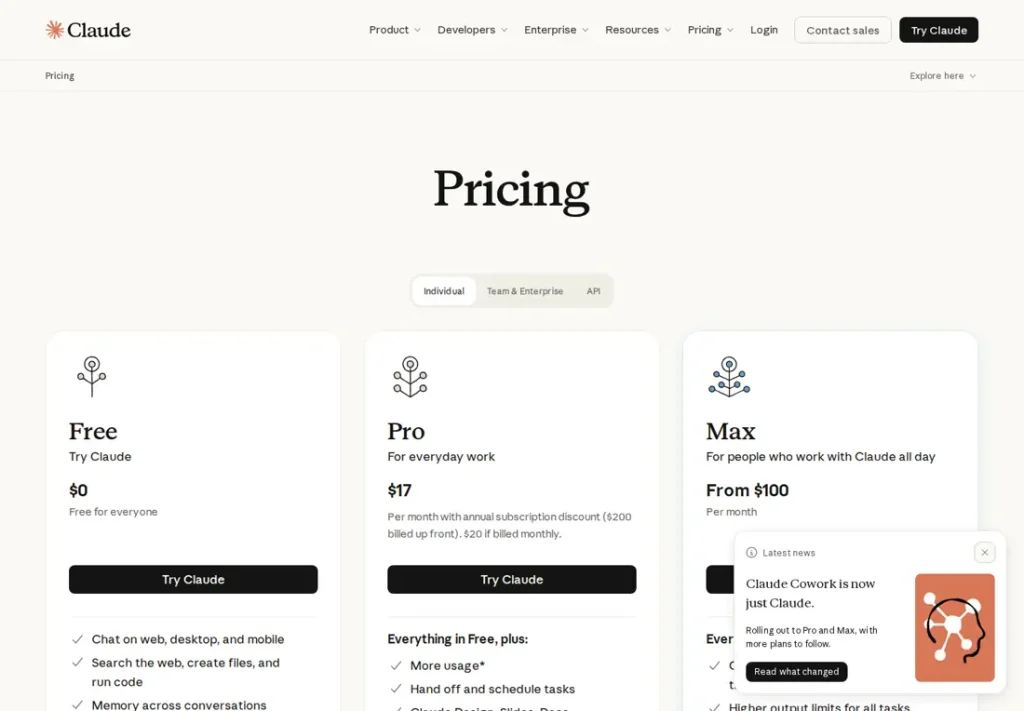
Claude is Anthropic's AI assistant for drafting and editing text, working through documents and reasoning about code. There is a free tier, and paid plans start at $20 per month billed monthly or $17 per month billed annually, as listed on the official pricing page on September 22, 2026. Usage limits apply on every plan, including the paid ones.
Key features
- Chat on web, desktop and mobile
- Web search, file creation and code execution
- Projects and memory for ongoing work
- Artifacts for generated documents and apps
- Claude Code for developer workflows (paid plans)
- Chrome and Microsoft 365 extensions (paid plans)
Feature list taken from the sources listed at the foot of this profile, not from our testing.
What can you actually do with Claude?
Writing evaluation
Use the same source material and constraints when comparing assistants.
Where it falls short: This profile does not measure a writing-quality winner.
Web sources
Free lists web search and paid plans list Research.
Where it falls short: Check supporting sources; access is not an accuracy guarantee.
Annual billing
Pro is displayed as about $17 monthly on annual billing.
Where it falls short: The upfront annual amount is $200, not a month-to-month $17 subscription.
Feature descriptions follow the sources listed at the foot of this profile; the limits are our editorial reading of what those sources do and do not promise.
Strengths and limits
Strengths
- Free includes web search and file creation
- Paid plans list Research and additional tools
- Multiple usage levels support different workloads
Limits to plan around
- Usage limits apply on every tier — a paid plan is not unlimited
- Max starts at $100/month, a steep step up from Pro
- Listed prices exclude applicable tax
- We have not tested output quality against other assistants
Derived from documented behaviour and published limits, not from a scored review.
Who is it for?
- Writers and editorsTurning a brief into a draft and tightening existing copy.
- Small teamsWorking through documents and pulling out open questions.
- DevelopersClaude Code and code reasoning, available on paid plans.
- AnalystsReading long material and producing structured summaries you then verify.
Our editorial judgement about fit, based on what the documented features support. The vendor makes no such claim about these groups.
How much does Claude cost?
Pricing check: Individual details checked. Check the current provider terms before subscribing.
| Plan | Price | What it covers |
|---|---|---|
| Free | Free | Web search, file creation, code execution and Artifacts; usage limits apply. |
| Pro | $20 monthly or $200 upfront annually | The provider displays the annual equivalent as approximately $17 per month; taxes excluded. |
| Max | Confirm selected usage tier | More usage than Pro, with limits; a starting figure is not a maximum plan price. |
No comparable numeric price range is confirmed here. Individual plan notes may include documented amounts, but unknown billing units, unavailable figures or inconsistent terms are not converted into a single price range. See the evidence checks and original pricing source below.
What is Claude used for?
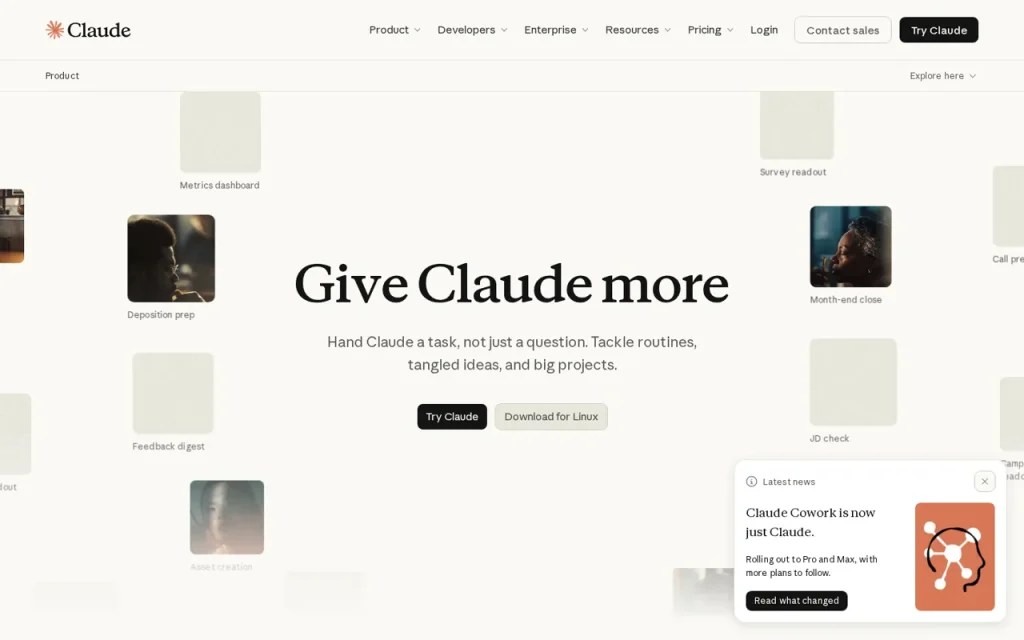
Claude is an AI assistant built by Anthropic. It is used for tasks such as drafting and editing text, working through documents, and reasoning about code. If you need to turn a content brief into a first draft, or make an existing piece of writing clearer, it is one of the options worth evaluating. The current scope of the product is described on the official product overview.
When you evaluate a tool like this, “can it write?” is the wrong question. The useful questions are how well it holds on to the context you gave it, and how much editing the output needs before you can actually use it. This profile does not score output quality, and we have not run a comparative test of it against other assistants.
Where it fits in a workflow
- First drafts: asking for a draft from a brief that states the audience, the purpose and the constraints.
- Editing: tightening a long explanation, finding repetition, or reshaping a piece for a different reader.
- Working through documents: pulling the main points and the open questions out of text you supply.
These are starting points, not guarantees of a correct result on every task. Numbers, names and claims about the outside world need to be checked separately. A feature appearing in the official documentation does not mean it will work flawlessly on your particular data.
Free and paid plans
On the official pricing page, checked on September 22, 2026, the individual plans are Free, Pro and Max. Free costs nothing to start. Pro is listed at $20 per month billed monthly, or $17 per month on an annual subscription. Max starts at $100 per month. The listed prices do not include applicable tax.
Do not read a paid plan as “unlimited”: usage limits apply on every tier, and the page says so explicitly. Higher usage and some advanced features vary by plan. Before you subscribe, check the price shown in your own account, the billing period and the current limits. The figures above reflect the date of our source check; they are not a lasting price commitment.
A first task to try
The brief below is an original prompt you can use to watch how closely a tool follows instructions. We are not claiming that we ran it and measured the result.
“Write a 120-word introduction for a beginner coffee brewing workshop. The audience is adults taking a class for the first time. Do not add any date, price, instructor name or success claim that I have not given you. List your questions about missing details first. Keep the language plain and direct.”
Look at three things in the output: did it invent information you did not supply, does it match the audience, and how much work is the edit? Running the same brief through a second tool tells you more than comparing two unrelated outputs.
Should you choose Claude?
Choose it when the work is producing and reshaping text: turning a brief into a draft, tightening a long explanation, or reasoning through a document you supply. Use an available account to evaluate a representative brief. If annual Pro suits your needs, note the $200 upfront annual charge rather than treating its approximate monthly equivalent as monthly billing.
If source retrieval is your main task, compare the workflow with Perplexity. Claude also provides web search, and its paid plans list Research. Our preference for one workflow is an editorial assessment, not evidence that Claude cannot cite sources or that another service is more accurate.
Before you commit
Before uploading sensitive files, review the data handling settings of the plan you are on and your own organisation’s rules. In research that needs sources, fluent prose is not evidence of accuracy. If you are looking for an alternative built around web sources instead, read the Perplexity profile.
Everything above is traceable to the links in the sources section, with the date we checked them, and the editorial policy explains how we check and correct profiles.
Source check: September 22, 2026. This profile is based on the vendor’s official product and pricing pages. It contains no hands-on performance test, no sponsored review and no user ratings.
How to compare it for a writing task
Give Claude and ChatGPT the same brief and source pack. Mark invented facts, missed constraints and edits needed before publication. Then request one targeted revision. This is a suggested evaluation method; we have not run a scored head-to-head writing test.
Watch Claude in the vendor's own words

Published by Anthropic on their official YouTube channel, September 1, 2026. Nothing loads from YouTube until you press play — the preview image is served from this site. We did not produce this video and do not endorse its claims.
Official Claude channels
Collected from links published on the vendor's own website, checked September 22, 2026. Use these to verify announcements and current pricing at the source.
Frequently asked questions
Is Claude free to use?
Yes. The free tier covers chat on web, desktop and mobile, web search, file creation and code execution, plus memory and Artifacts. Usage limits apply, and features such as Claude Code, task scheduling and the browser extensions are reserved for paid plans. Checked on the official pricing page on September 22, 2026.
How much does Claude Pro cost?
The provider lists $20 on monthly billing, or $200 paid upfront annually, displayed as approximately $17 per month. Applicable tax is excluded. Read the checkout price and billing cycle rather than treating the annual equivalent as a monthly subscription.
Does a paid plan mean unlimited usage?
No, and the official pricing page states this directly: usage limits apply on every tier. Max offers either 5x or 20x more usage than Pro, along with higher output limits and priority access at peak times, but it remains a bounded allowance rather than an unlimited one.
What can Claude do besides writing?
It handles document work, code reasoning, web search, file creation and code execution, and produces Artifacts such as documents and small applications. Paid plans add Claude Code for developer workflows, task scheduling, and extensions for Chrome and Microsoft 365. Projects and memory keep long-running work in context between sessions.
What is the difference between Pro and Max?
Max adds usage capacity, higher output limits, early feature access and priority during busy periods. Limits still apply. The starting price is not the highest possible Max price, and this profile does not infer a complete price range from a from amount.
Have you tested Claude's output quality?
No. This profile is an official source check, not a hands-on review. We publish no quality score, no benchmark and no comparison of its writing against other assistants. Where we describe what it does, we are reporting the vendor's documentation, and we say so rather than implying testing we did not perform.
Evidence for key details
These checks apply to the individual details below. A recent check of one detail does not mean every section was reviewed again.
- Free includes web search, file creation, code execution and Artifacts.Documented · Provider documentation · Checked . Read the source (opens in a new tab)
- Pro is listed at $20 monthly or $200 billed upfront annually, displayed as about $17/month.Documented · Provider documentation · Checked . Read the source (opens in a new tab)
- Usage limits apply; Max offers different usage multipliers rather than unlimited access.Documented · Provider documentation · Checked . Read the source (opens in a new tab)
- The individual plan table includes Research on paid plans and web search on Free.Documented · Provider documentation · Checked . Read the source (opens in a new tab)
- For a writing comparison, use the same brief and measure factual additions, instruction adherence and revision effort.Documented · Editorial assessment · Checked . Original evaluation method, not a provider promise or a completed output-quality test. Read the source (opens in a new tab)
Sources for this profile
Provider plan table reviewed; no comparative writing test. Annual Pro billing is $200 upfront, displayed as approximately $17 per month. Search and research access should not be confused with output accuracy. Checked September 22, 2026. Found something out of date? The editorial policy explains how we correct profiles.