
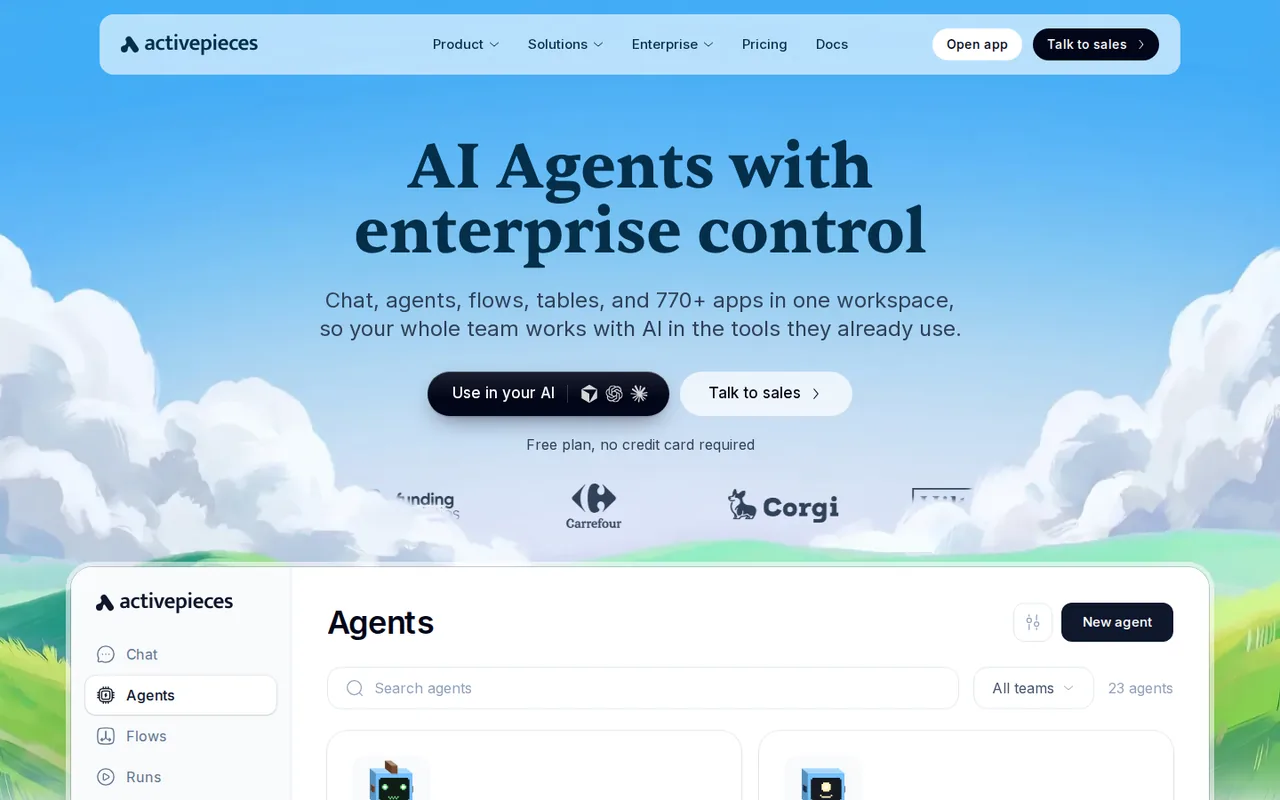
What is Activepieces, in short?
Updated October 24, 2026 · By Elias Brandt · Documentation review, not tested hands-on
Pros
- Steps are not metered
- Open source core
- Self-hosting on every plan
- Clear AI surcharge
Cons
- Free reset is inconsistent
- Short cloud run limits
- No SOC 2 report yet
- Terms not published on the day checked
- Community Edition is the core only
Best forTeams with long, mostly non-AI flowsCompanies that must keep data on their own serversBuilders who already pay a model providerDevelopers using Claude or CursorNot for long-running jobs on the cloud
Strengths, limits and who it suits, in full
Strengths
- Steps are not metered A run costs one credit whether it has two steps or twenty, so long non-AI flows do not multiply the bill.
- Open source core The repository is MIT-licensed outside its enterprise directories, so the core can be read, forked and run on your own hardware.
- Self-hosting on every plan The pricing table lists cloud or on-prem hosting for Free, Plus, Team and Ultimate, and paid plans apply in-app without a license key.
- Clear AI surcharge The pricing FAQ publishes the AI step rates (2, 10 or 20 credits by model tier) and the 1-credit rate with your own key.
Limits
- Free reset is inconsistent The pricing table says Free credits reset daily and runs over quota wait for tomorrow, while the FAQ says 1,000 credits a month and to wait until next month.
- Short cloud run limits On Activepieces Cloud a flow run times out after 10 minutes of active time, a worker gets 1 GB of memory and run data is deleted after 30 days.
- No SOC 2 report yet The pricing FAQ says the SOC 2 programme is in progress; a penetration test summary, DPA and sub-processor list are available on request.
- Terms not published on the day checked The Terms of Service page on activepieces.com said the document was not available, so contract terms could not be read.
- Community Edition is the core only Agents, Chat, projects and the access, audit and release controls need a paid plan, even when you self-host.
Who it suits
- Teams with long, mostly non-AI flows Because steps are not counted, a ten-step sync costs the same credit as a two-step one.
- Companies that must keep data on their own servers Every plan can run on-prem, and an air-gapped Enterprise option is sold by sales.
- Builders who already pay a model provider With your own key on Plus, AI steps drop to 1 credit and the model cost stays on your provider bill.
- Developers using Claude or Cursor The MCP server lets an AI client create, test and publish flows in a project.
- Not for long-running jobs on the cloud the 10-minute run timeout and 1 GB worker memory push large batch work to split flows or a self-hosted instance with raised limits.
How much does Activepieces cost?
Prices confirmed · checked
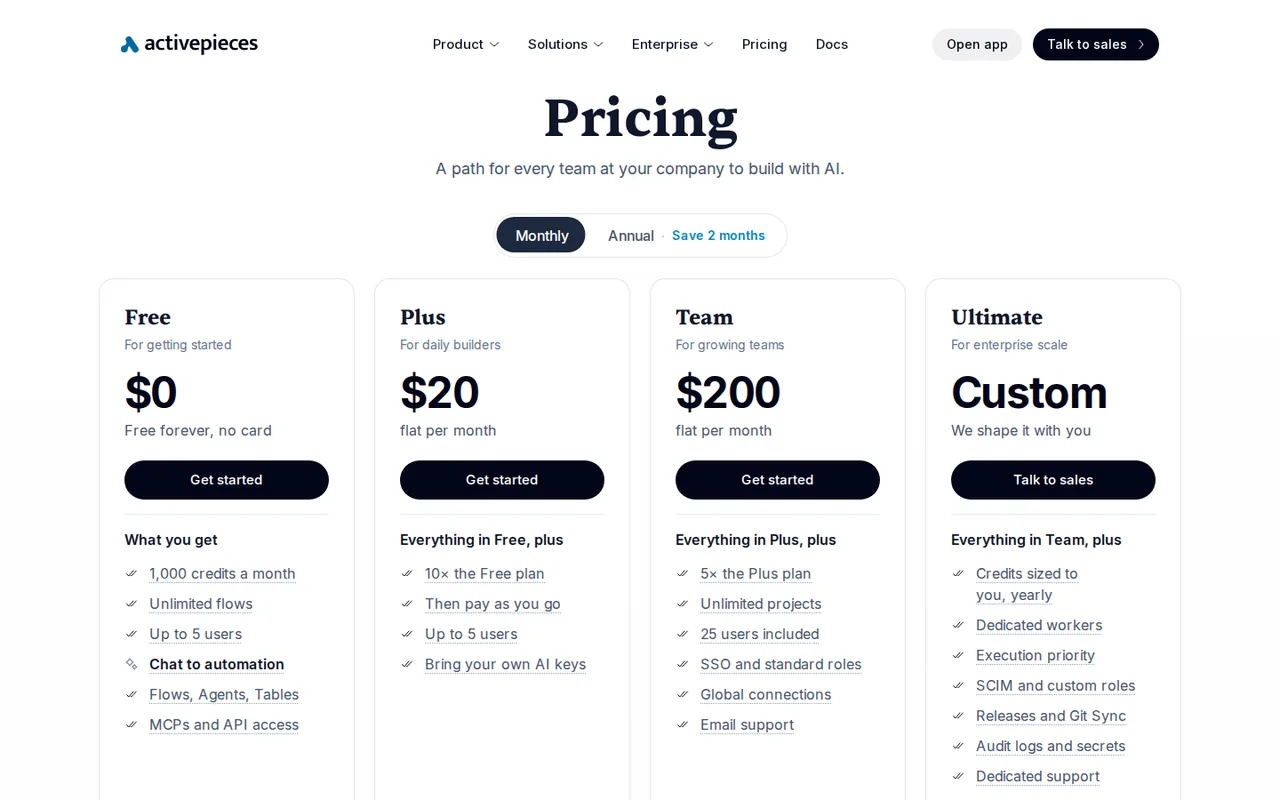
Regional prices: Plus and Team are flat monthly prices with overage at $0.007 per credit; the annual view shows $16 and $166 a month billed yearly ("save 2 months").
Ultimate has a yearly credit pool instead of a monthly one. A run is 1 credit; an AI step adds 2 (fast model), 10 (smart) or 20 (frontier) credits, an agentic action 1, and with your own AI key every AI step is 1 credit. MCP tools are free except ap_run_action at 1 credit. Upgrades and added seats are prorated immediately; downgrades apply at the end of the billing period. All plans take cards; Team and Ultimate can pay by ACH or wire. The pricing page counts 770+ integrations and the docs 760+.
| Plan | Price | What you get |
|---|---|---|
| Free | $0 sourceFrom activepieces.com/pricing, checked Oct 24, 2026 (opens in a new tab) | 1,000 credits a month with no card, unlimited flows, up to 5 users, flows, agents, tables, MCP and API access; the comparison table lists a daily credit reset and runs past the quota wait for the next refresh. |
| Plus | $20/month$16/month billed yearly sourceFrom activepieces.com/pricing, checked Oct 24, 2026 (opens in a new tab) | 10,000 credits a month, then $0.007 per credit; up to 5 users; bring your own AI keys. |
| Team | $200/month$166/month billed yearly sourceFrom activepieces.com/pricing, checked Oct 24, 2026 (opens in a new tab) | 50,000 credits a month, then $0.007 per credit; 25 users, unlimited projects, SSO and standard roles, global connections and email support. |
| Ultimate | Custom quote | Yearly credit pool sized with sales, dedicated workers, execution priority, SCIM and custom roles, releases and Git Sync, audit logs and secret managers. |
| Embed | From $36k a year sourceFrom activepieces.com/pricing, checked Oct 24, 2026 (opens in a new tab) | White-label flow builder, AI agents and 770+ integrations inside your own product through one SDK. |
| Community Edition (self-hosted) | FreeMIT licence sourceFrom activepieces.com/pricing, checked Oct 24, 2026 (opens in a new tab) | The automation core on your own servers with no credits; Agents, Chat, projects and the team and admin layer are not included. |
Which plan fits?
Smallest plan whose monthly credits cover your number with 15% spare for regenerations. Arithmetic from the plan table above, not a usage test.
How far does it go?
- One lead-routing flow, one monthAssume 40 form leads a day, each run going trigger, one AI step that classifies the lead, a sheet row and a Slack message: 1,200 runs in a 30-day month. On a fast model each run is 1 + 2 = 3 credits, or 3,600 credits, so Free (1,000) covers about 333 runs and Plus ($20, 10,000 credits) covers the month. On a smart model it is 11 credits a run, 13,200 in total: Plus plus 3,200 x $0.007 = $22.40, or $42.40. On a frontier model, 25,200 credits cost $20 + $106.40 = $126.40, still under Team at $200. With your own key on Plus it is 2,400 credits, and the model provider bills the AI calls. Editorial arithmetic on published rates and an assumed workload, not an Activepieces figure.
Arithmetic from the published allowances above, not a usage test.
Taxes, currency and promotions can change the price you see at checkout.
Try Activepieces free (opens in a new tab)
Key features
| Feature | What it does | Watch out |
|---|---|---|
| Flows: a trigger (schedule, webhook or app event) followed by actions such as app steps, code, branches and loops; each run shows every step's input and output in the run view (Debugging Runs docs) | — | |
| AI Router: write one question and name the possible answers; an evaluation model picks the branch, with an Otherwise route and an optional confidence floor (AI Router docs) | — | |
| Agents: brief an agent in plain language and attach single app actions, your own flows or MCP servers as tools; an agent can also run as a step inside a flow and return structured fields (Agents docs) | On plans with audit logs, each non-read action an agent takes through an app action or flow tool is recorded with the agent, app, account and outcome. | MCP server tools, code the agent wrote and ran, and email the agent sent leave no audit event, and the values passed to an action are never stored. |
| Tables: store rows inside Activepieces and read, write or trigger on them from flows and agents | — | |
| Built-in MCP server: Claude, Cursor and other MCP clients can build, test and publish flows and manage tables through natural language (MCP docs) | — | |
| Self-hosting: one-command Docker Compose install with PostgreSQL and Redis, a Helm chart for Kubernetes, and every pricing plan available on your own servers (install and license docs) | — | |
| Bring your own AI keys | On Plus and above an administrator connects OpenAI, Anthropic, Google Gemini, Mistral, DeepSeek, xAI, Azure, AWS Bedrock, OpenRouter, Cloudflare AI Gateway or any OpenAI-compatible endpoint once for every project, and each AI step then costs 1 credit. | The model bill moves to your provider; the docs suggest putting a gateway in front of the key if you need budgets, rate limits and request logs. |
| Durable runs | Every completed step is checkpointed, so a run interrupted by a crash or deploy resumes on another worker without repeating finished steps. | The step that was executing re-runs, so an email or payment fired just before the crash can happen twice; the docs call this at-least-once and advise idempotent side effects. |
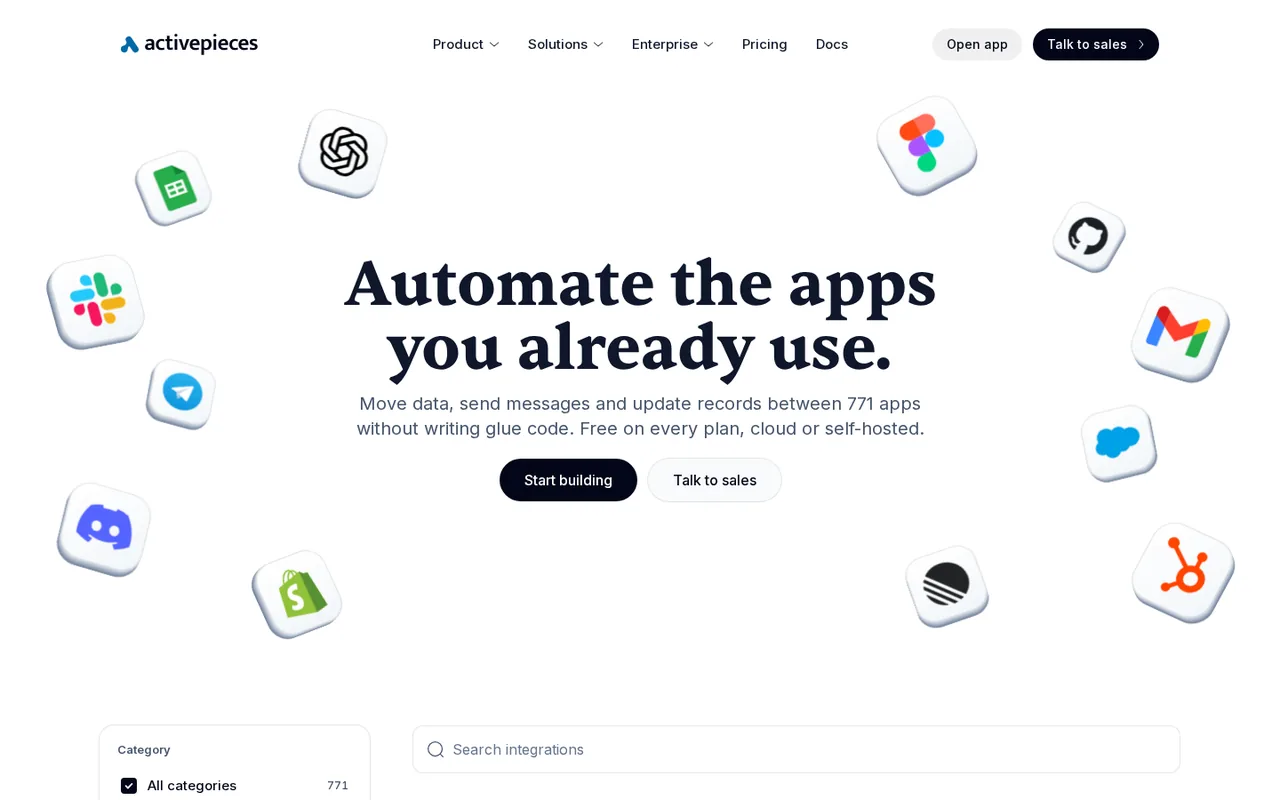
How does Activepieces count a run?
By the whole run, not by the step. The pricing FAQ says a run is one credit however many steps it has, and AI is the exception on top: an AI step costs 2 credits on a fast model, 10 on a smart model and 20 on a frontier model, and each agentic action is 1 credit. Connect your own AI provider key on Plus or above and every AI step drops to 1 credit, with the model cost moving to your provider bill.
What happens at the limit depends on the plan. On Free, flows stay switched on but runs past the quota do not go through until the credits refresh. On Plus and Team they keep running and the extra is billed at $0.007 per credit. The page is not consistent about Free: its comparison table lists a daily reset and “waits for tomorrow”, while the FAQ describes 1,000 credits a month and waiting until next month. Check the counter in your account before you rely on a free daily allowance.
What changes when you self-host?
Hosting, not features. The licence page puts the core under MIT and the enterprise directories under a commercial licence. Community Edition is that core on its own: the pricing FAQ says paying adds access control, change history, separate projects, safe releases and running Agents and Chat. The license key docs add that every plan on the pricing page is available self-hosted, and Plus or Team subscribed in the app applies without a key.
The recommended install is one command that starts four containers (app, worker, PostgreSQL, Redis) and needs Docker Compose v2, at least 2 vCPU and 4 GB of RAM. Back up the generated .env file: without its encryption key, stored connections cannot be decrypted even from a full database backup. The single-container hobbyist install runs on an embedded database and cannot move to Enterprise later. If you are weighing self-hosted tools by billing unit, the n8n profile sets out its Community edition and per-execution cloud plans.
How do flows, agents and the AI Router fit together?
A flow is a trigger followed by the steps you choose, and it runs the same way every time. An agent is briefed in plain language and decides which tools to call on each run. The agent tools docs describe three kinds: a single action from a connected app, one of your own flows handed over as a tool, or an external MCP server. You attach individual actions, so an agent given “Send message” can post to Slack and do nothing else there.
Between the two sits the AI Router. You write one question, each branch is a possible answer, and an evaluation model picks the route, with an Otherwise branch and an optional confidence floor. The docs advise the ordinary Router for numbers, dates and approval thresholds, because it is free and gives the same answer every time.
What limits apply on Activepieces Cloud?
The limits page lists a 10-minute timeout per run and per action (time paused in Wait for Approval or Delay does not count), 1 GB of worker memory, 30 days for paused flows and run data, 10 MB per step file, 25 MB of combined run log, and 5 MB webhook payloads with a 30-second synchronous response. On your own servers each is an environment variable you can raise.
The crash recovery docs promise that completed steps never re-run after a crash or deploy, but the step that was executing does, so delivery is at-least-once. Make steps that send email or charge money safe to repeat.
Where does your data live?
The pricing FAQ says data is encrypted in transit and at rest and lives in the EU cloud in Frankfurt, another region on request, or your own servers. It also says the SOC 2 programme is in progress and offers a penetration test summary, DPA and sub-processor list on request. Self-hosted instances send product analytics unless you switch them off, and licensed instances send a daily snapshot of the deployment shape that the telemetry page says carries no flow data; it has its own switch. The Terms of Service page showed no document on the day we checked.
How could you check Activepieces before upgrading?
Proposed evaluation · not performed yet
Build the lead-routing flow on the Free cloud plan and read the credit counter, then decide between Plus, your own key or self-hosting.
- Sign up for the cloud Free plan, note the credit balance, and connect a test sheet and a test Slack channel.
- Build a webhook trigger, an AI step on a fast model that labels a lead as sales, support or spam, a sheet row and a Slack post.
- Send ten test leads, including two with an empty message, and open each run to check the step inputs and outputs.
- Read the counter again and confirm it fell by about three credits a run.
- Rename the sheet column for one run, let it fail, fix it and re-run, then confirm no lead produced two rows.
Accept if the counter matches the published rates, empty messages take the Otherwise branch and the retry creates no duplicate. Reject if credits fall faster than the rates explain, a lead is posted twice, or the flow needs a paid plan to finish. No result is recorded here.
Activepieces alternatives
Other automation tools checked with the same method. Pick by the job, not by a score.

Building and enriching lead lists from websites

Meeting owners who verify commitments

Agent tasks that need an inspectable file handoff

Inbox triage and draft replies for busy professionals

Browser tasks and research handed to an AI agent

Connecting web apps without code

Teams drafting work from shared context

Visual automation for app workflows
Used Activepieces? Write the first review. Visitor opinions are moderated and kept separate from our source checks.
Frequently asked questions
Is Activepieces free to use?
Yes, in two ways. The cloud Free plan needs no card and gives 1,000 credits a month, unlimited flows and up to 5 users, enough for light automation. Community Edition is the MIT-licensed core you run on your own servers with no credit meter; you pay only for the hardware, and Agents, Chat and the team and admin features stay with the paid plans.
Is Activepieces really open source?
The core is. The repository's LICENSE file, copyright Activepieces Inc., places everything outside the packages/ee and server ee directories under the MIT Expat licence. Code inside those directories is under a commercial licence, and using those enterprise features on a self-hosted instance requires a paid Activepieces licence.
Can I use my own OpenAI or Anthropic key?
On Plus and above. A platform administrator adds the key once under AI Providers and it serves every project; supported options include OpenAI, Anthropic, Google Gemini, Mistral, DeepSeek, xAI, Azure, AWS Bedrock, OpenRouter and any OpenAI-compatible endpoint. Each AI step then costs 1 credit and the provider bills you for the model calls.
What do Plus and Team add besides credits?
Plus keeps the Free limit of 5 users and adds 10,000 credits, pay-as-you-go overage and your own AI keys. Team raises that to 50,000 credits and 25 users and adds unlimited projects, SSO with standard roles, global connections and email support. Billed yearly, the page shows $16 and $166 a month instead of $20 and $200.
Can Claude or Cursor build flows in Activepieces?
Yes, through the built-in MCP server. Turn it on in Settings, copy the server URL into Claude, Cursor or another MCP client, and sign in with OAuth. The client can then create, test and publish flows, edit tables and inspect failed runs in that project. MCP tools are free except ap_run_action, which costs 1 credit per call.
Sources and method20 official sources · 26 details checked · Oct 24, 2026
How we checked this profile
26 details on this page were checked against Activepieces's own pages and help documentation (Oct 24, 2026).
See the checks by section25 documented1 editorial assessment
| Section | Checks | Last checked | Sources |
|---|---|---|---|
| Plans and prices | 7 documented 1 editorial | activepieces.com/pricing | |
| Strengths and limits | 2 documented | activepieces.com/pricingactivepieces.com/terms | |
| Article text | 8 documented | activepieces.com/pricingactivepieces.com/enterprise-licenseactivepieces.com/docker-composeactivepieces.com/dockeractivepieces.com/limitsactivepieces.com/telemetryactivepieces.com/overviewactivepieces.com/ai-router | |
| Questions | 3 documented | activepieces.com/licensegithub.com/LICENSEactivepieces.com/overview | |
| Features | 4 documented | activepieces.com/crash-recoveryactivepieces.com/toolsactivepieces.com/setup-ai-providersactivepieces.com/debugging-runs | |
| Official channels and media | 1 documented | activepieces.com |
Sources for this profile
- Pricing page, comparison table and pricing FAQ (monthly and annual views)activepieces.com
- Activepieces homepageactivepieces.com
- Docs: welcome and building blocksactivepieces.com
- Docs: licenseactivepieces.com
All 20 sources
- Docs: install optionsactivepieces.com
- Docs: self-host with Docker Composeactivepieces.com
- Docs: hobbyist single-container installactivepieces.com
- Docs: activate an enterprise license keyactivepieces.com
- Docs: cloud limits and self-hosted overridesactivepieces.com
- Docs: crash recoveryactivepieces.com
- Docs: telemetryactivepieces.com
- Docs: agentsactivepieces.com
- Docs: agent tools and audit eventsactivepieces.com
- Docs: AI Routeractivepieces.com
- Docs: MCP serveractivepieces.com
- Docs: AI providers (bring your own keys)activepieces.com
- Docs: debugging runsactivepieces.com
- GitHub repository activepieces/activepiecesgithub.com
- GitHub LICENSE file (MIT Expat core, commercial ee directories)github.com
- Terms of Service page (showed "not available right now")activepieces.com
Official pages read on 24 Oct 2026 with plain HTTP requests (the docs site serves Markdown copies) and a local browser for the annual price view: homepage, pricing page with its comparison table and FAQ, docs on the licence, install options, Docker Compose and hobbyist installs, the enterprise license key, cloud limits, crash recovery, telemetry, agents and agent tools, the AI Router, the MCP server, AI providers and debugging runs, and the GitHub repository and LICENSE file. The Terms of Service page said the document was not available. The pricing table and FAQ disagree on whether Free credits reset daily or monthly. We did not install Activepieces or run a flow. Third-party pricing pages that describe per-active-flow billing contradict the official page and were not used.
Sources checked Oct 24, 2026. Found something out of date? See how we correct profiles.