
Gumloop: agent runs that end in a downloadable file, but no ongoing free plan and Pro from $37/month
Updated September 27, 2026 · By Elias Brandt · Documentation review, not tested hands-on
Pros
- File-centered handoff
- Detailed consumption model
- Configurable tool access
Cons
- No ongoing free plan in this offer
- Variable run cost
- Permissions need setup
Bottom line
Your task has to finish as a file someone else can open, such as a CSV or report, and you are willing to inspect the saved copy rather than the chat preview.
You need a plan you can keep using without paying, since the current offer is a card-required 14-day trial that converts to a subscription unless cancelled.
Best forOperations analystsAutomation buildersTeams sharing agent output
Strengths, limits and who it suits, in full
Strengths
- File-centered handoff Download and inspect a generated spreadsheet or report outside the chat.
- Detailed consumption model Separate components make a small pilot easier to diagnose.
- Configurable tool access Use per-tool or conditional rules when a whole connector needs more precise controls.
Limits
- No ongoing free plan in this offer The current Pro trial requires a card and has an expiry.
- Variable run cost A message can trigger multiple model and tool steps rather than one fixed charge.
- Permissions need setup Default Always allow does not provide a review step for every external write.
Who it suits
- Operations analysts useful when a task must end with an inspectable CSV or report.
- Automation builders begin with narrow tool permissions and examine a complete run ledger.
- Teams sharing agent output check artifact access separately from the content of the file.
How much does Gumloop cost?
Prices confirmed · checked
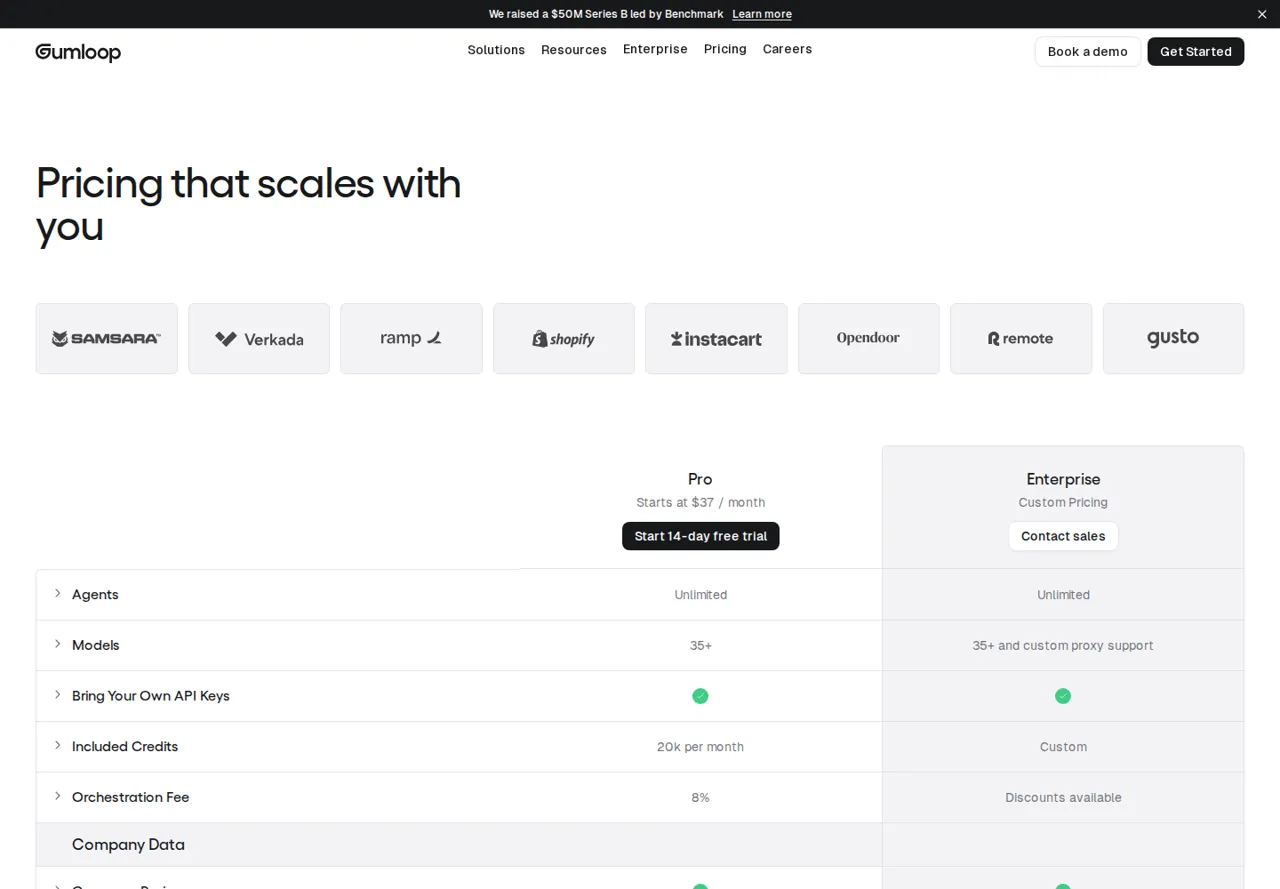
Regional prices: The documented trial lasts 14 days, requires a credit card and converts to the selected paid subscription unless cancelled.
It is not an ongoing Free plan. The 20,000-credit Pro allowance includes bonus credits; multiplying that allowance by the list credit value does not reproduce the subscription price. Confirm checkout currency, tax, selected allocation and overage controls.
| Plan | Price | What you get |
|---|---|---|
| Pro | From $37/month; confirm checkout currency and tax sourceFrom gumloop.com/pricing, checked Sep 27, 2026 (opens in a new tab) | 20,000 monthly credits and unlimited seats listed; default 8% orchestration fee. |
| Enterprise | Custom agreement | Capacity, deployment and negotiated fee conditions depend on the contract. |
How far does it go?
- A hypothetical agent runAssume 20 model credits, 2 tool credits and 5 compute credits: subtotal 27. An 8% orchestration fee is 2.16, rounded up to 3 credits, giving 30. At the documented $0.005 list value that is $0.15 of credit value, not an observed bill; bonus credits, extra tool costs and negotiated rates change the comparison.
Arithmetic from the published allowances above, not a usage test.
Taxes, currency and promotions can change the price you see at checkout.
Visit Gumloop (opens in a new tab)
Key features
| Feature | What it does | Watch out |
|---|---|---|
| Agent conversations with connected tools | — | |
| Downloadable artifact files | — | |
| Artifact revisions under the same filename | — | |
| Model and tool cost breakdowns | — | |
| Connector and per-tool approval modes | — | |
| Conditional app approval rules | — | |
| Artifact delivery | Generated files appear as previewable, downloadable cards in the conversation. | Check the actual saved file and sharing settings, not only its chat preview. |
| Credit accounting | The run groups charges into model work, tools, compute and orchestration. | Some external tools and Company Brain searches add their own costs. |
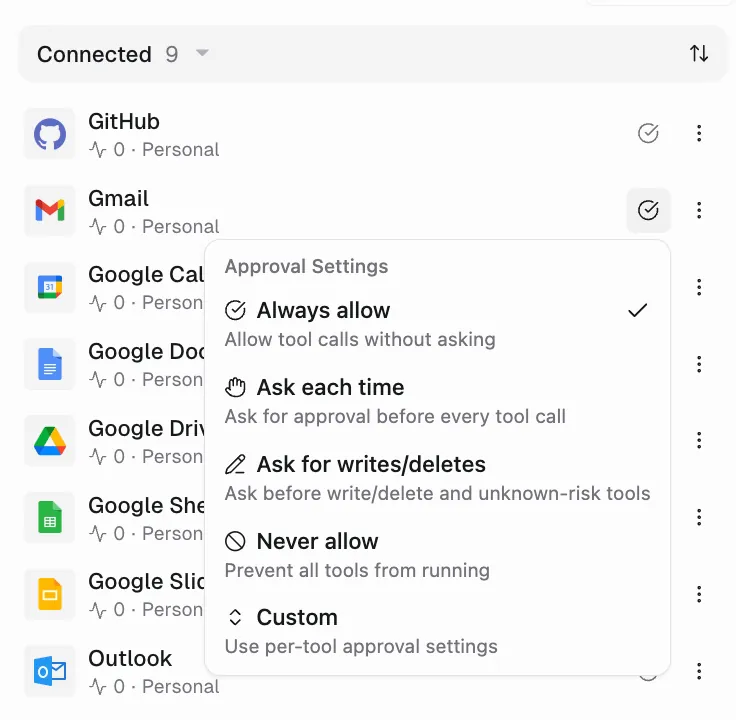
| Approval controls | Connector modes and custom tool rules determine when an agent must pause. | Always allow is the documented default; choose the required restrictions before use. |
Should you plan around agents or legacy workflows?
The current pricing page distinguishes the agent product from Legacy Workflows. When a tutorial refers to a node graph or an older free allowance, first identify which product and billing model it describes. An agent conversation can select tools and perform repeated steps, so a price quoted for an old workflow execution is not a reliable budget for a new agent task.
Define the deliverable before choosing connected apps. A report assembled from supplied text may only need a generated file, while a live account update requires a connector and its permissions. Begin with the smallest set of capabilities that can complete the brief. Adding unused tools can increase the context an agent receives, and connecting a service also expands the operations you need to review.
Why does one message have several credit charges?
The credit guide separates model work, successful tool calls, active processing time and the orchestration fee. One request can involve several model decisions as the agent selects a tool, reads its result and continues. The length of the conversation and the chosen model matter too. A short request is therefore not necessarily one cheap model call, especially if it triggers research or repeated execution.
For a bounded pilot, preserve the component breakdown after delivery. The documented minimum for a successful tool call is one credit, with some tools adding their own charge. Compute is five credits per active session-minute with a minimum per response; waiting for the person to reply is separate. Company Brain searches can add another line, and Enterprise agreements may change deployment or fee conditions.
Does the trial match the way you intend to evaluate it?
The current documentation describes a fourteen-day Pro trial that requires a credit card and becomes a paid subscription unless cancelled. Put the end date and chosen subscription in the evaluation record before starting. Do not treat an older free-tier article as permission to run indefinitely without a bill. Confirm any automatic top-up or overage setting in the account before a task that could expand.
The displayed Pro package includes bonus credits alongside the portion corresponding to its list credit value. A calculation based only on twenty thousand multiplied by the unit rate misrepresents the package price. Use the actual selected subscription when preparing a budget, then keep observed task consumption as a different number. A comparison with Lindy also needs the same output, because the two credit units are not equivalent.
What turns a chat answer into a delivered file?
Gumloop describes generated files as artifacts with previews, download controls and version tracking. For a CSV brief, request an actual file with an explicit filename and column order. A Markdown table may look correct in the conversation but still leave the recipient without a file they can import. Open the artifact, download it and inspect the saved copy in the application where it will be used.
Reusing a filename creates a new version in the documented artifact system. Preserve which revision was approved, particularly after asking the agent to fix an ID or a missing row. Sharing is another decision: inspect whether access is private, workspace-scoped or available through a link. A correct file should not become broadly accessible simply because someone needs to review its contents.
Which approval mode fits the first connected task?
The approval guide lists Always allow as the default. Other options ask for each call, ask for writes and deletes, block a connector or let you choose rules per tool. Select the control deliberately before adding a service that can send messages or modify records. A tool’s presence in a catalog does not mean it will pause for permission in its default configuration.
For a later pilot that needs reading but no writing, examine the connector’s classification and use custom rules where the grouping is unsuitable. Conditional app rules can inspect the proposed arguments, such as a destination, while an Ask Question capability serves a different purpose: gathering missing input. A clarification prompt should never be mistaken for a guaranteed approval checkpoint before an external action.
Can an agent deliver a clean support-triage CSV?
Proposed evaluation · not performed yet
On an authorized Pro subscription or accepted card-required trial, supply three fictional messages. A01 reports a duplicate bill item, A02 reports an expired login link and A03 asks for a dark theme. Request support-drafts.csv with id, category and reply_draft columns; categories must be billing, access or feature. Leave external connectors disabled.
- Record the plan, model and initial credit balance.
- Generate exactly three records with the supplied IDs and no invented customer data.
- Download the artifact and reopen it, importing all columns as text.
- Check quoting, line breaks and any spreadsheet formula-like content before using a spreadsheet.
- Record model, tool, compute and orchestration usage; include any correction run.
Accept only a downloadable file with three valid rows and drafts that make no unsupported refund or delivery promises. Reject a chat-only table, changed IDs or a sent message. Keep actual output and usage observations empty until execution.
Compare Lindy for a teammate centered on shared team requests. For explicit workflow logic and hosting choices, see n8n. Neither comparison should rank raw credit counts without a common deliverable.
Compare these options
Read the documented differences, then follow the links to each profile for its sources and plan details.

Is Gumloop worth it?
Documentation review plus dated public user reports. Documentation review, not tested hands-on. Not scored.
Worth it if
- Your task has to finish as a file someone else can open, such as a CSV or report, and you are willing to inspect the saved copy rather than the chat preview.
- You want to see where a run's credits went, because model work, tool calls, compute and orchestration are itemised separately.
- You can set connector approvals before the first run and keep early tests to narrow permissions.
Probably not if
- You need a plan you can keep using without paying, since the current offer is a card-required 14-day trial that converts to a subscription unless cancelled.
- You need one predictable price per request, because a single message can trigger several model and tool steps with variable credit use.
- You plan to connect tools that write to external accounts and expect each action to pause for review, since the documented default lets them run without asking.
Gumloop alternatives
Other automation tools checked with the same method. Pick by the job, not by a score.
Teams drafting work from shared context

Visual automation for app workflows

Self-hostable workflow and AI-agent automation

Browser tasks and research handed to an AI agent

Organisations on Microsoft 365 that want to automate Teams, SharePoint, Outlook and Excel work, with RPA for desktop apps

Sales, support and operations teams that want AI agents acting in their CRM and inbox with per-tool approvals

Connecting web apps without code

Teams that want Zapier-style flows and AI agents with the option to self-host the open source core
Used Gumloop? Write the first review. Visitor opinions are moderated and kept separate from our source checks.
Frequently asked questions
Can a viewer open an artifact on a phone?
The artifact guide says mobile viewers open a file card in a separate viewer page instead of the desktop side panel, with automatic preview disabled. Include a phone check when the recipient will review there. Download availability and readability of the actual document still need to be checked for your selected file type.
Does a failed tool call spend the same minimum as a successful call?
The credit documentation says failed tool calls are not charged the successful-call minimum. That does not erase model reasoning or active computation already used in the attempt. Read the separate components for the complete run rather than treating one failed connector action as proof that the entire request consumed nothing.
Is a screenshot of a table sufficient evidence of a CSV export?
A screenshot can show what was displayed, but it cannot establish the encoding, quoting or records inside a downloaded CSV. Preserve the actual file and reopen it with columns imported as text. Check the requested IDs and row count there before marking a spreadsheet handoff accepted.
Can the agent ask a question without blocking every tool call?
The Ask Question ability gathers choices or missing information from a person. Connector approvals serve a different role by deciding which tool actions must pause. You can configure both for a task, but enabling the question ability alone does not replace approval settings for writes, deletes or other operations you want reviewed.
Should I compare the package price by multiplying all included credits?
The advertised allocation contains bonus credits, so that multiplication does not describe the subscription invoice. Keep the package price, list credit value and measured task consumption in separate columns. Also record any third-party tool charge or negotiated rate before comparing a task with an alternative service.
Sources and method5 official sources · 5 details checked · Sep 27, 2026
How we checked this profile
5 details on this page were checked against Gumloop's own pages and help documentation (Sep 27, 2026).
See the checks by section5 documented
| Section | Checks | Last checked | Sources |
|---|---|---|---|
| Plans and prices | 3 documented | docs.gumloop.com/creditsgumloop.com/pricing | |
| Features | 1 documented | docs.gumloop.com/agent_artifacts | |
| Strengths and limits | 1 documented | docs.gumloop.com/human_in_the_loop |
Sources for this profile
- Plansgumloop.com
- Agent platformgumloop.com
- Credit accountingdocs.gumloop.com
- Artifact deliverydocs.gumloop.com
All 5 sources
Current pricing presents Agents separately from Legacy Workflows. The credit documentation supplies trial conditions and the variable run components. Artifact and approval guides describe delivery and controls; their examples are provider demonstrations, not measured results from our account.
Sources checked Sep 27, 2026. Found something out of date? See how we correct profiles.